At the end of WW2 the Soviet Union ensured that many of their neighbouring countries fell under the Soviet sphere of influence, either by occupation, annexing land or installing communist governments. However, after liberating Northern Norway, the Soviet Union pulled out all their forces only a few months later. Less than four years after that, Norway was a founding member of NATO and in clear opposition with the Soviet Union.
Why didn't the Soviet Union occupy Northern Norway, annex bordering regions or Svalbard, or ensure that they had some influence over Norway by any other means?
I found this old answer by /u/dlamontagne to the same question. However, the answer is rather short and contains a dead link. I believe the link is supposed to be to this paper from 1994.
This paper shows that there was discussion among Soviet officials regarding Norway, and even a proposal for a "border adjustment" in the north (page 15). But the reasons the Soviets dropped all these plans doesn't seem so clear to me. The paper mentions a lack of coordination between foreign policy-makers and the military (page 17). It also mentions that Molotov realised "a Soviet initiative along the lines proposed by Zhdanova, Vetrov, Dekanozov et al. would have repercussions far beyond the Soviet-Norwegian relationship." (page 18). But repercussions far beyond the Soviet-"insert-any-other-Soviet-occupied-country" relationship doesn't seem to have stopped a Soviet occupation of other countries after WW2? What was the difference between Norway and countries like Finland and Poland, that made the Soviets wary of annexing land or occupying the northern regions?
And was there any discussions among Norway or other Allies on the possibility of a Soviet occupation or annexation of Northern Norway? Do we know what they planned for in case this happened?
2 Answers 2018-07-22
Because if he wasn't a pedophile, did that garbage come from homophobic pious Christians? I'm starting to feel pretty dumb, because I feel like I was told a lie as a child by a relative who was ALSO told a lie...
1 Answers 2018-07-22
1 Answers 2018-07-22
Wasn't sure if this was better suited to sociology or history, so please redirect me if you think this is something sociologists could answer better.
Not necessarily limited to the US, but focusing there.
Some more specific questions:
-Did people at the turn of the 20th century find women dressed in drag as funny as we find men dressing in drag today? (It's still a frequent plot point on sitcoms and laugh tracks always go nuts during it, but women dressed in men's clothes is pretty normal now or is often just a fashion statement.)
-Were there specific ad campaigns, public figures, events in the media, social movements, activism, etc. that changed public perceptions?
-How did change in public perception relate to change in women's everyday behavior? Did women start acting masculine to massive ridicule and just put up with it for decades? Was there some pressure from some other source to accept it as normal?
-By the time I was sentient (late 90s), it was not only acceptable, but in many subcultures, taking part in certain masculine behaviors (e.g. watching sports; not being neurotic, which shows pretty big sex differences; being able to socialize platonically with male friends) was and still is actually a desirable quality in dating: the so-called "Cool Girl" ideal. What kinds of social movements led to that going from "abnormal" to "acceptable" to "desirable?"
I guess ideally I'd like a sort of historical sketch of the transformation of culture and perceptions surrounding this issue across the century.
2 Answers 2018-07-22
1 Answers 2018-07-22
So...I look at diagrams related to DNA, and they make a fair bit of sense to me, like this:
and this:
and this:
OK great.
And I hear reports on how, for example, people in Africa have the highest genetic diversity, and native Americans have the lowest genetic diversity (with less genetic diversity as you get further from the Bering Strait).
Cool, right, makes sense once I think about it.
And then I often hear that linguistic evidence follows similar patterns. And I go to look at the evidence, and mostly find myself confused.
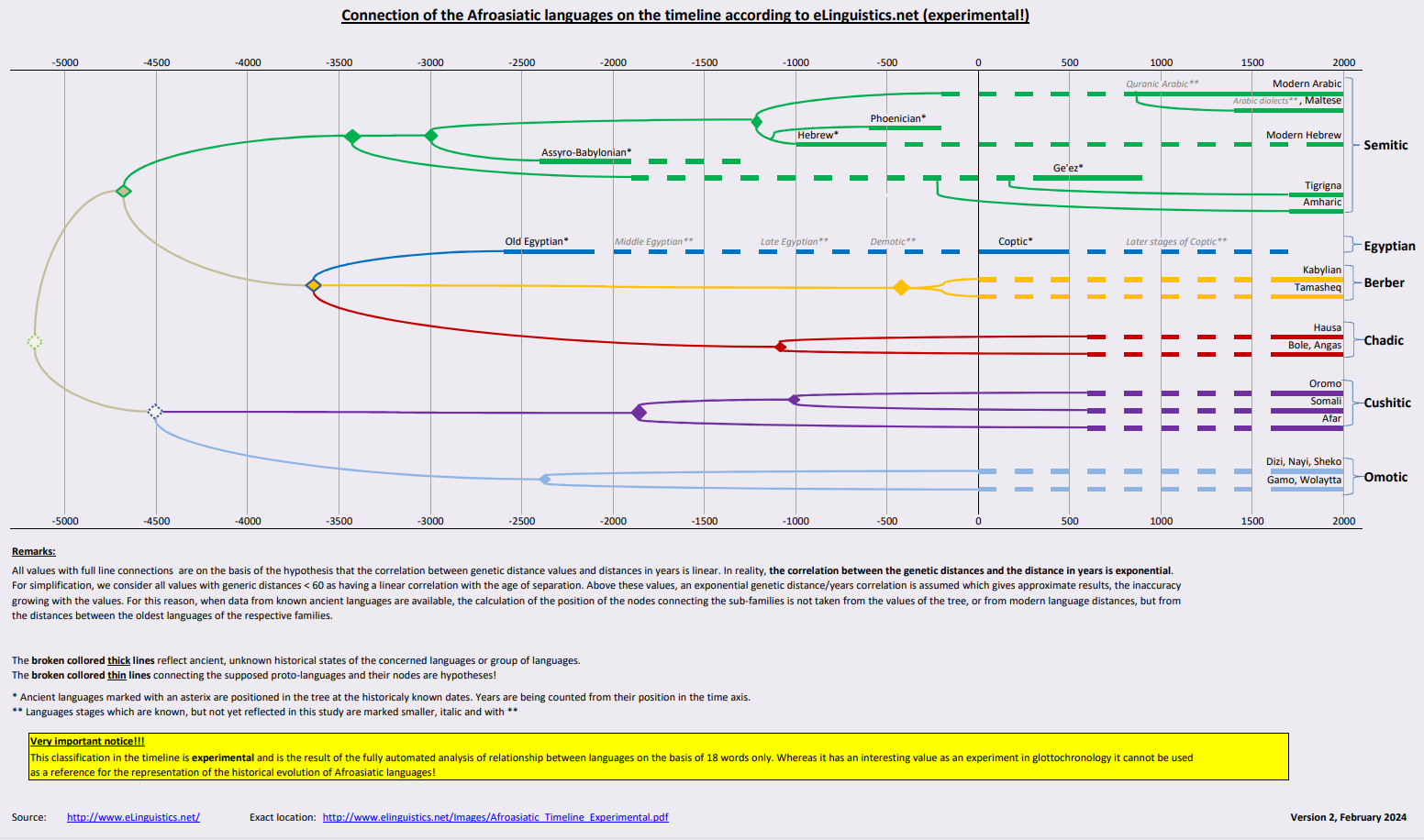
I do feel like I have a decent grasp on the Afro-Asiatic linguistic group, that one makes sense to me:
http://www.elinguistics.net/Images/Afroasiatic_Timeline.png
This chart at least I can follow. The semitic languages are all related (Assyrian, Babylonian, ancient Hebrew, Arabic, Phoenician). There's one branch in southern semitic languages that seems to have crossed back into Africa over the horn of Africa (Tigrigna, Amharic, closely related to some southern semitic languages). Semitic languages are in turn (although more distantly) related to ancient Egyptian. None of them are related to Sumerian (which is apparently outside of any language tree).
Meanwhile, more distnatly related there's Chadic, Cushtic, Berber (not shown on chart), with this split happening earlier. This also makes sense to me, given the timeline, I saw a handy documentary recently on how the Sahara Desert used to be a jungle prior to 3500 BC:
https://www.youtube.com/watch?v=LIAkJg8knTI
Which would cause various people to scatter to various water sources (the nile, Chad which is on a lake)--and then isolate those languages.
Modern day distribution of these languages is mostly Arabic in an area that looks an awful lot like the Islamic Caliphate (minus Persia and Iberia).
OK cool, that one makes sense. Aaand then I go to look at, say, Indo-European and...WTF am I looking at?
http://labs.bio.unc.edu/Hurlbert/langtree.htm
Like...my first instinct is "oh, well yeah, the Achaemenid, Greek, Roman, and Parthian Empires covered a lot of this area" but this tree is telling a completely different story--it's saying most of these languages split off and spread apart 2000-3000 years before the first of these (Achaemenid Empire). Like...I have a hard time putting a lot of the splits in this table into historical context (I can point at the Roman empire, and romance languages that came from that, but I have comparably very little context for the splits that happened 5000 years ago).
OK, but still, at least they're linguistically related right? Let's now go to Asia. What exactly is going on in Asia? Chinese, Japanese, Korean, and Vietnamese are apparently all completely unrelated languages. This is despite all of them borrowing the Chinese alphabet, and having commonalities that I can point at (r/l sounds being equivalent in most of these languages; most of these are tonal languages; Korean's not, granted). So...that's a little surprising right? Are these languages all really unrelated? Really?
And then I look further East to America and things get more confusing for me. So...I've seen it claimed that people have found linguistic similarities between Siberian hunter gatherers and Native Americans. And then I go to try and actually find that evidence and...well, I kind of don't. I mean, National Geographic printed this, and NatGeo is a reliable source right...?
https://news.nationalgeographic.com/news/2008/03/080326-language-link.html
Except, hmm, something's funny about this right? Shouldn't all Native Americans have linguistic commonalities with the one tribe that germinated them? And...turns out there's a much better explanation:
Using computational phylogenetic methods, Sicoli & Holton (2014)[16] suggest that Yeniseian represents a back-migration from Beringia back to Asia.
Well, ok, are there any other theories? Well there's this:
http://humans-who-read-grammars.blogspot.com/2016/07/a-global-tree-of-languages.html
Which...granted that whole blog is critical of the methods of this tree that tries to put every human language into a tree, buuut it seems to suggest that native american languages belong together (ok good start) and also that they are most closely related to...Paupan languages? (So...from what I understand there's genetics to suggest some Paupan influence, with trace Paupa DNA being found in South America, but these are pretty isolated DNA in a sea of DNA that looks a lot more Siberian, so I'd expect maybe loan words from Paupan languages but not the roots of the language).
All of this leads me to believe that--we don't really have linguistic evidence that Native Americans came across the Bering Strait. Archaeological and DNA evidence sure, but despite the claims I've seen around, the linguistic evidence doesn't seem to be there.
TL;DR -- when I look at linguistic trees, I can make sense of them for regions where there's a lot of written history with which I'm already familiar (Egypt and the fertile crescent) but I feel lost trying to extract historical conclusions when I don't have that written history as context (even most of the Indo-European tree is a mystery to me). Any advice?
1 Answers 2018-07-22
What I've heard so far:
The Asian ideas of impermanence in Buddhism and/or Hinduism
An Old English poem, titled (I believe) The Lament of Scol(?), in which each stanza is about some mythical character's horrific troubles, ending each one with something along the lines of "That passed, so too will this".
A Persian story about a king (I think) who wanted a ring that would magically make you happy when sad, and sad when happy, and wise men gifted him with a ring that had the phrase inscribed on it
A group of similar Jewish stories surrounding King Solomon, similar to the Persian story, but with Solomon as the giver or receiver of the ring -- I believe I've seen this story attributed to Maimonides, but I'm not sure. The Jewish stories also had the unique facet that some of them have the ring only bearing the first letter of each of the three words in the phrase, rather than the whole thing.
My thoughts are that the Asian schools of thought are too distant to be considered related, and I find it unlikely that something in Jewish and Persian thought (as well as Turkish, but I haven't found any attribution to Turkish sources, only that the phrase is known there as well) would have a parallel that is genetically^1 related in Anglo-Saxon England. I find it fairly likely that the Persian and Jewish stories, however, are genetically related, since the stories are very similar, and the groups have historically been in closer proximity than England and the Middle East.
So, keeping this in mind, where did the phrase, and in turn the Persian/Jewish stories, come from?
^(1: When I say genetically related, I'm using it in the same sense as in linguistics, where something being genetically related means that either one descends from the other, or they both descend from the same source.)
1 Answers 2018-07-22
2 Answers 2018-07-22
1 Answers 2018-07-22
To go a little more in depth, I'm talking about overall organization and logistics.
The Confederates had to start from scratch on forming their entire command structure; forming the armies, along with assigning rank, jobs, and pay to all men who join. They had to secure weapons, ammunition, food, and other supplies for a standing army that stood at over 50,000 soldiers by July of 1961, and over 300,000 by the height of the war in 1863.
This seems like a herculean task for the CSA who only had one major weapons manufacturer in Virginia for the duration of the war. How were they able to be in fighting shape just 5 months after declaring their state and secure enough resources for such a strong start against the Union for the first year of the war?
2 Answers 2018-07-22
1 Answers 2018-07-22
From what I understand, Japan during World War 2 established significant garrisons on dozens of islands assuming America would shed significant amounts of blood and resources taking each island, whittling down America's forces for a final decisive battle.
However, nearly all the islands lacked sufficient local food sources for the size of their garrisons. They also lacked industrial facilities and oil wells thus they were reliant on shipped supplies to remain combat effective. Did the Japanese high command not take into account that their supply lines would be disrupted or that America would just ignore or isolate Japanese occupied islands?
1 Answers 2018-07-22
Or was it played up a bit?
Eg, at the start of the movie, they redid the entire orchestra because they didn't record the first run at it and Stalin wanted a copy. Would he really have executed people because he didn't get some lit tunes?
When he had a stroke in his office, the guards didn't investigate for fear of being killed. Would knocking on Stalin's door and asking if something was wrong really be a life or death decision? And furthermore, did Stalin actually die this way?
Even Kruschev, Beria, Malenkov, etc were analysing their own jokes so they didn't use unfunny material around Stalin. Would he actually have executed his own top command over something so petty?
1 Answers 2018-07-22
2 Answers 2018-07-22
So I know that in the early Middle Ages the turks lived in Central Asian steppe. Around XIII century I think, they migrated to Anatolia (Sultanate of Rüm, Ottomans etc).
I would like to know the details of the whole process. When exactly this happened, why (were they only seeking rich byzantine land, was there any migration pressure like with the Hunes...?) and how exactly they "transfered" most of their nation to a relatively distant place.
Sorry for possible grammatical errors and thanks beforehand.
1 Answers 2018-07-22
I don’t know a whole lot about what I was given. I’ve researched a bit and it’s all kind of confusing. Here is what I’ve got. His name was Jack Weiler. Here are the items I’ve been given from my family. Any help would be greatly appreciated. Thank you! https://imgur.com/gallery/O9Oe5iZ
4 Answers 2018-07-22
I've heard a number of crass jokes in American culture about starving Ethiopians... Not just any Africans, but Ethiopians specifically. I'm a little confused by this, not knowing much about the history of their nation, and also having met a handful of Ethiopians and never getting the impression that they'd been starving before they came to the U.S. What do these references of Ethiopian starvation refer to?
1 Answers 2018-07-22
Culturally, just how Kurdish was Saladin? He is used as a source of Kurdish nationalism today due to his Kurd heritage but I wonder just how much he identified himself as such. Did he use Kurdish in day-to-day life? Did he practice Kurdish customs? Would he have called himself a Kurd over anything else?
1 Answers 2018-07-22
We're all familiar with the idea of Roman Circuses, Christians vs Lions, Gladiators and so forth, but /u/Thymebeing suggested in this AskReddit thread that folk from 100 years ago would be horrified by modern CGI, thinking folk were being killed for entertainment.
Which got me thinking, hence the question - when did that moral shift happen?
1 Answers 2018-07-22
Let me preface this by saying obviously Holocaust denial is a heinous and atrocious lie and one of the most damaging in modern history. Understandably you are on thin ice and will be very easily discredited in the academic world if you start to promote denial or anything bordering it. But given that, how can historians tell if someone who is conducting research that turns up lower casualty counts or something of the sort is a genuine scholar or just an anti-Semitic propagandist? Seems like a fine line and not easy to tell but maybe better historians of the Holocaust can set me straight.
1 Answers 2018-07-22
1 Answers 2018-07-22
1 Answers 2018-07-21
And what was the mood in the Empire following these defeats?
1 Answers 2018-07-21
This is something I am extremely curious about. During the uprising, Prince Mianning used his musket (which was forbidden in China at the time) to defeat the rebels. How did he get this musket? I've read that it was supposedly a gift from Napoleon, but there is no citation for this anywhere. So, where and how did Prince Mianning get his musket?
1 Answers 2018-07-21