As the title says, I'm interested in if this was a sentiment felt by fans of Rock 'n' Roll in that period. If it was, what were the reasoning behind it? How did Buddy Holly's passing effect the landscape of American music? How did his death have an impact on the actual sound the music took?
2 Answers 2018-07-04
1 Answers 2018-07-04
My sister's roommate's grandpa's neighbor (four degrees of separation from the Nazi party? Cool, I suppose) showed my sister this medal and she was wondering if anyone had any additional information on it. Also, whose signature is that on the back? Any resources you could send would be very much appreciated!
1 Answers 2018-07-04
It strikes me as odd that in the current age (up to 1998, of course) one state could use a different judicial system. This just came from a Wikipedia source - is it true? And if so why is that even allowed?
1 Answers 2018-07-04
With so many merchant ships being sent with supplies to Europe I always see metal ships on history shows being sunk by U-boats, why didn’t we use ships made with wood to cross the Atlantic and therefore having more steel for the war effort.
4 Answers 2018-07-04
1 Answers 2018-07-04
Edit: I meant to ask if they helped the Allies when they invaded Sicily?
1 Answers 2018-07-04
3 Answers 2018-07-03
Why did Christianity basically disappear in North Africa (aside from Egypt ofc) after the Muslim conquest, while surviving elsewhere in the Mideast?
1 Answers 2018-07-03
1 Answers 2018-07-03
I’m looking for books on 1500s European warfare specifically Western European but other areas would be interesting as well. I’m currently reading about some of the politics of the Holy Roman Empire and the Habsburgs and I am intrigued about the wars the book talks about so any recommendations would be appreciated.
1 Answers 2018-07-03
I’ve been looking to read about David Ben-Gurion for some time. He strikes me as a fascinating figure. However, he would undoubtedly be a polarizing one. I want to read a biography on this man that is as little one-sided as possible - not rabidly claiming that he was a genius whose every action was correct and justified, not claiming him to be some senselessly malevolent, evil monster. For instance, the (expatriate) Israeli historian Ilan Pappé would likely act as if he is more the latter, being hailed as one of the foremost New Historians of Israeli history, intensely critical of its place in the Middle East. Many other historians may treat him as the former.
What is an excellent yet moderate biography of such a conflicting person?
2 Answers 2018-07-03
I keep browsing this sub a lot only to click on threads that have over 50 deleted comments and no valid answer. I get the quality standards and appreciate them a lot, but it would still be nice to know if a question has been thoroughly answered or not.
4 Answers 2018-07-03
Hello fellow humans! I have a question swirming around my head for years, which no one can and wants to answer me, that is: It is known, that Josef Mengele and other doctors at concentration camps did very gruesome and cruel human experiments. But I never heard about the outcome of them. Please don't misunderstand my question, I dont want to glorify the doings of those people, but did those experiments contribute to science? Did they discover something new and maybe even helpful for future scientific generations? (please don't roast me on this one) Or was this just torture and had no scientific benefit at all? I hope this one wasn't asked before. Thank you for your replies!
1 Answers 2018-07-03
I recently read "The Alienist" which is the fictional story of a killer murdering underaged boys who dressed as girls at brothels around New York City. It takes place in 1896 and one of the things that shocked me is how many of these brothels there seemed to be and how their existence was accepted by the characters in the story. I know the author Caleb Carr was a historian himself so I'm wondering how close this is to reality.
1 Answers 2018-07-03
Not sure if it's too specific, but I am especially interested in books which focus on the political processes which led to these topics, and of the interaction of people with the legal and political systems that arose from them. (e.g., what was it like for both a White and Black American to deal with the police in the Jim Crow era, what difficulties did everyday people face when living under surveillance in East Germany, etc. etc.)
Thank you!
1 Answers 2018-07-03
Essentially the title. From experience with the French Revolution, different calendars and dating systems become agonizing. How was it possible for Western historians to convert ancient and even contemporary dates into something the Western audience could comparably understand?
1 Answers 2018-07-03
I'm British so I don't know much about American history, but I am to believe that Hawaii wasn't made a state until 1959, and since the Pearl Harbor attack was during WWII, how did the USA have anything to do with it? Wouldn't that be the Hawaiian government's problem?
2 Answers 2018-07-03
1 Answers 2018-07-03
Please note this is absolutely not some kind of NK-version of a Holocaust denial post!
NK is in the news a lot lately, and something that never fails to be mentioned in a reddit thread about NK is the "three generations" policy, where someone deemed an enemy of the state is sent to labor camps along with their parents and children.
I was curious to read more about this. The history of the policy, the stories of NK refugees who had experienced this horror, etc. So I started googling around old askhistory threads and wikipedia and so on. I.e. places where you can follow the sources.
I was surprised to find that almost every instance I encountered of this claim was unsourced. On wikipedia, I found that the only cited mentions of the policy pointed to this Freedom House report:
https://freedomhouse.org/sites/default/files/ConcentrationsInhumanity.pdf
Several other articles on the web mentioning the three generations policy also cited this report.
However that report also makes claims about the three generations policy without any apparent insight on how this information was sourced. Except for this important 1972 quote from Kim Il Sung:
Factionalists and enemies of class, whoever they are, their seed must be eliminated through three generations”
Various versions of this quote (due to translation differences etc.) are present in several articles I found talking about the three generations policy.
The thing is, I can't find any concrete information about the application of the policy. There's nothing in Kim Il Sung's quote that is prescriptive about labor camps, or the other commonly repeated things about the policy such that the parents/children may be released on the death of the "traitor".
What are some sources I could read for some real information on this policy?
1 Answers 2018-07-03
Edit: With the hygiene query this was prompted in part by remembering how Napoleon wrote to Joséphine telling her:
“Je reviens en trois jours; ne te laves pas!” (I will return in three days. Don’t wash!)
which is presumably referring to cunnilingus - so was guessing that, ahem, tastes had changed, and wondered what trends there have been in this area.
2 Answers 2018-07-03
1 Answers 2018-07-03
1 Answers 2018-07-03
A year or two ago I came across William Alexander's The Costume of China, with illustrations and notes he made on the 1793 Macartney Mission. Generally the information and art seems extremely accurate, and most of the illustrations match my prior expectations, such as this typical soldier of the time.
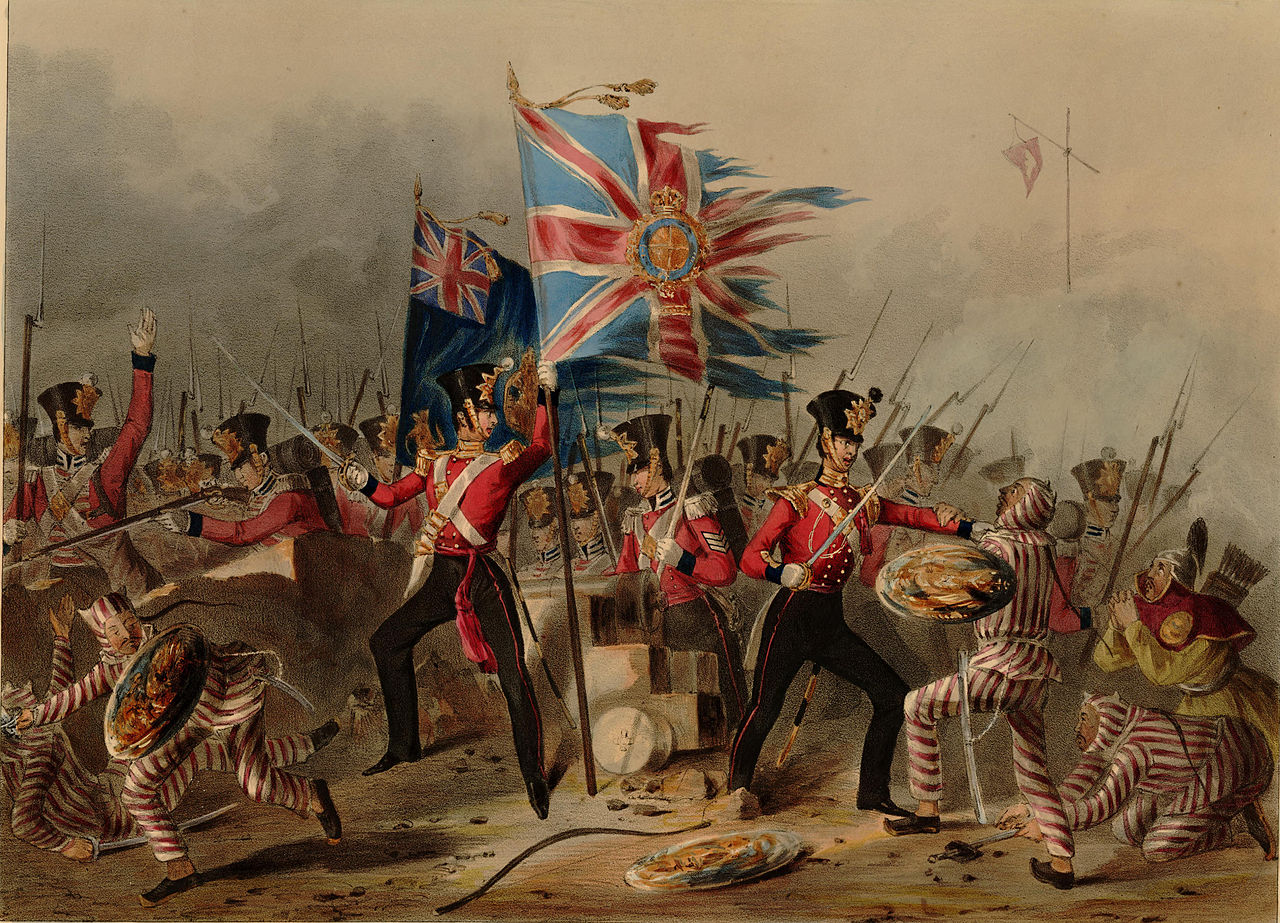
Then he also has this picture of an infantry soldier which he says the missionaries call a Tiger of War, armed with swords and wicker shields with mythical monster (or tiger) faces on them.
I tried to look into this more and have found a couple of other depictions of such soldiers— another 1790s illustration showing regular soldiers but also two men with shields, swords and cat ears sparring off to the side, this probably fictionalized 1840s Opium War era painting showing primarily tiger soldiers with only one of the regular soldiers off to the right, and lastly an undated French museum photo showing various Asian uniforms that includes one attributed to China which is sure enough a tiger outfit with a sword and wicker shield.
Apparently they existed, but I don't have access to and wouldn't know how to read any Chinese sources about them. I'm tempted to think that that Opium War painter was imagining their outfits based on William Alexander's work. Did they play a real role in a Qing army unit? Were they more of an occasional mascot, or were there whole forces of swordsmen dressed this way? How long were they a part of the Chinese military? Was there a religious or ceremonial aspect to them?
1 Answers 2018-07-03