http://www.lib.utexas.edu/maps/historical/shepherd/austria_hungary_1911.jpg
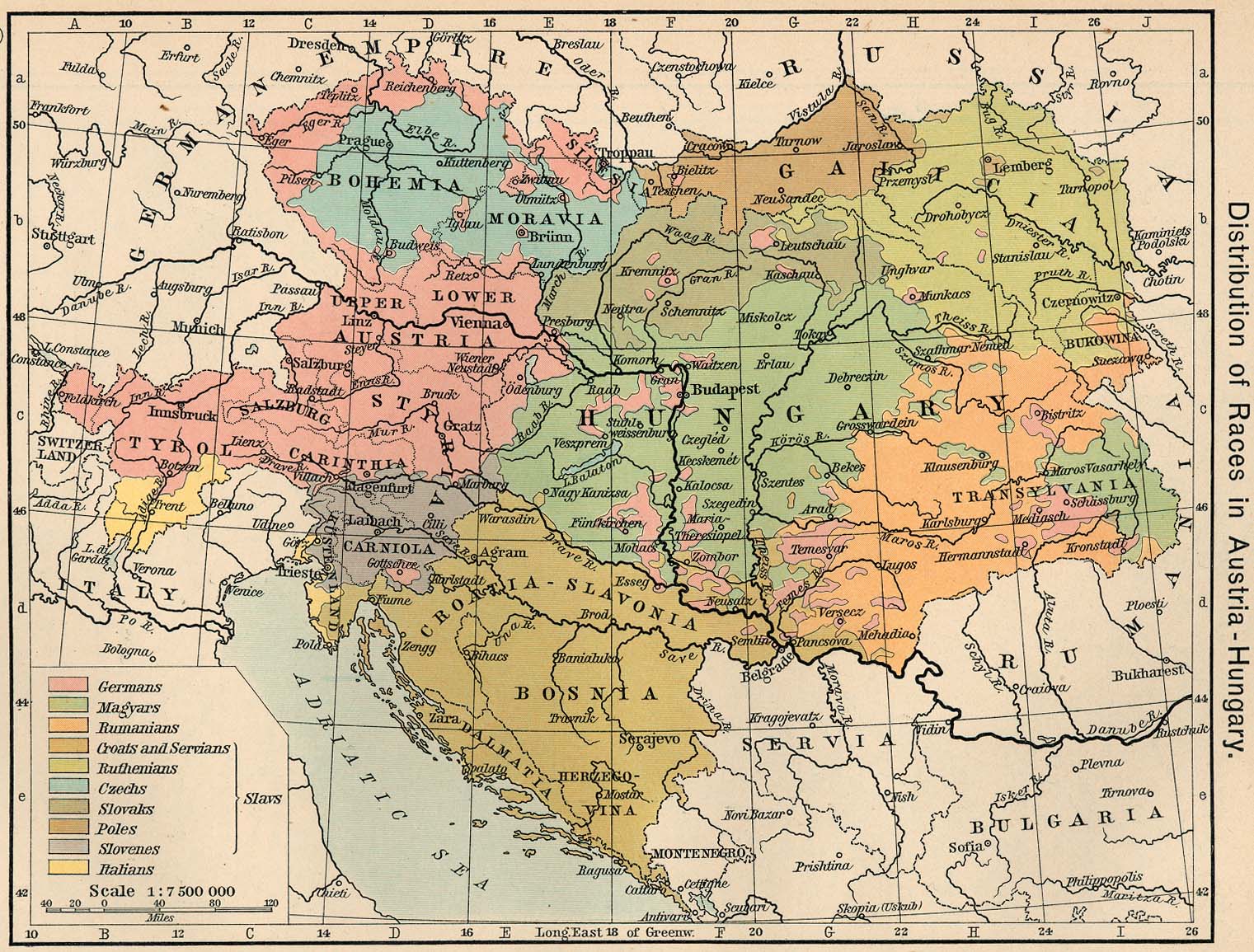
This is a map called Distribution of Races in Austria-Hungary, from The Historical Atlas by William R. Shepherd, 1911. It is quoted in every single text about Austro-Hungary and the Hungarian population after the treaty that broke it apart. None of the texts doubts it, and none mentions what are the sources behind it.
What polls, surveys, research or anything went into this map, that has now solidified itself as an absolute fact, and is less doubted by naysayers than evolution and even the spherical nature of our planet.
1 Answers 2017-10-18
This is such a narrowly specific question that I don't have much hope of it being answered, but I came across a statement in a book I'm reading that the Russian Army utilized steam traction engines (basically a road locomotive) in 1870. This seems remarkably early (especially for Tsarist Russia, which I don't usually associate with novel technology), so I was wondering if anyone had anymore information about them - where were the vehicles manufactured? Who designed them? How were they used? Were they successful? If anyone has an image of the traction engine, that would also be extremely helpful!
1 Answers 2017-10-18
I always see on Reddit these anecdotes about Russians/other Soviet citizens coming to the USA and being shocked by the abundance in our stores. How true is this? If it is true, why?
1 Answers 2017-10-18
Hi i am building a city archery guild members kit late 15th century. Burgundian eara Brugge. I have a jack and open sallet. Would i use a brigandine ore a breastplate to protect the chest?
1 Answers 2017-10-18
After the war the entente didn't hand over Italy their promised territory which lead to resentment. Was there specific reasons for this? E.g. Did they feel Italy didn't provide enough to the war effort and gave them what they felt was enough to compensate Italy for joining them ? Additionally The treaty also talks about a partitioning of turkey and how some land should go to Italy however later Britain and France would go on to make the Sykes-Picot agreement in secret just a year later (1916) were they planning on disavowing the agreement with Italy that early?
1 Answers 2017-10-18
I have read some history books on the colonial period, namely Ida Altman's The War for Mexico's West: Indians and Spaniards in New Galicia, 1524-1550 and Grant D. Jones' The Conquest of the Last Maya Kingdom. In Altman's book, Central Mexican groups like the Aztecs, Tlaxcallans, and Chalcos, and the Tarascans/Purepecha from Michoacan still utilized their traditional weapons of atlatls, bows, and obsidian tipped spears or obsidian edged macuahuitl as well wearing their quilted cotton armor, animal order (eagle and jaguar) costumes, and banners attached to their backs during the Mixton War of 1540-1542. In Grant's book the Itza Maya of Nojpeten/Tayasal in the Peten region of southern Mexico were using spears, axes, and machetes while the forces of Martín de Ursúa y Arismendi were using muskets, cotton padded armor, and Native bows in the 1690s.
While this is obviously a huge gap of 153 between the end of the Mixton War and the beginning of the conquest of the Itza Maya, I'm curious at what point did indigenous peoples largely stop using traditional arms and armor? It appears that certain pre-Columbian arms and armor (cotton padded armor, bows, and spears) were still in use as late as the 1690s even though muskets had become more accurate, less heavy, and more available.
1 Answers 2017-10-18
I just finished listening to Dan Carlin’s King of Kings III and he talks a lot about Eunuchs. Why were there so many in the aincent world? Was it strictly a Persian thing, or was it common everywhere?
1 Answers 2017-10-18
If Scottish Gaelic died out within the elite, why did this happen? Was it cultural influence from England?
2 Answers 2017-10-18
I'm taking a class on modern Algeria right now and we're covering the war for independence. Tangentially we have discussed Vichy France, of course, and it was mentioned in passing that during WWII, the Americans supported the Allied move to hand the government of French North Africa to Francois Darlan, a Vichy official.
I don't really understand why this was the case. Why would the Allied powers have wanted to install a Vichy government at all, instead of someone like de Gaulle who actually was associated with the Allies, and why would the United States support it?
1 Answers 2017-10-18
1 Answers 2017-10-18
From interwar to end of 1945, was there ever a case of the Axis ever sharing eqipment or at least trying to aide each other by giving some equipment amongst themselves?
1 Answers 2017-10-18
How long did the Saxons of the mainland and Britain consider themselves to be the same people? Why did they stop?
How long did the Angles of the mainland and Britain consider themselves to be the same people? Why did they stop?
What was the reason for settlement of Britain, and why did both the Angles and Saxons do so at roughly the same time?
How, if at all, did the formation of Saxon and Anglo monarchies in Britain affect the mainland? Was there opposition by existing dynasties? Were the Saxon settlements in Britain regarded as colonies of the mainland or were they formed by separatist groups that were regarded with indifference by those who remained in the homeland?
What was the relationship between the Angles and the Saxons before British settlement in mainland Europe?
How much trade and exchange was there between the island and mainland?
Were the Angles from what is now Northern Germany or Southern Denmark?
1 Answers 2017-10-18
3 Answers 2017-10-18
greetings, I have a thesis on problems Georgia had with the union when writing the constitution. Any documents or articles that can aid me in my thesis.
1 Answers 2017-10-18
Why the French (and Prussians) blue? Was it an economic decision due to dye availability or something else? Where did they get the dyes from?
1 Answers 2017-10-18
1 Answers 2017-10-18
[deleted]
1 Answers 2017-10-18
In the season 1 of the tv show Black Sails which is set in the golden age of piracy in 1715, a group of pirates plan a heist to rob a Spanish warship that is carrying 5 million Spanish dollars. In a later season, another pirate is suprised at how another pirate spent 500 pieces of eight in 2 days. I wanted to know how much this would be worth today?
1 Answers 2017-10-18
2 Answers 2017-10-18
2 Answers 2017-10-18
You keep seeing movies with signal fires like lord og the rings. Is there any historical accuracy to that? If so, what was life like for signal tenders?
1 Answers 2017-10-18
1 Answers 2017-10-18
Where ancient medieval masters gathered to teach Law, Medicine, or Theology, historic european universities like Bologna, Oxford, and Paris sprung up. During the industrial revolution new Polytechnics were founded in Europe's rising manufacturing centers to train a new generation of skilled scientists, technicians, and engineers, while the old universities expanded by adding new faculties. In the post-war era, universities were founded even where there had been no historic precedent for one, as governments decided education was a right to be accessed by all.
In the United States, many of the oldest universities were founded in the colonial era by the citizens of prosperous cities and towns, petitioning local government or even the monarch to provide a place of learning local scholars; as did the citizens of Boston to found Harvard University, Virginians to found the William & Mary, and New Yorkers to found Kings College, later renamed Columbia University.
In the 19th century, states and the federal government collaborated to found Teacher's Colleges and Technical Colleges. These institutions were also useful producers of skilled labor, especially in the sparsely populated west. In many respects, they were the American equivalent of the european Polytechnics, and indeed great industrial tycoons also contributed to the foundation of scientific and technically focused universities that still bear their names, like Johns Hopkins, Vanderbilt, and Carnegie Mellon.
But a second, uniquely american, phenomenon seems to have emerged that I don't fully understand. All across america liberal arts colleges were founded: small, humanities-focused schools, many in rural areas. What led to these liberal arts colleges being founded in the 19th century?
1 Answers 2017-10-18