Hello everyone!
Today we will be implementing a change to the submission rules, and will no longer be allowing questions which are asking for the specific instance of the 'First' or 'Last' iteration of a thing or phenomenon. These have been some of the most problematic questions that we get in this subreddit, and after some very lengthy discussion within the mod team, the decision has been made to add the following to our Rules Page:
No 'First'/'Last' Questions
Questions which specifically ask for the first or last known instance/example of an object/phenomenon/etc. will be removed. Past experience has shown these questions aren't well suited to /r/AskHistorians. Such questions often end up with speculative answers, either because the first simply wasn't recorded by history, or because answering the question requires historians to have detailed knowledge across numerous eras and specialties. Alternatively, if the question is answerable, it often doesn't lend itself to the detail and context we expect from answers on this subreddit. As such, these questions are banned.
We still welcome questions which ask about rises and falls in a general sense, so we request that users keep their questions focused on origins or declines. For example, a question such as "Who was the first person to kill someone else with a gun?" is a problematic one to answer - we may not even know the answer - but "What do we know about the early development and use of firearms?" covers the same ground, without the same issues.
For those who nevertheless are specifically looking for 'First'/'Last' answers, we do run a "Short Answers to Simple Questions" thread every other Wednesday where these questions are still allowed.
The wording of the rule should hopefully be somewhat self-explanatory as to its reason and application, but this is /r/AskHistorians, so we're going to break it down a little bit more for you below.
The most important thing to be aware of is that this rule will be applied fairly narrowly. The intent is to target a very specific class of questions which are quite ill-suited to the format of /r/AskHistorians. A question which, to use the example from above, asks "Who was the first person to kill someone else with a gun?" is going to be a problem whether there is a known answer or not. If we don't know, the threads quickly fill with speculative responses, or "The first one I know of" answers, which end up removed. If we do know - and this puts aside the additional issue of 'absolute' first versus 'first known' - the question can be answered in a mere sentence, i.e. "Liao Bao was the first person to be shot with a firearm, in 1257." But that simply creates more problems, as it comes in conflict with the rules and aim of the subreddit. An answer which would be allowed to stand would be one which at the very least provides background and context for his death. Taken together, this results in many threads which are the proverbial graveyard, and a disproportionate number which never receive an answer.
Generally speaking, our stated policy has always been to try and maintain a light touch with how questions are formulated and asked. As with the Example Seeking Rule, we do at times need to strike a balance when a specific type just becomes too troublesome - and that is what we are doing here. Our intention is not to entirely prevent these questions in a broader sense, but to ensure that they are better focused to comply with the format of the subreddit. As is made clear in the wording of the rule, and as will also be explained in the Removal Macro deployed in conjunction with enforcement, we want to encourage people to think about what the underlying topic of their question is, and strongly encourage people to resubmit the question to ask about the broader milieu. To return to the example, an answer to "What do we know about the early development and use of firearms?" would quite possibly include the answer to the original formulation if it is known, while certainly avoiding the speculation about that fact if it is not.
Conversely, when it comes to 'Last' questions, similar problems of course can crop up, but there is the additional issue of 'Fading out but not yet gone'. Something might have gone out of general use a long, long time ago, but still sees use in some limited form today, resulting in answers which blow past the 20 Year Rule. By having questions focus on 'Decline' instead of 'Last', it allows the questions to briefly touch on continued use to the present (which is allowable under the 20 Year Rule!) without entirely blowing by it and focusing solely on that (Which isn't!).
So in short, we want 'First'/'Last' questions to focus on the broader origins, development, declines, and falls which underpin what would make those examples the first or last of their kind, which in essence does nothing more than to bring these questions in-line with how they are moderated anyways. If you are having trouble asking a question in this way though, the mod team is always standing by to offer some advice, so don't hesitate to reach out.
Now that all being said, we realize that while some people ask these questions because, well, it can be hard to ask a question about a topic you don't know about, there are also people who ask these questions because that literally is all they really want to know. To be perfectly frank, those situations can be rather frustrating for the mods, and rather off-putting for the flairs. When the answer to the question is going to be the first result of putting the question title into Google, it leads to the feeling that little thought was put into asking the question, which in turn leads to the irony that the simplest questions are often the ones which go unanswered. Or put another way, "Who was the first President of the United States?" might have 50 comments all saying "George Washington" but they will all be removed, while "Why was George Washington elected as the first President of the USA?" might have only one comment, but it will be visible and explain why he became the president.
So we can't know why a given question is being asked like that, but while laziness is likely the answer for some, we'd like to believe that most of them are because while the question might be quite specific and not call for anything in-depth as a response, it being asked here is purposeful, as the user still wants more than whatever Google tells them. So to this end we are going to try to be accommodating, and if anything, actually make the subreddit a little more friendly towards these types of questions. In conjunction with the implementation of the rule, we are also going to be making the "Short Answers to Simple Questions" a more permanent feature. We ran this last month as a test run, and it worked reasonably well, as well as gave us some insight into the kinks we need to iron out. We're going to put it into the rotation of regular features, alternating on Wednesdays with the "What's New" feature, starting later this week on the 7th. The hope is to be able to provide a space for reliable answers to questions which otherwise wouldn't be a good fit for /r/AskHistorians, and not just 'First'/'Last', but also plenty of other questions about simple facts or figures.
So that is the sum of it. We're restricting specific questions about 'First'/'Last', and implementing a "Short Answers to Simple Questions" Feature to complement this rule. Our hope is that the two in conjunction will both improve the quality of threads in the subreddit, as well as increase the breadth of coverage that the subreddit offers. It is doubtful that every question you might have about this new rule has been covered, however, so if there is anything that remains unanswered after reading through here, please don't hesitate to ask here.
8 Answers 2017-06-03
On a practical level, both nuclear war and nuclear skirmish wouldn't have served any more purpose then today. Less was understood about nukes, but nevertheless MAD was pretty clear.
1 Answers 2017-06-03
Hi,
I'm interested in history and background of the name and place called Acropolis of Athens. Is this the original name for the place itself? Is every Acropolis always tied with "Acropolis of"? Specifically, I'd like to know if (example only) "Xerxes Acropolis" would be viable or if "Acropolis of Xerxes" is the only way how would you name such structure or place back in the day (c. 450 – 400 BC).
Thank you in advance!
1 Answers 2017-06-03
I know he discovered it, as well as some moons, but available technology was in its infancy and research in the field was essentially non-existent.
Did he speculate as to its distance, size or anything else which made it into historical records?
1 Answers 2017-06-03
A friend insists that, while Shakespeare existed, he isn't responsible for most of the works attributed to him. Rather, a collection of various playwrights penned them.
Arguments were the sheer volume of written material being implausible, and the fact that his hometown isn't mentioned in any of his texts.
1 Answers 2017-06-03
Since it's founding has the United States' Federal government, a member State's government, or any U.S. municipality withstood an attempt or organized conspiracy to attempt a military coup?
3 Answers 2017-06-03
They were clearly quite practiced at it, but I've never seen much about the specific, on-the-ground methods used to ensure the local populace cooperated and came to self-identify as Romans. What was the civilian experience? Was it just force of arms for a long enough period or did they have administrative methods they would use?
In the same vein, did they use the same techniques to get conquered enemy fighting forces to fight for Rome?
1 Answers 2017-06-03
1 Answers 2017-06-03
More specifically what were some of the most notable Cities of Ancient Rome that are in Italy? If there are any other cities that are interesting though please do share.
1 Answers 2017-06-03
This would be assuming the king doesn't have any brothers either. Would there be a shift in power to another family? Or would there be a regency until that unborn child was of age.
2 Answers 2017-06-03
1 Answers 2017-06-03
I was thinking today about the evolution of words and language, specifically about adjectives becoming nouns through habitual use. By which I mean we now use the word "commercial" in lieu of "commercial break" or "commercial advertisement." Was there a time in history where this changeover happened, or was it always a shorthand? My guess would be the advent of radio brought about the change, but that's just a shot in the dark.
1 Answers 2017-06-03
I'm doing research for a project. Sorry if this violates any rules.
2 Answers 2017-06-03
I looked up this topic on this sub, but there are very few answers. Can someone knowledgeable in the Biblical field help me out here?
3 Answers 2017-06-03
we had tons of gold before the spanish came but we still have gold so how come we dont have the same power as usa??? peru could be the most powerful country in the world it has everything a rich country needs but why arent we as powerful as usa??
2 Answers 2017-06-03
1 Answers 2017-06-03
I was watching the History Channel documentary "Mankind; the History of all of us" it stated wheat was the first crop ever grown by man. I wanted to find out which kind. After googling I found not so clear answers. The first is the Wikipedia page about the Neolithic founder crops https://en.m.wikipedia.org/wiki/Neolithic_founder_crops
just below that link though was this one stating figs where the first domesticated crops. http://news.harvard.edu/gazette/story/2006/06/figs-likely-first-domesticated-crop/
Then I decided to search this sub. I found this post from two years ago with only one reply which again gives a different answer. https://www.reddit.com/r/AskHistorians/comments/2gzkym/do_we_know_what_the_first_crops_were/cko63xr
So which one is most accurate?
1 Answers 2017-06-03
1 Answers 2017-06-03
I.e., Prague around 1426, during the Hussite Wars. Did government consist of a noble and his chosen council, or were there something like elections and common rule? (I would guess that eligible / voting members would be fairly restrictive).
1 Answers 2017-06-03
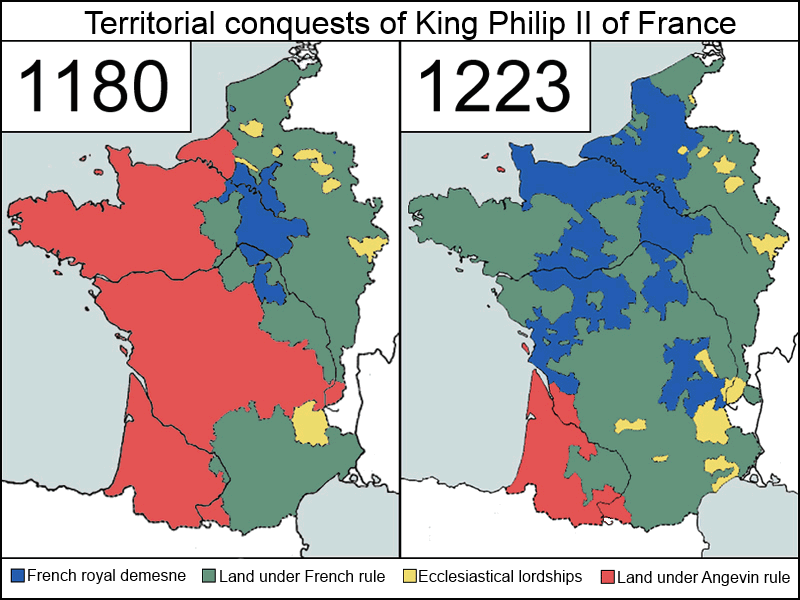
Between the 11th and 15th centuries, the English held large amounts of land in what is today France, like Aquitaine, Anjou, and Normandy. But were these territories considered part of the "Kingdom of France" at the time? I use "part of" loosely here since I'm aware that feudalism took much power away from the French kings anyway.
I know that this situation began in 1066 when William the Conqueror, who was Duke of Normandy, became King of England but also kept his old title. What I don't understand: the Duchy of Normandy (and later acquisitions like Aquitaine and Anjou) was originally a fief of the kings of France. How did this relationship change when a vassal of the French king became a king in his own right somewhere else?
The source of my confusion is somewhat illustrated by maps such as this one and this one, which appear to show English ("Angevin" or "Plantagenet" on the maps) possessions as distinct from lands of the French king and his vassals. Yet I've never heard anyone describe Aquitaine or Anjou as part of England. If I am a landowning noble somewhere in the "English possessions" on the continent and the King of France is at war with the King of England, which one is "my" king, at least in theory?
1 Answers 2017-06-03
Prior to 1944 (during WW2, from 1930s onwards), was Ukraine a part of Russia? particularly the Crimean Peninsula, and cities like Sevastopol. After doing a bit of research, it looks like it wasn't Ukrainian - it was under Soviet control. But was that area called Ukraine in the 1940s? Or was in under a Soviet name?
1 Answers 2017-06-02
I live in Washington state and I'm pretty sure that I have never distinctly voted for them as seperate entities, but only as a group, which would imply that we do not, directly or indirectly, vote for the VP of the United States.
Edit: please answer with more than "see article 2, section 1"
1 Answers 2017-06-02
2 Answers 2017-06-02
When reading the Grapes of Wrath one thing that stuck with me was how all the migrant families believed California was the place to go for work, when in reality that work was mostly low wage farm work. It made me wonder if there was anywhere in the country they could have gone that would have had better work available.
To clarify the parameters of the question we'll say that the main time of interest is 1929 to 1939.
1 Answers 2017-06-02