I ended up in an argument with someone over whether or not medieval armies recruited levies more from towns or the countryside^1 , and my interest in and research of is rapidly spiraling out of control. I'm in the process of starting up a blog that compares medieval history with medievalesque fantasy and then offers suggestions as to how using history as more than a superficial cloak can improve and enhance a story. The various forms of recruitment and development of recruitment would make an excellent post for it.
Now, I have plenty of information on the recruitment of English armies from the Early to the Late Middle Ages, good information on EMA "French" armies, and good information on the role of towns in the early Reconquest of Spain. I have some sparse information on LMA French recruitment and some information on the overall organisation and recruitment of armies of the Reconquest up to the mid-13th century. I don't know how many of you would include the Byzantine Empire in the classification of "Europe", but I'm all set there as well.
What I'm missing are sources on France during the HMA and then the rest of Europe almost entirely. I'm especially interested in Scandinavian recruitment and organisation in the EMA, and also the Holy Roman Empire, but I want to do a reasonable survey of Europe proper^2 .
However, I've run into a wall when it comes to finding English language sources on areas outside of England. JSTOR's search engine doesn't really help much, and I'm finding it difficult to find books on the subject, probably both because I don't know the best terms to use and because the subject is mostly dealt with by chapters in books.
Are any historians here able and willing to point me to some English language sources on the subject?
^1 Yes, I know that the "peasant levy" of popular culture never existed, except in local defensive situations. It was a much more complicated beast and, at least by the end of the 13th century in England, was more a militia than a levy.
^2 This is a big task, and I am aware of this. No, probably not fully aware, but what's life for if not making mistakes?
1 Answers 2017-02-20
Hi all, I'd imagine that those best equipped to rule a nation with the interests of the people in mind are not the ones ruthless and driven enough to seize control. Enlightened dictators are far and few between.
Thus, I'm wondering if it's a common occurrence in, say, dynasties, for the dynasty's founder to be powerhungry and oppressive, but for successive generations to lead benevolently since they don't need to be able to seize power themselves.
Much appreciated!
1 Answers 2017-02-20
And if not — how and why did the idea come to be this way, and how was it viewed by other faiths?
1 Answers 2017-02-20
1 Answers 2017-02-20
I found this picture of my great uncle, and I can't find a uniform that matches his, particularly the large symbol on his cap.
Any info would be greatly appreciated.
1 Answers 2017-02-20
[deleted]
2 Answers 2017-02-20
Would a fleet of ships with all forward turret layouts (like the French battleship Richelieu) be able to fire all guns directly in front?
Advantages
270 degree arc of fire (in theory), which could prevent the enemy from crossing your T
Probably the most efficient in terms of weight savings, due to the armored citadel being shorter and the savings from 2 rather than 3-4 turrets. That could be used for anything else (ex: propulsion, protection, or firepower).
Drawbacks
No main guns directly behind or secondary directly behind (could solve by zig-zagging the ship)
If any turret was disabled, it would knock out half the firepower. Richelieu attempted to mitigate this by trying to armor between the turrets, making them 2 twins. Offsetting this somewhat would be the fact that you could use a more heavily armored turret using some of the weight savings. The turrets were also somewhat spaced a bit further and I suppose one other drawback was large holes in the hull to support the quadruple turrets. I suppose these would negate some of the weight savings.
Other
Was the accuracy problems to firing directly in front ever resolved? If I understand correctly, the formal term is called Canted Trunnion Error, and there was later better fire control in the form of Cross Leveling Gear for firing directly in front. Were there any other accuracy problems inherent with the 2 turret design that could not have been resolved with better fire control?
To the best of my knowledge, and please correct me if I am wrong, the rate of fire did not suffer under the Richelieu despite being quads, unlike the King George V class battleships. That said, the hoists themselves on the French battleships weren't too good, and I suspect that with far better hoists, the rate of fire would have matched other battleships like the Bismarck. They were basically a turret of 2 twins. I wonder if it would be possible to complete automate the reloading process in a way kind of like the Des Moines class, built just after WW2.
I think that the Richelieu could have used a better secondary armament and certainly better anti-aircraft armament too (Richelieu was refit in the US during WW2, which somewhat addressed this).
Are there any other drawbacks that I am overlooking in a 2x4 arrangement versus say, a 3x3 arrangement? Was the potential of this layout (4x2) never really realized?
1 Answers 2017-02-20
1 Answers 2017-02-20
[deleted]
1 Answers 2017-02-20
Because I grew up being taught about the 4 candidates but in the game Crusader Kings II, in the 1066 start date, King Svend II of Denmark has a strong claim to the English throne. Although he isn't pressing his claim to the throne, obviously. So where does this supposed claim come from? Probably from Canute the Great but.. I don't know.
1 Answers 2017-02-20
I am reading Hannah Arendt's Eichmann in Jerusalem: A Report on the Banality of Evil and she makes the assertion.
1 Answers 2017-02-20
And why did they become popular here in America?
1 Answers 2017-02-20
Examples of what the Puritans are allegedly responsible for in America: blue laws, shaming females for being open about their body or sexuality, hiding or ignoring mental health problems.
3 Answers 2017-02-20
[deleted]
1 Answers 2017-02-20
Hi historians!
I've watched an interesting documentary on "The battle of Lepanto"
https://www.youtube.com/watch?v=igJVWh0BRKc
I was wondering, why the 'Holy League' didn't continue to attack the Turks after the Battle and try to take down the Ottoman Empire.
They talked in the documentary of some priest who called after the Battle to retake Jerusalem.
Edit: *didn't try to take down
forgot the "to" in the title, sorry
1 Answers 2017-02-20
I know philanthropy became a big deal in the Victorian times and using your own funds to create public libraries etc and religions have always collected donations for the poor. Just wondering if there was actual charitable organisations etc? More interested in Roman era
1 Answers 2017-02-20
I have a history presentation this week and have been unable to find any information, it would be greatly appreciated if anyone could help.
Up until now i know that there were two factions: The Kodoha or imperial way factions, which was more radical and believed in a dictatorship with an emperor and a rigid mental and physical training of the army. Also that they were led by and army general named Araki Sadao.
And the tosei-ha which was the more moderate, they believed in legal means to get military influence, the modernization of the army, and believed in relations with the USSR as good.
I would really appreciate getting some help since i have been struggling to find any information and resources.
1 Answers 2017-02-20
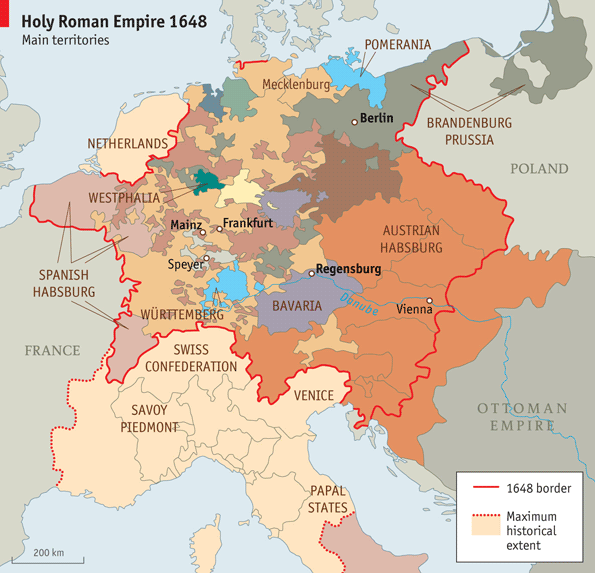
The Holy Roman Empire was (obviously) a very complicated entity. Modern maps often will try to show some range of this complexity, ranging from showing the major members and labelling the rest "SMALL STATES" (such as with this map) or trying to show as many of the member states as possible (such as here). Modern maps show independent political entities, and it's generally accepted that the member states of the Empire (especially after the Peace of Westphalia) were more or less independent.
However, maps made when the HRE still existed often only show the borders of the HRE, often labelled "GERMANY" or "THE EMPIRE". While individual areas may get their own smaller labels, no attempt is made to show internal borders (frex this map from 1650, or this map from 1598).
Is this because cartographers of the time couldn't be bothered to map out each and every minor fiefdom? Or, was the understanding of "sovereign state" different in the 17th century than it is today?
1 Answers 2017-02-20
It seems that tengrism was maybe the last major religion in Eurasia to dissappear/stop having a major following (I know small revival projects exist).
When did this happen, when did no more major tengri nations/communities exist?
1 Answers 2017-02-20
1 Answers 2017-02-20
I've tried to spend some (admittedly limited) time researching the title topic, but have come up short. Everything I've found refers to the area around Tennessee, Missouri, Mississippi and Alabama as the "Western Theatre", but I am more specifically interested in the area west of the Rockies.
Was this area of North America affected by the Civil War in any great regard? Or did the geographic distance cause it to be thought of as more of "their" problem (in regards to the East Coast of the continent). California and Oregon had already been admitted to the Union by this time, so I can't imagine it was possible to stay "neutral", so to speak.
Any info anyone has would be greatly appreciated, especially sources to follow up with so I can do some additional reading!
1 Answers 2017-02-20
I am currently enrolled in a MAT History program and I am kind of lost when it comes to the differences in jobs that Historians and teachers do. It feels like the most obvious one might be that Historians work closely with the archive and teachers don't always, though I believe in incorporating more primary sources in a classroom. But another distinction could be that Historians create a text and all teachers do is teach. But even then teachers can still create a narrative for their classrooms and that is dependent on which texts or sources they are drawing from.
So I'm wondering: Is there a difference and why or why not?
2 Answers 2017-02-20