1 Answers 2016-12-13
Today's theme is brought to you by /u/LukeInTheSkyWith:
Tell me about trances, drugs, visions, hallucinations, meditation, and whatever else it meant to trip the light fantastic in your favorite historical era!
Next Week: Imprisonment
4 Answers 2016-12-13
The folks over at /r/sociology recommended I ask you all this question.
So, I know people do a lot of unpaid work for themselves and others (cooking for their families, babysitting for neighbors, growing food to eat, the unpaid editing of Wikipedia articles, etc. i.e.). How much labor is done outside of the market? To be clear, I don't mean forced labor like slavery. How has this changed over time? Are there any good books or resources you would recommend on the subject?
1 Answers 2016-12-13
Twice during Louis the 16th's minority the royal family was forced to flee Paris out of fear for their safety. At one point an angry mob broke into their home and was only pacified when they saw the young king (feigning) sleep. Later during the French Revolution, the Royal Family would be caught trying to flee their insecure homes to safer locations only to be found out by the mob.
So my question is: Why don't they live in a castle, like the British monarchs lived in Windsor castle? That way if things go poorly, you can buy time to wait it out. An angry mob isn't going to have heavy artillery to blow through the fortifications.
1 Answers 2016-12-13
I know that the Byzantines called themselves "Roman", but what did other peoples, such as the Venetians, call them at the time?
2 Answers 2016-12-13
[deleted]
1 Answers 2016-12-13
Reeeepoaaast of an old question that never got an answer. I'm a hard working dirt-farmer Gael and some lordling just evicted me for the Agricultural Revolution so now I am homeless. How do I choose a new home and why was it so often in Canada?
2 Answers 2016-12-13
[deleted]
3 Answers 2016-12-13
According to the Canadian census, Canada's largest cities suffered significant population declines in the 1970's (from 1971 to 1981, Montreal declined from 1.2 million to 980 000, Toronto from 712 000to 599 000, and Vancouver 426 000 to 412 000). Meanwhile, medium sized cities like Calgary, Edmonton, Winnipeg and the Toronto Area cities (York, Mississauga, etc) saw significant growth.
https://en.wikipedia.org/wiki/List_of_largest_Canadian_cities_by_census#1971
I've always understood the 20th century to be one of almost linear urbanization. What happened to Canada's urban populations in this kind of rebalancing?
2 Answers 2016-12-13
From a variety of texts I've read, both growing up in the South and now, it seems that it took until the mid-20th century for a general agreement on the facts of the matter. Yet Bruce Levine's extremely readable The Fall of the House of Dixie cites page after page of primary source documents (from newspapers, to diaries, to the text of the Confederate constitution itself) that clearly and loudly trumpet the defense of slavery and its attendant way of life as the cause of the war.
It seems strange that people so much closer to the time of the publication of these primary source documents could have arrived at a place so much further from the truth than today's scholars. Was there a significant contingent of scholars who saw slavery as the cause of the war but were shouted down, or did it really take nearly a century for that fact to be agreed upon?
1 Answers 2016-12-13
In the case of WW1 and WW2, how did they declare war on each other? Did they send a telegram, or just start mobilizing their armies?
1 Answers 2016-12-13
I just finished watching a documentary about Rommel and how he believed that if the Allies were allowed to get a beachhead in France that the Germans should surrender to the British and Americans straight away and that together they could stop the Soviet Union from entering Germany.
Apparently, he was not the only General who had similar thoughts as a lot of German Generals had similar thoughts but Hitler would never have agreed to it.
I also watched another documentary on the last few months of WW2 and apparently there were rumours in the German army that very soon they would be fighting alongside the British and Americans to push the Soviet Union back as the German soldiers believed that the Western Allies would dislike the Soviets more than the Nazi's and would not want to see the Soviet's gain any control of Europe. Now obviously this was never going to happen as for many reasons such as Roosevelt, Stalin and Churchill already having an agreement on how to carve up Europe after the war and also Roosevelt actually quite liking Stalin, or thinking he could trust him somewhat (as well as a host of other reasons) but at the time the German soldiers and Generals did not know about this.
So my question is this rumour accurate in that it was a common belief among German soldiers or even German Generals that they would fight along side the British and Americans against the Soviets or was it something that the documentary makers sort of overstated?
1 Answers 2016-12-13
What better way to break the deadlock of the western front? The entente had the naval clout of the british, and gallipoli showed they clearly weren't afraid of dangerous naval invasions too. So they appear to have had the means, the courage, and the impetus. Were they scared of gallipoli 2, or was their man/naval power too bruised after Jutland and the numerous land massacres? What stopped the british sailing up to the german coast with a few thousand troops and sticking it to Jerry? Thanks in advance <3
1 Answers 2016-12-13
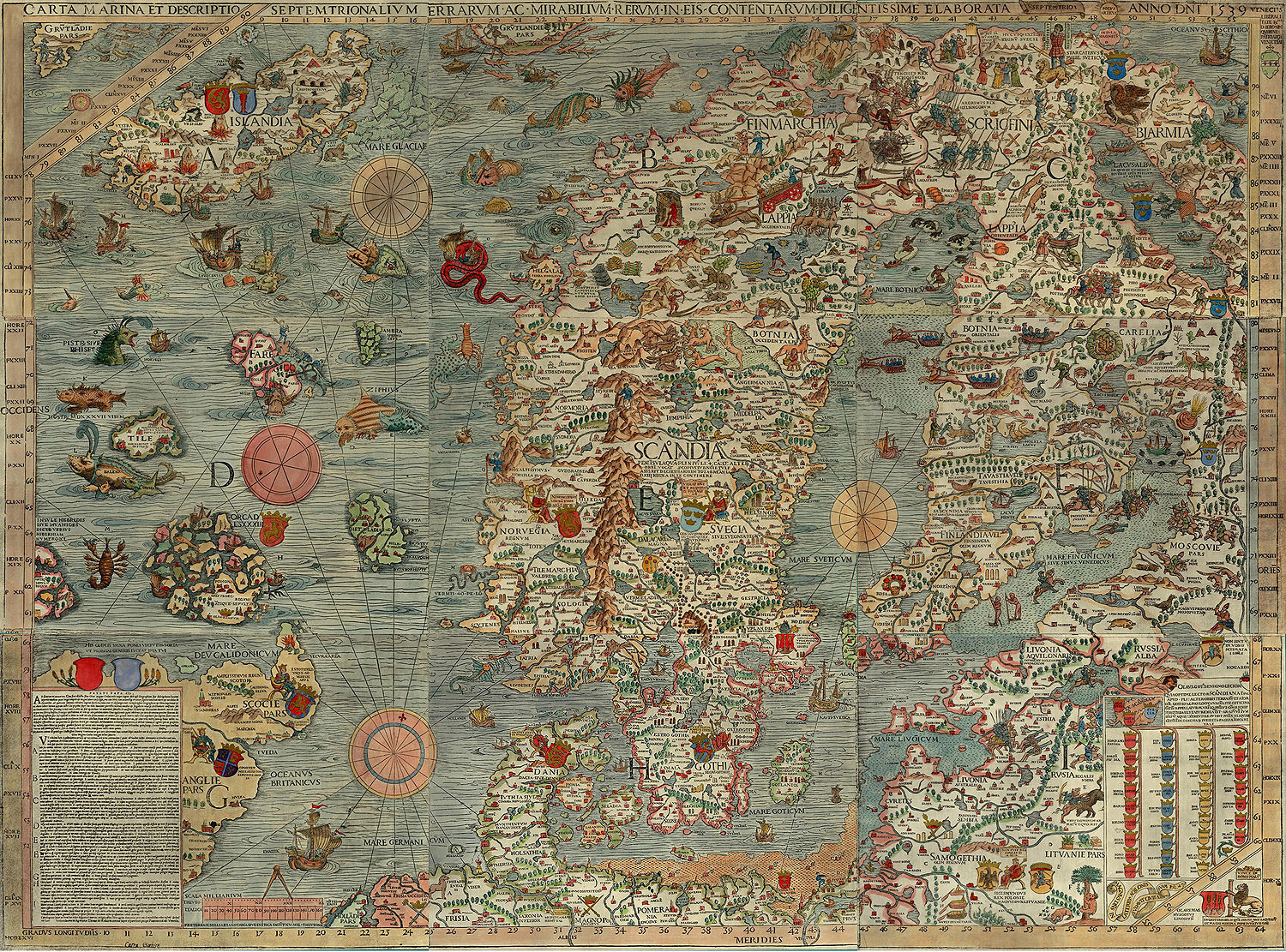
Were they purely decorative or did they serve as warnings to sailors?
Did the cartographers belive that specific monsters roamed specific parts of the sea?
Example link: https://espliego.files.wordpress.com/2008/01/1500px-carta_marina.jpeg
1 Answers 2016-12-13
(New to this sub. Have been reading along for a long time, first time posting something. Read rules.)
The Glorious Revolution, as it is called in British history books, was by definition a invasion by the Stadtholder William of Orange. He crossed the channel with over 50 Dutch warships holding over 1700 canons. With him he took 20.000 men, Dutch and all kinds of mercenaries, and another 7.000 horses.
The Dutch Republic, and with that William, feared to the Catholic King to team up with the catholic French and would thereby threaten the Republics future.
I realise William enjoyed ''a lot'' of support from within Britain, including encouragement from Parliament members, but that still does not make this a revolution. He took London by force. When William entered London, he forced all English regiments to leave the city, as Dutch forces would take over their positions. Even sending the Coldstream and Life guards out of London.
For 15 months London remained under Dutch military ocupation. I am fully aware this is a special case, and it's not some heroic Dutch invasion of the British Isles. But by the very definition of a invasion, it very clearly is one. A foreign leader with a foreign force invading a sovereign nation and taking it's throne, is very much a succesfull invasion.
With this the Dutch are the last one who succesfully did what the Spanish and French attempted for centuries, Hitler and Napoleon would dream off in the future and all fail. Even Churchill claiming the Isles hadn't been taken since 1066 and would not happen during ww2 was basically wrong. But i guess noting that the Dutch were actually the last ones to invade Britain wouldn't really help British morale during ww2, either.;p
My question is: Why is it called the Glorious Revolution, and when when did people start naming it? Is it out of pure propoganda and pride? Would love to here English historians about this. Why aren't historians in England pointing at this being wrong? I only found one article about it.
http://www.dailymail.co.uk/news/article-560614/The-1688-invasion-Britain-thats-erased-history.html
1 Answers 2016-12-13
I have some questions about ethnicities in Roman Empire, which are linked with each other.
Is there any Information about the number of different cultural and ethnic groups in Roman Empire? For example, how many ethnic Romans, Carthagians, Greek, Gaul, Numidians and other lived in Roman Empire, lets say in the year 0, or 100 AD, or other dates.
In the New Testament of the Bible, we find this: „Now when this was noised abroad, the multitude came together, and were confounded, because that every man heard them speak in his own language. And they were all amazed and marvelled, saying one to another, Behold, are not all these which speak Galilaeans? And how hear we every man in our own tongue, wherein we were born? Parthians, and Medes, and Elamites, and the dwellers in Mesopotamia, and in Judaea, and Cappadocia, in Pontus, and Asia, Phrygia, and Pamphylia, in Egypt, and in the parts of Libya about Cyrene, and strangers of Rome, Jews and proselytes, Cretans and Arabians, we do hear them speak in our tongues the wonderful works of God.“ According to this, it seems, that people from many different places lived in ancient Jerusalem. Was it normal for big Roman cities? Did other big cities like Carthago, Syrakus or Antiochia also had such big ethnic diversity?
And last, was it normal for people to move to an other place, like from Crete to Jerusalem or from North Africa to Roman Germania for example. And how common was the Migration from other countries (in the Bible verses I mentioned there are also people from parthia, which wasnt Part of the roman Empire). And did people have to register anywhere when they moved to Roman Empire?
Sorry for the long text.
1 Answers 2016-12-13
Hi everyone, I'm having a hard time finding where to ask this, but I figure it is an historical question. Does anyone know the proper name (if there is one) for the style of description/argumentation that follows numbered paragraphs? I see this in 19th century scientific texts, and I also know that it occurs in philosophy texts. I do wonder where this comes about, too, but I'm having trouble even describing the style of writing, and if I knew the term I am sure I'd be able to get to its various origins/deployments. Anyone know?
I am also interested in WHY this was used, but that's a different problem altogether. I do know one answer, which accounts for the numbered paragraph in present-day use: different editions have different page numbers, so reference by paragraph is more useful to scholars and students. So, for instance, the copy of Plato's Republic you read in college had numbered paragraphs because there have been thousands of different versions (and translations), so reference must be made to the paragraph rather than page.
My question is rather about the numbered-paragraph mode of writing before their were many different editions. Scientific journals sometimes used this format, and these were not expected to ever see a second edition, so I am almost sure that the reference by edition argument doesn't fit here. Of course, reference by paragraph can still be an useful tool in the case of single-edition texts.
tldr - what do you call the style of writing that uses numbered paragraphs?
2 Answers 2016-12-13
I'm an undergrad studying history right now. I have 3 years of Latin in high school under my belt and I'm studying Russian as well. What language training do I need to study history at the Phd level?
1 Answers 2016-12-13
[deleted]
1 Answers 2016-12-13
Hey all,
Was hoping someone might have some insights into this random historical question that seems to be a bit too specific for my Google skills. No homework question here, just wanted to fact check for my little video game how a scribe working in the Pharaoh's court should have their earned wages (aka their score) be represented as :)
I've come across the various common forms of payment that a village scribe might earn (bread, beer, clothing, meat)... But I'd assume the status of top scribe brings along with it better wages/wealth than just extra life necessities? Maybe Gold, Silver, or Copper? Or land?
Any tomb walls, texts, etc from any of the various Egyptian periods to provide insights on this?
Thanks for any potential help!
1 Answers 2016-12-13
It can also be trades that were made between the city-states of Greek itself.
1 Answers 2016-12-13
I would like to know more about world history and how it helped shape the world today. I was blissfully unaware about the historical events of this world and quite frankly believed they were unimportant. Long story short, I have realised how much of a neanderthal I was. I know now how much fo the history taught to me at highschool was as much on the surface as it was largely unreliable, I,personally want to learn about key events which led to the birth of racism,fascism, slavery , terrorism, police brutality, totalitarian governments,corruption etc.
I have already viewed the following thread and have learned alot
However, I have two questions :
The commenters in the aforementioned thread advised on reading journals, but what exactly should I search for ? What should my search terms look like ?
To what degree is this sub's resource list helpful to get me off to a good and accurate start ?
Any form of help will be massively appreciated.
2 Answers 2016-12-13