In "The Gallic Wars" Caesar describes the use of a siege tower to gain a hight advantage over the defenders on the wall which would then be used to attack them with missiles. I was under the impression that a siege towers main purpose was to provide a way to scale a wall. Was that just an exception that was popularized by movies like LOTR? How often were siege towers used in the way Caesar described? What was the basic philosophy on how they should be used?
1 Answers 2022-01-11
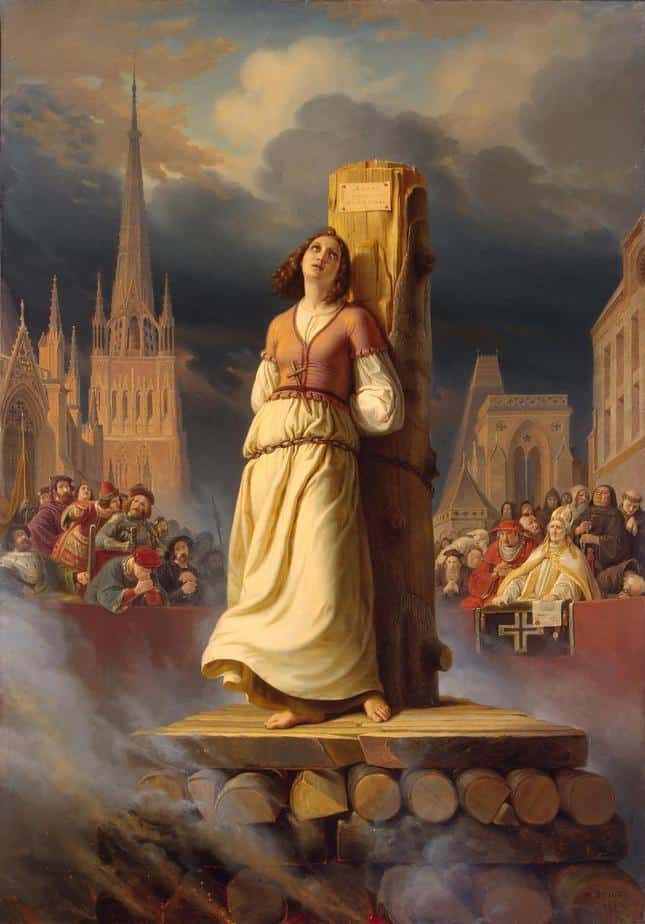
I am finishing a book of mine about magical nonsense, and one of the final scenes I have to set up is set around Joan's execution. The scene is written as one of the bystanders memories (a legally distinct version of the Pensieve in Harry Potter), but for the life of me, I cannot find anything specific about the area.
I have taken (some) inspiration from the two movies for how this will be set up, but do not trust them with the specifics, which is apparently my thing these days (in the Messenger, she was 16, in the TV mini-series, it was set during the winter.)
Specifically, I am looking for the buildings around her, very specifically, I am looking for the tower in both this and this painting. I found the spot in Rouen that she was executed at, and for some godawful reason, Google Street View doesn't have any photos of the area dating 400 years before photography was invented.
I have looked my darndest to connect scenes in these paintings with shots from Le Bûcher de Jeanne d'Arc, but it seems to have been taken down since way back then. Since I failed my art history class, I am not quite capable of dissecting the different features of the architecture to guesstimate when it might have been built, and I don't think my class went anywhere outside of Greece.
I know this sounds incredibly specific, but with a chapter long bibliography packed in the back of this thing, I want to know I got something right. Since I am writing this scene from the POV of someone at her execution, it would make sense that they would know what to refer to the things around them as.
Perhaps I was just spoiled by the amount of information I was able to find about Finchale Priory, but this is a big scene, especially after I was reminded that Merlin wrote a prophecy about her. Merlin is in my book, so I gotta do him right. And because over-researching this thing makes me feel smart.
kthx
3 Answers 2022-01-11
For example the automated pinned mod comment could be used as a starting point for casual answers and discussions. Stuff like "I forgot the source, but I read that..." or "not an expert, but I'm pretty sure that ... because ...". As great as it is to push for the very high quality answers this sub receives, many thread often look pretty deserted, even tho I'm sure some people could at least give some decent insight, even if they don't have the time to back up there post with sources right now.
3 Answers 2022-01-11
Welcome to Tuesday Trivia!
If you are:
this thread is for you ALL!
Come share the cool stuff you love about the past!
We do not allow posts based on personal or relatives' anecdotes. Brief and short answers are allowed but MUST be properly sourced to respectable literature. All other rules also apply—no bigotry, current events, and so forth.
For this round, let’s look at: Minorities, Persecution, and Oppression! Tell us about the treatment of minorities in the societies you study. Were they subjected to oppression, prosecution and pogroms? How did they cope, resist and endure? Tell us all the interesting and important stories you feel must be told!
1 Answers 2022-01-11
1 Answers 2022-01-11
So I was wondering, recently ive been curious about the Sistine Chapel painting, because it seems like a LOOOT of work, and it oubviously is. I also learnt that Michelangelo actually didnt want to do it, but he had to so he did. So i was wondering. Michelangelo allegedly got paid 3200 florins for his work on thé Sixtine Chapel. How much would that be worth during these times (1500-1510) I know there's no way to Say exactly how much 3200 florins would bé worth in € or $, but is there a way to know, what i could do With 3200 florins back then ?
Very sorry if its badly worded, english is not my main language
🤗❤️
1 Answers 2022-01-11
The wikipedia article has no detail on how this came to be. Why was he chosen? What was the controversy?
1 Answers 2022-01-11
1 Answers 2022-01-11
Some sources attribute thousands of invented words to the Bard of Avon. Presumably, not every linguistic invention of his gained as much momentum as the others. What do we know about the way these fresh phrases proliferated through Shakespeare's time? What do we know about how one invented word gained popularity whereas another didn't?
2 Answers 2022-01-11
1 Answers 2022-01-11
For example, what conditions would have led to Mainz becoming an archbishopric while Brandenburg became a margraviate, and Bohemia became a kingdom?
1 Answers 2022-01-11
I saw this post about him and wanted to know more but when I search him up, not much comes up.
1 Answers 2022-01-11
I always was fascinated by history in general( watched youtube channels on the topic, liked pop culture media that took place in the past, really liked the subject in school, etc) but recently i perceived that i never studied profoundly or took time to actually read on the subject in more reliable/professional way. So i decided to start doing so now, starting with the Ancient Greek time perioud (bronze age, classical, etc), but i took notice not only there isnt a lot of books about Ancient Greece in my country(Brazil) at least from what i looked for, but the ones that i did found were or very specific(talking about specific points like the politics of Athens at the time), very superficial(talking about the time period in a more general way, or talking about it alongside many others time periods) or relatively old(things from the 90s/early 2000s, i know that they aren't really that old but since history is an always changing subject i got afraid that they might be already dated). As so i started searching for ways to start studying Ancient Greece and got through a recomendation of primary source books written by greek authors, they being: Homer, Herodotus, Thucydides, Plutarch, Xenophon, Strabo, Polybius and Craterus. I founded it interesting, and decided to follow such recomendation, but i am afraid if it may be imprecise or ineficient way of studying history, so decided to ask about opinions on this. What you think?
P.S: Yes, i do know that if i read this primary sources i shoudn't take them at face vallue, since bias and some imprecisions do exist, and some of those aren't actual historical reports(like Iliad and Odyssey by Homer), but they can give a good notion on the culture and views of theese people on that time frame. I also don't take problem on more complicated writing, and i do have a general knowledge on the time period. Also, if you have some recomendation of books etc, that is no problem if they're in english, i surely prefer to have ones in potuguese(since it is my mother language), but i take no problem reading stuff in english aswell.
1 Answers 2022-01-11
I am working on a novel, and the first chapter takes place at Huntsville Unit (Texas State Penitentiary at Huntsville, AKA Walls Unit) in 1882. Noted outlaws who were held there during that year include John Wesley Hardin and Jesse Evans.
In 1879, John Wesley Hardin attempted to escape from Walls Unit by boring a hole through the wall into the prison's armory. From there, he planned to arm a small army of fellow conspirators and fight their way out of the prison. Unfortunately for the prisoners, they were caught and stopped before they broke through the wall.
In my (historical fiction) story, I allude to the fact that many African American prisoners were leased out by prisons (including Huntsville) to nearby plantations for cheap forced labor. [The 13th Amendment ended slavery in America, with the crucial exception of convicted criminals. In former slave states, this loophole was used to essentially continue the practice of slavery by using (almost exclusively black) prisoners.]
The story features John Wesley Hardin's escape attempt at Walls Unit. I say that the prisoners involved were punished, but not equally. The few blacks involved were leased out to a nearby plantation for hard labor, but the white conspirators were punished on site rather than being sent away, in order to avoid public criticism from whites.
Is this historically accurate? Were both black and white prisoners held at Huntsville Unit in 1879? If so, is it believable that they would be held in the same part of the prison, and that they might even conspire together on an escape attempt? Many thanks in advance for any help/advice!
2 Answers 2022-01-10
I'm interested in reading about the Romance of the Three Kingdoms. Any recommendations would be greatly appreciated.
1 Answers 2022-01-10
I was having a discussion with some friends about how different cultures dress differently, yet they all seem to agree that genitals are inappropriate and should always be covered, which is something not observed in nature (animals). I was wondering if there is a rough guess as to when we started covering it down there, and if there were interactions between ancient civilisations that were completely naked.
1 Answers 2022-01-10
1 Answers 2022-01-10
Today I'm going to discuss the relative chronology of Egypt and Ḫatti, two of the most powerful kingdoms of the Bronze Age. Ḫatti (1650-1180 BCE), also known as the Hittite kingdom/empire, was located in what is now central and southern Turkey and northern Syria.
Periodization
Historians typically divide early Egypt into three periods of centralized rule (Old Kingdom, Middle Kingdom, New Kingdom) and two periods of decentralized rule and competing polities (First and Second Intermediate Periods).
Old Kingdom (ca. 2650-2150 BCE)
First Intermediate Period (ca. 2150-2030 BCE)
Middle Kingdom (ca. 2030-1650 BCE)
Second Intermediate Period (ca. 1700-1550 BCE)
New Kingdom (ca. 1550-1070 BCE)
Additionally, each of these periods consists of one or more dynasties. The New Kingdom consists of the 18th, 19th, and 20th Dynasties, for example. "Dynasty" is a bit of a misnomer since there are instances of a dynastic break despite the same family staying in power (e.g. the 17th/18th Dynasty transition) as well as dynastic continuity despite a ruler from another family ascending to the throne (e.g. Horemheb in the 18th Dynasty), but the term has been in use for so long that I fear we're stuck with it.
Similarly, modern historians have divided the history of the Hittites into two periods.
Old Kingdom (ca. 1650-1400 BCE)
New Kingdom, or Hittite empire period (ca. 1400-1200 BCE)
Thanks to the efforts of early Egyptologists, we have a fairly complete relative chronology of the most prominent Egyptian kings. In other words, we know that Khufu (4th Dynasty) reigned earlier than Amenemhat I (12th Dynasty), who in turn reigned earlier than Ramesses II (19th Dynasty).
We also have a relative chronology of Hittite rulers. For example, the New Kingdom consists of the following kings:
Šuppiluliuma I
Arnuwanda II (son of Šuppiluliuma I)
Muršili II (son of Šuppiluliuma I and brother of Arnuwanda II)
Muwatalli II (son of Muršili II)
Muršili III (son of Muwatalli II)
Ḫattušili III (uncle of Muršili III and brother of Muwatalli II; seized the throne in a coup)
Tudḫaliya IV (son of Ḫattušili III),
Arnuwanda III (son of Tudḫaliya IV)
Šuppiluliuma II (son of Tudḫaliya IV and brother of Arnuwanda III)
So how did scholars reconstruct this sequence of rulers? How do we know which kings ruled when?
King lists
Scribes in ancient Egypt dated texts according to the regnal year of a king. An example from a scarab of Amenhotep III of the 18th Dynasty (14th century BCE):
Year 11, third month of Akhet, day 1, under (the reign of)... the King of Upper and Lower Egypt, Nebmaatre, son of Re, Amenhotep, the ruler of Thebes, given life, and the Great Royal Wife Tiye, may she live.
Of course, you need to keep a chronological list of rulers for such a system to work. Knowing that an event took place in Year 3 of the reign of Senusret III doesn't help you very much if you have no idea when Senusret III ruled. There are several surviving king lists from ancient Egypt, including but not limited to the following:
Royal Annals, including the Palermo Stone (Dynasties 1-5)
Turin King List (Dynasties 1-17)
Abydos King List (Dynasties 1-19)
Saqqara Tablet (Dynasties 1-19)
Most of these lists are monumental inscriptions from temples and tombs, but the Turin King List was written on papyrus. The dry desert of southern Egypt has excellent preservation conditions, but papyrus is nonetheless a delicate material, and the Turin papyrus allegedly crumbled to bits shortly after its discovery. As Barbara Mertz put it in Temples, Tombs, and Hieroglyphs,
The papyrus was complete when it was discovered in 1823 by a gentleman named Bernardino Drovetti, who stuck it into a jar that he tied around his waist. He then rode off to town on his donkey. The gait of a donkey being what it is, Egyptologists have been pushing the pieces of the papyrus around ever since, and cursing Drovetti as they do so.
Though these king lists are an invaluable source of information about the relative chronology of Egyptian kings, there are several problems and limitations.
Most are quite fragmentary. Although the Turin list originally included the names of more than 300 kings, less than half of the names have survived and are at least partially legible.
Kings viewed as problematic were intentionally excluded. This includes female kings such as Hatshepsut, the kings of the Amarna period, and kings of foreign origins such as the Hyksos kings of the Second Intermediate Period.
Some kings were contemporary rather than consecutive, particularly in periods in which centralized rule was breaking down.
Seals and offering lists
No such king lists have survived from the Hittite empire, but there are a couple of texts that include the names of several successive kings. One of these inscriptions is the cruciform seal found at the Hittite capital of Ḫattuša. As the name suggests, the seal impression takes the form of a cross, with the names of kings and queens written in the central portion of the seal and each of the four wings.
Five kings are named on the obverse of the seal, and another five are listed on the reverse. Šuppiluliuma, the first king of the New Kingdom, is in the center of the reverse side of the seal, and his son Muršili II is in the center of the obverse side. Šuppiluliuma's name is surrounded by the names of the earliest kings of the Hittite kingdom (Labarna, Ḫattušili I, and Muršili I), whereas Muršili's name is surrounded by the names of the predecessors of his father Šuppiluliuma – Tudḫaliya I, Arnuwanda I, Tudḫaliya III, and another Tudḫaliya probably to be identified as Tudḫaliya the Younger since he is the only king without an accompanying queen. (Tudḫaliya the Younger was murdered so that Šuppiluliuma could ascend to the throne. The familial relationship between them remains unclear.)
Strangely, there is a considerable gap in time between the most recent king of the reverse (Muršili I) and the oldest king of the obverse (Tudḫaliya I). This was a period of weakness for the Hittite kingdom, however, so Muršili II may have intentionally focused exclusively on the kings who founded the Old Kingdom and New Kingdom, when the Hittite kingdom was at the height of its power.
Additionally, Hittite festival texts occasionally list kings in chronological order while outlining the offerings made to deceased ancestors. For example, tablet KUB 11.8+9, which describes the events of day 32 of the nuntarriyašḫaš festival, mentions offerings made to early kings such as Alluwamna, Ḫantili, Zidanta, Ḫuzzia, Tudḫaliya I, and Arnuwanda I.
Biographical statements
Royal inscriptions such as annals and chronicles sometimes list a king's ancestors. For example, the Apology of king Ḫattušili III (13th century BCE) begins as follows:
Thus (speaks the) Tabarna Ḫattušili (III), Great King, King of Ḫatti, the son of Muršili (II), Great King, King of Ḫatti, the grandson of Šuppiluliuma (I), Great King, King of Ḫatti, descendant of Ḫattušili I, king of Kuššar.
Unfortunately, while such statements are helpful for establishing genealogies, they often omit rulers and are therefore not as helpful as they appear for establishing sequences of kings. Here Ḫattušili is omitting three kings: Arnuwanda II (his uncle), Muwatalli II (his brother), and Muršili III (his nephew and predessor).
Such biographical statements could be rather lengthy and go back multiple generations, as in the case of the hieroglyphic inscription Maraş 1 of the late 9th century BCE.
I am Halparuntiya the ruler, Gurgumean king, the son of the governor Laramas, the grandson of the hero Halparuntiya, the great-grandson of the brave Muwatalli, the great-great-grandson of the ruler Halparuntiya, the great-great-great-grandson of the hero Muwizi, the descendant of the governor Laramas...
Historical and diplomatic texts
Hittite treaties often begin with a historical prologue that provides the context for the treaties. These are invaluable not only for establishing the sequence of rulers of a kingdom but also for linking the chronologies of contemporary kingdoms. For example, the treaty between Šattiwaza of Mitanni and Šuppiluliuma I of Ḫatti mentions several kings who preceded Šattiwaza on the Mitannian throne.
[Thus says] Šattiwaza, son of Tušratta, king of Mitanni: Before Šuttarna, son of Artatama... of the land of Mitanni, King Artatama, his father, did wrong. He used up the palace of the kings, together with its treasures. He exhausted them in payment to the land of Assyria and to the land of Alši. King Tušratta, my father, built a palace and filled it with riches, but Šuttarna destroyed it, and it became impoverished. And he broke the [ . . . ] of the kings, of silver and gold, and the caldrons of silver from the bath house. And [from the wealth(?)] of his father and his brother he did not give anyone (in Mitanni) anything, but he threw himself down before the Assyrian, the subject of his father, who no longer pays tribute, and gave him his riches as a gift.
Thus says Šattiwaza, son of King Tušratta: The door of silver and gold which King Šauštatar, my (great-)great-grandfather, took by force from the land of Assyria as a token of his glory and set up in his palace in the city of Waššukanni —to his shame Šuttarna has now returned it to the land of Assyria...
Diplomatic correspondence is similarly useful for linking the chronologies of contemporary states like ancient Egypt and Ḫatti. Thanks to the Amarna letters found in Egypt, for example, we know that the Egyptian kings Amenhotep III and Akhenaten were contemporary with Kadašman-Enlil I and Burna-buriaš II of Babylonia, Šuppiluliuma I of Ḫatti, Aššur-uballit I of Assyria, and Tušratta of Mitanni.
Lingering issues: Kings sharing names and the difficulties of dating texts and inscriptions
Although we have made great progress in reconstructing the sequences of ancient kings, there are still aspects of Egyptian and Hittite history that remain poorly understood. As an example, let's look at the Hittite kings named Tudḫaliya.
As you've probably noticed, Bronze Age rulers liked to repeat names, particularly the names of powerful or prominent kings of the past. Egyptologists refer to 1300-1100 BCE as the Ramesside period because there were no fewer than 11 kings named Ramesses in this period. The numbering system we use today is a modern convention used for convenience, and unfortunately the Egyptians did not provide numbers to distinguish one Ramesses from another. Egyptian kings of the New Kingdom had five names, however, which does allow us to distinguish between them. For example, Ramesses II and Ramesses III had different throne names – Usermaatre-Setepenre and Usermaatre-Meryamun, respectively.
Unfortunately, while a few Hittite kings had both a Hittite name and a secondary Hurrian name – Hittite Muršili III and Hurrian Urḫi-Teššub, for example – most Hittite kings were content with only a single name. Since several names were shared by kings, it can be difficult to tell whether a text referring to "King Tudḫaliya" dates to, say, the reign of Tudḫaliya I (14th century BCE) or the reign of Tudḫaliya IV (late 13th century BCE).
As an example, let's take a look at the Ankara silver bowl, which has elicited more controversy than any other Anatolian hieroglyphic inscription.
zi/a-wa/i-ti CAELUM-pi sa-ma-i(a)-*a REGIO.HATTI VIR2 *273-i(a)-sa5-zi/a-tá REX ma-zi/a-kar-hu-ha REX PRAE-na
tara/i-wa/i-zi/a-wa/i(REGIO) REL+ra/i MONS[.tu] LABARNA+la hu-la-i(a)-tá
wa/i-na-*a pa-ti-i(a)-*a ANNUS-i(a) i(a)-zi/a-tà
This bowl Asamaya, the man of Ḫatti, made in the time of King Mazi-Karḫuḫa.
When the labarna Tudḫaliya smote Tarwiza,
in that year he (i.e. Asamaya) made it.
The key question is which "labarna Tudḫaliya" is being referred to here. Scholars are divided as to whether the bowl dates to the Bronze Age or Iron Age, and if it does date to the Bronze Age, whether it should be dated to the reign of Tudḫaliya I (14th century BCE) or Tudḫaliya IV (13th century BCE).
There are a few grammatical features that suggest a dating to the Bronze Age, such as an undifferentiated za/i (za and zi were separate signs in later inscriptions), a-initial-final (the a glyph is moved to the end of the word, as in Asamaya's name, marked here with an asterisk), and relatively few inflected nouns. On the other hand, the pervasiveness of syllabic writing and conjugated verbs points to a much later Iron Age dating, as does the theophoric name Mazi-Karḫuḫa. Several sign forms, particularly the glyph ma (a ram's head) strongly resemble those of Carchemish, home to the god Karḫuḫa. While it is most likely that the bowl is an Iron Age artifact from Carchemish written in an archaizing style, the dating of the bowl remains an unsettled issue.
As another example, the Museum of Fine Arts has a silver drinking vessel in the shape of a fist inscribed with the name of King Tudḫaliya (written as MONS-tu MAGNUS.REX). The MFA has identified this Tudḫaliya as Tudḫaliya III, primarily on the basis of the work of the Hittitologist Hans Güterbock, who compared the artistic style with the reliefs from the Hittite town of Alaca Höyük, which at the time were dated to the 15th/14th century BCE. Since the reliefs are now believed to date to the latter part of the 13th century BCE, as outlined in Piotr Taracha's article "The Iconographic Program of the Sculptures of Alacahöyük," an identification with Tudḫaliya III is almost certainly incorrect. It is more likely that the rhyton is referring to Tudḫaliya IV of the late 13th century BCE.
Further reading on relative chronology and king lists
Ancient Egyptian Chronology edited by Erik Hornung, Rolf Krauss, and David Warburton
Pharaonic King-lists, Annals, and Day-books: A Contribution to the Study of the Egyptian Sense of History by Donald Redford
Royal Annals of Ancient Egypt: The Palermo Stone and Its Associated Fragments by Toby Wilkinson
"History as Charter: Some Observations on the Sumerian King List" by Piotr Michalowski
"The 'Cruciform Seal' from Boğazköy-Hattusa" by Gernot Wilhelm, Ali Dinçol, Belkis Dinçol, and David Hawkins
4 Answers 2022-01-10
I've noticed when people discuss sensitive topics, they avoid trying to use any kind of data or objective analysis to answer their questions and instead pick one or two accounts are treat them as representative. Isn't a few anecdotes not enough to get a full picture. Unless you can corroborate that account with a wider view?
The example in mind is a recent question about the nutrition of slaves in the US and the top answer brushed aside a previous analysis and cited Fredrick Douglas' account. I'm not doubting anything Douglas said, but isn't one account not enough to say that all slaves lived the same way?
1 Answers 2022-01-10
Most romance/Germanic speaking areas use tea or something similar while Slavic and other eastern language family’s use the Sinitic origin of “chai”, why is that?
1 Answers 2022-01-10
So before the Islamic conquest Persia had a sprawling empire that extended from what's now Iran to Egypt, including large parts of the Near East. The size of the empire varied, of course, from dynasty to dynasty. However something noticeable about the areas that were formerly under Persian control is that they have no evidence of Zoroastrian heritage whatsoever, not even a few scattered communities like Christians and Jews that still exist to this day.
So I'm curious if Zoroastrians never bothered to proselytized their religion outside of Iran proper (I know Indian Zoroastrians don't proselytize), or was the religion completely supplanted by Islam in the Middle Ages?
1 Answers 2022-01-10
Hi, I am doing a history research project on how the government kept the Manhattan Project secret. What history resources do you recommend to find in-depth information about these? They can be online articles or books but not paid versions.
1 Answers 2022-01-10
The Sassanid Empire had various Cataphracts and horse archers which were much more powerful than the naked Visigothic warriors,but the Sassanids not only couldn't sack the City of Rome throughout its history but they even got their capital besieged by Julian in 363.In contrast the Visigoths annihilated the Roman army led by Valens in 378 and sacked the City of Rome in 410.Why couldn't the Sassanian army crash the Romans in Roman soil and sack the City of Rome prior to the Goths?
1 Answers 2022-01-10