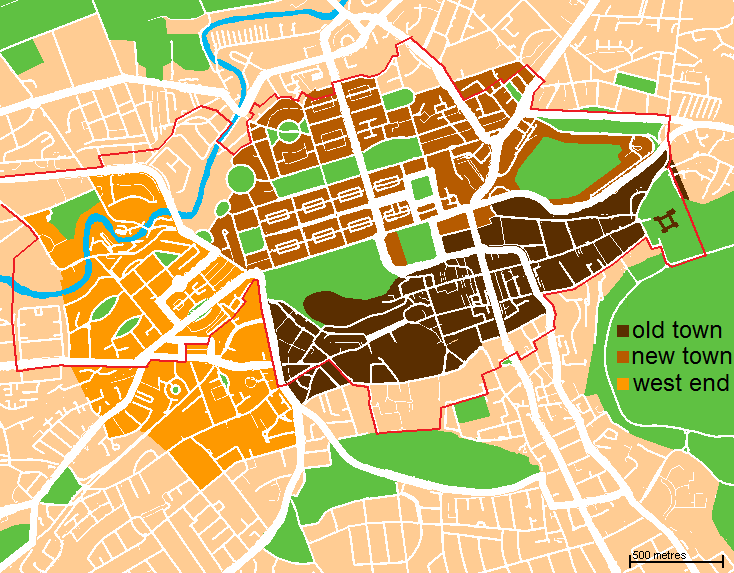
Cllickbait title, maybe. This really concerns Edinburgh specifically, but I'd be interested in similar examples.
I've read that the development of Edinburgh's New Town in the late 18th Century was designed for higher income people - mostly in preparation for the impending boom of the industrial revolution, but also the due to the affordances that came with the ideals of enlightened living. Architecturally, they wanted to break away from the traditional, "uncivilised", weaving clusters of buildings, and designed a strict grid-like arrangement which would better represent the values of the British Empire's Enlightenment - Reason, Liberty, Happiness and Order.
Determined spaciousness allowed for future urban development, sizable public buildings, and less spreading of disease or mould. New Town was not only aesthetically unfamiliar, but migration was also too expensive for Edinburgh's many existing working-class city inhabitants, who stayed in the slowly dilapidating Old Town. Intentionally or not, city planners created a clear residential divide of classes.
As an aside here, England were obviously very concerned with "naturalising" the Scottish people to industrial sensibilities using Economic and Political motions (maybe too many examples to mention, but this was around the same time as the Jacobite rebellion).
Were there any ways in-particular that British city planners managed to use architecture to alienate the Edinburgh working classes, or dissuade Scottish identity at this time? If they did so deliberately, how did they benefit from this? Were any "tricks" employed, such as with Robert Moses notorious bridges (disputed, I know.), or were class divisions purely coincidental? Are there other ways that architecture or urban development was used to the same effect around other parts of the British Empire?
1 Answers 2022-01-11
It could (as a good historian should) also consider perspective from the time prior, specially before World War 2 and what effects it had on it. But mostly looking for the rise of the US as the main global superpower after World War 2, Cold War and beyond.
1 Answers 2022-01-11
Hi all. Please forgive me if this is not specific enough, I’m not a historian or anything. I am just really interested in history in general.
To be more specific to my question though; what I mean, is how has it become this feared & propagandized thing that it is? I tried a quick YouTube search of this, hoping for a video on how/why this happened, but couldn’t find anything. Most of the videos I found inherently held the assumption you already knew what communism is at the very least.
So potentially…where did it come from, has it worked anywhere (besides current China?), why was it propagandized how it is in the US, why are so we afraid of it? Why is it still this dramatically hated philosophy even today?
I appreciate any answers to this. Thanks a lot.
PS - I think this is one of the coolest subs on Reddit due to how strictly it is moderated. I have never seen another sub that is so adamant about retaining its function, with such a dedicated mod team. You guys are all awesome. Thanks for teaching us all so much, so in depth. I hope anyone reading is doing well. Thanks.
1 Answers 2022-01-11
I'm writing a historical fantasy novel and trying to work out some of the grittier parts of history that aren't very google-able nor yield themselves easily to research.
I know at this time, things were a mess in Europe, but France and Britain didn't officially declare war until September of 1939. My protagonist is a distant relative of the Roosevelt family, mid-twenties, with an American father and a French national mother, so I assume there would be dual citizenship. He marries and wants to take his new wife to live in France on a piece of property owned there some place rural basically because they want to drop out of New York society and go back to nature. The story leads eventually into the characters being established there by the time the Nazis invade and becoming part of the resistance.
I am trying to work out whether or not Americans would allowed to immigrate at this time; if it would even be immigration if one had dual citizenship and married the other. I'm trying to work this out because I would like to have this take place circa-1938; however, if the history doesn't fit, I can roll things back several years.
Thank you so much for any and all insight!
1 Answers 2022-01-11
And, more broadly, is the literary and film device of the "mystical minority" (namely the Magical Negro trope here in the U.S.) related?
Thanks!
1 Answers 2022-01-11
Ok so a friend of mine told me that the only reason Japan surrendered was because of nukes and they were actually defeating USA. Is this true? Could they have done this considering that Soviet Union would come for? Also isn't USA huge? Wouldn't have been a logistical nightmare to control an occupied territory as big as that?
1 Answers 2022-01-11
I have heard this being said since elementary school. But I have a hard time imaging colonials who had just broken away from a monarchy wanting to establish their own.
2 Answers 2022-01-11
I was listening to a podcast about the history of China and she was mentioned as an exception to the role the women of her time played but when I checked Wikipedia, apparently, some of the other wives of Wu Ding also led military campaigns. So my question is, if and how Fu Has exceeded these other women. Thank you.
1 Answers 2022-01-11
From the records of her mentioning that a sword (which no one knew of) was buried in a church, to her making prophecies that seemed to keep turning out to be true and even her ability to somehow banish the lust of the men around her (and keep her subordinates from acting out lustfully).
I am extremely curious about how these are treated by historians and the level of weight assigned to the narrations of her contemporaries.
1 Answers 2022-01-11
Was this a matter of courtesy under detente? Or did Disney have some legal recourse to enforce its copyright?
1 Answers 2022-01-11
1 Answers 2022-01-11
I understand that some ancient empires - like Rome or the Hellenistic Kingdoms - were known for being cosmopolitan, with people from all over the empire intermingling in the largest cities. Was this also the case for the Achaemenids, Parthians, or Sassanians?
1 Answers 2022-01-11
I won't go into the entirety of my research into the topic, because it's a lot. But I did my internship studying this question and would like to know what you guys think.
In short, the placement of Otzi's tattoos are within millimeters (most likely due to skin drift) of Chinese acupuncture points. Over 70% of his tattoos follow classical Chinese acupuncture points. These points have been used to treat rheumatism, which Ötzi suffered through during his life time, as well as gastro-intestinal problems.). If you look at them, they also resemble what we see in therapeutic tattooing.
The craziest thing to me though, is that Otzi lived 5200 years ago, and the first mention of acupuncture in China was the Yellow Emperor's Classic of Internal Medicine, in 2600 BC (More likely 300-100BC). However, even at the earliest, Otzi lived between 3350 and 3105 BC, placing his therapeutic tattooing long before China's own acupuncture.
I've seen mention of therapeutic tattooing being done as far back as 6000BC, but I'm not certain on that. So the question is, where did acupuncture really begin? Who discovered those acupuncture points?
Any experts on this?
1 Answers 2022-01-11
My very basic understanding of the US Supreme Court is that today its primary function is to rule on wether or not laws are constitutional. But if I understand it correctly, Marbury v. Madison (1803) marks the first time the court ruled that a law established by Congress was unconstitutional. So what were they even doing before that landmark case?
2 Answers 2022-01-11
1 Answers 2022-01-11
Gold, fossil fuels and fishing have long-since paid back the purchase price. Apart from that and a bulwark against cold-war aggression, what other advantages did the Tzar not foresee?
1 Answers 2022-01-11
Hello. Let me tell you the origin of this question. Somewhere on twitter a while ago I said that North Korea is basically a monarchy. Somebody told me wait, it isn't, it's just a dictatorship. Yes, I said, but hereditary, which is basically a monarchy. Well, they said, but that's not the same thing, there isn't a legal basis for that heredity. Ok, I replied, then I guess the question is was the Roman Empire a monarchy? And they said I don't know, was it?
So basically that's the thing: was the (early) Roman Empire a monarchy? Yes, power was concentrated on an individual, and that power was inherited from father to (adopted) son. But is that enough to define a monarchy? What even is a monarchy anyway? Is it just a hereditary dictatorship or do we need something else (like a golden crown) to name a system a monarchy?
1 Answers 2022-01-11
It seems to not be overly heavy. Can be made mobile. Has a lot of utilities. Fast rate of fire. Proven effectiveness. Beyond just using leftovers from the war did anyone produce their own versions to adopt? If not, why?
1 Answers 2022-01-11
Or if this question is too specific, generally speaking, what was the book market like in the late 19th century in Europe? Would a literate person of modest means (e.g, a teacher or store clerk) be able to easily afford and shop for contemporary books? Or were books still a bit of a luxury at this time?
2 Answers 2022-01-11
^ title. When I ask if theres “room” Im asking if a book like this would do well or is this field/topic already over saturated? Id like to be a history prof one day (ik the odds are extremely not in my favor) but I was just curious is a well written book on civil war trends, or maybe an in depth analysis of less studied civil wars would succeed? Thank you
1 Answers 2022-01-11
The first part of my question is, hopefully, obviously true so I'll get to the second part:
How do Historians ensure that crucial (and beyond that, general) knowledge is passed on across generations of Humanity?
Obviously books and universities and databases are maintained, but how do Historians ensure that these resources are actually referenced and utilized by future humans?
1 Answers 2022-01-11
1 Answers 2022-01-11
Wikipedia puts his birth date at A.D 41 while Boudicca's rebellion took place in 60/61, making him only about 19 or 20. Not only was he a general but he was also the governor of Britain! Was it common for people in those days to have held such a high station at such a young age?
1 Answers 2022-01-11
I am currently reading Hilary Mantel's masterful A Place of Greater Safety, and whilst I am enjoying it immensely, I will confess that I am at a bit of a loss to exactly what is going on.
With that in mind, I wondered if there is anything that gives a clear overview of the events leading up to and during the French Revolution.
I recently read Bernard Cornwell's Waterloo, which I couldn't put it down, so anything in a similar vein would be hugely appreciated.
1 Answers 2022-01-11
I hear a lot about how terrible working conditions were in the 19th century. My question is, people have been living in pre industrial society for a long time, why did people abandon their previous lifestyles to move from their families into the cities if they were to be treated like dirt? I don't understand the mindset of those people, like how could people be compelled to work in such horrible conditions when they had a clear alternative?
1 Answers 2022-01-11