I've often been struck by how resilient both these armies were throughout the war. Despite a number of conflicts, none were completely routed and devastated in one battle. Was this due to innefective cavalry, superior supply lines, changing technology, or something else?
2 Answers 2016-07-15
The AskHistorians Podcast is a project that highlights the users and answers that have helped make /r/AskHistorians one of the largest history discussion forum on the internet. You can subscribe to us via iTunes, Stitcher, or RSS, and now on YouTube. You can also catch the latest episodes on SoundCloud. If there is another index you'd like the cast listed on, let me know!
NEW: The AskHistorians Podcast is now on Google Play!
This Episode:
/u/Falafel1066 discusses interactions between American communism (particularly the CPUSA) and Black workers against the Great Migration. The focus is on events in the Midwest, as Black workers and the CPUSA mobilized to claim labor rights, fight evictions, and obtain relief during unemployment. Special attention is paid to the role of women, both as laborers and as caretakers of the family. The episode concludes by tracing how a tradition of radicalism persisted through the early 20th into the 60/70s and on to modern day. (53min)
Questions? Comments?
If you want more specific recommendations for sources or have any follow-up questions, feel free to ask them here! Also feel free to leave any feedback on the format and so on.
If you like the podcast, please rate and review us on iTunes.
Thanks all!
Coming up after that: /u/hillsonghoods discusses mid-20th Century popular music and the rise of the guitar group.
Previous Episodes and Discussion
Want to support the Podcast? Help keep history interesting through the AskHistorians Patreon.
9 Answers 2016-07-15
1 Answers 2016-07-15
When we disregard the part where he got overthrown and beheaded.
How did he compare to contemporary rulers? Would the French Revolution still have happened if there was a different head of state?
1 Answers 2016-07-15
Namely, Theodore I, Marquess of Montferrat wrote what is probably the last Roman(Byzantine) military manual ever(Les Enseignemens ou Ordenances pour un Siegneur qui a Guerres et Grans Gouvernemens a Faire) and it was written first in Greek and then translated to French by Jean de Vignay.
I need access to that work in English, is there anyone who could point me in the direction of it?
1 Answers 2016-07-15
Did non-Abrahamic populations like Zoroastrians, Manicheans and Buddhists (as well as the indigenous pantheons of Afghanistan and Central Asia) convert faster than their counterparts, or were they already on the decline?
1 Answers 2016-07-15
I've read that the Reconquista was more of a jostling between Muslim and Christian factions (including alliances that spanned religions) that led to a net Christian gain in territory. Is that true? If so, why was there a net Christian gain? Was there ever a time when the Christians unified to push out the Moors?
1 Answers 2016-07-15
1 Answers 2016-07-15
I've always been asking myself this question. On the one hand, his decisions lead to the collapse of the Soviet Union, but on the other hand, he implemented very researched and complex policies.
1 Answers 2016-07-15
It seems possible that the memory of such cultures may have been dangerous to Spain's power over Natives and other disenfranchised groups. The memory that so-called "savages" built grandiose, advanced cities and held considerable power would be quite an empowering thought (and therefore a dangerous one to the Spanish overlords) to some exploited Native or even Mestizos and Africans. Was this ever an issue in Spain's New World colonies?
Edit: And just to clarify, I'm not asking about tribal/cultural identities being suppressed and/or attempts to "Christianize" natives, but specifically the legacies of advanced peoples that directly contradicted the narrative that Westerners were superior and civilized while natives were little more than savages.
1 Answers 2016-07-15
3 Answers 2016-07-15
Is there a good book or paper that covers the topic, starting from the period of the US Revolution to the present? Preferably covering both the diplomatic relations and public perception, and in particular the relationship between the US and major countries such as France, Spain, Germany, and Great Britain.
Thanks in advance!
1 Answers 2016-07-15
I can't seem to find much online. I understand that they would have likely been convicted of treason by the crown - but would they have even stuck around the colonies or escaped to France or other countries in Europe? It's strange to me that the leading men of revolution all could have died and had their land taken from them. History would be completely different.
1 Answers 2016-07-15
So, i'm new here, so if i bugger something up, do let me know so i can improve ^^
So, for my question, i try to study as much history as i can, and i searched all local libraries, as well as a bit of google(maybe i just missed a search term?) but alas, no replies, so here we go
How did a medieval battle start, like, how did the 2 armies decide where to fight?
I have heard theories from some of my peers that the two leaders meet up beforehand and decided upon a location, but that sounds a bit silly to my ears, after all, what is stopping Commander A from then just preparing some men behind the field picked, and then turn Commander B's men into chopped steaks.
Did the 2 armies just play a game of cat and mouse until one caught the other?
I am really perplexed by this question, as i cannot find a clear reply to it that makes sense...
so i turn to you all
(for era if that is important, i am mostly wondering about High and/or late medieval europe, altho ill take what i can get, one can never have enough knowledge afterall ^^)
(If this question has already been answered somewhere, i do apologize)
1 Answers 2016-07-15
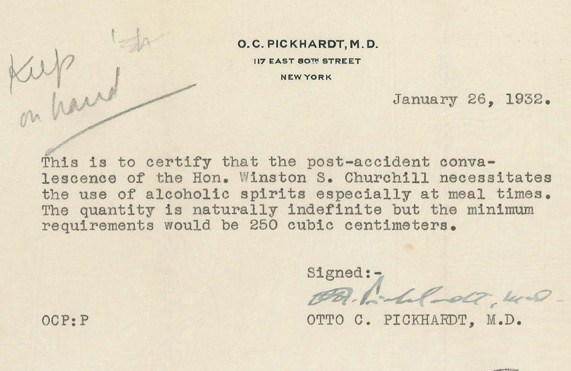
According to this /r/TodayILearned post, Churchill's GP wrote him this prescription for alcohol during his visit to America in 1932.
Was this a legitimate way to get around the ban? Did the average person also attempt to do this?
2 Answers 2016-07-15
I was watching The West Wing the other day, and in Season 6, Episode 14 ("The Wake Up Call"), Toby states that only 4 Presidential Democracies have lasted longer than 30 years.
Obviously the US is one of them, but what are the other three that he's referring to?
What made them (and the US) different?
Why did others fail? And after how long? Which ones were they?
1 Answers 2016-07-15
Nowadays we usually name them by one of their names such as Justianian, Augustus or Honorius. But most of the time they had multiple names so what did the Romans themselves call their Emperor?
1 Answers 2016-07-15
Like would an adventurous peasant from the Middle Ages been able to pack up and move across Europe. Was there even much desire to move about back then?
1 Answers 2016-07-15
[deleted]
1 Answers 2016-07-15
Today:
You know the drill: this is the thread for all your history-related outpourings that are not necessarily questions. Minor questions that you feel don't need or merit their own threads are welcome too. Discovered a great new book, documentary, article or blog? Has your Ph.D. application been successful? Have you made an archaeological discovery in your back yard? Did you find an anecdote about the Doge of Venice telling a joke to Michel Foucault? Tell us all about it.
As usual, moderation in this thread will be relatively non-existent -- jokes, anecdotes and light-hearted banter are welcome.
7 Answers 2016-07-15
It has crossed my mind a few times now, and i thought to seek the knowledge of an historian. Also i thought it to be an interesting discussion.
For one, i find it quiet odd. Since it was used to quite an degree in the Pacific theater, judging by the success it had on a lot of the beach landings on island's. I don't see why they didn't use them during the D-day, seeing how they could also be equip with a 37mm and 75mm gun.
1 Answers 2016-07-15
1 Answers 2016-07-15
I am curious to learn more about the history of the modern concept of an address, i.e. "1 Smith Lane." Looking around on google and wikipedia has not proven very helpful. I am wondering where the idea started that "we are going to name this stretch of road or area, and assign numbers to the specific parcels on this road or area." I am also curious to know if the concept developed in multiple places at once, or if it started somewhere and was spread from there. Similarly, in places that don't have modern forms of addresses, how do they generally give directions and mark locations, as well as designate ownership of real estate?
1 Answers 2016-07-15