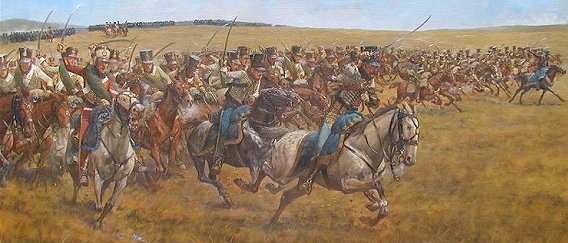
During the 16th and 17th century armored lancers were largely replaced by pistol or harquebus armed cavalry who would deliver a volley at close range while charging and then either wheel away or follow through with their swords. During the napoleonic wars and later, aside from mounted infantry like dragoons, cavalry seem to be generally depicted as charging forward with sword-point only. example
When and why did the close range volley stop being used while charging?
1 Answers 2016-05-20
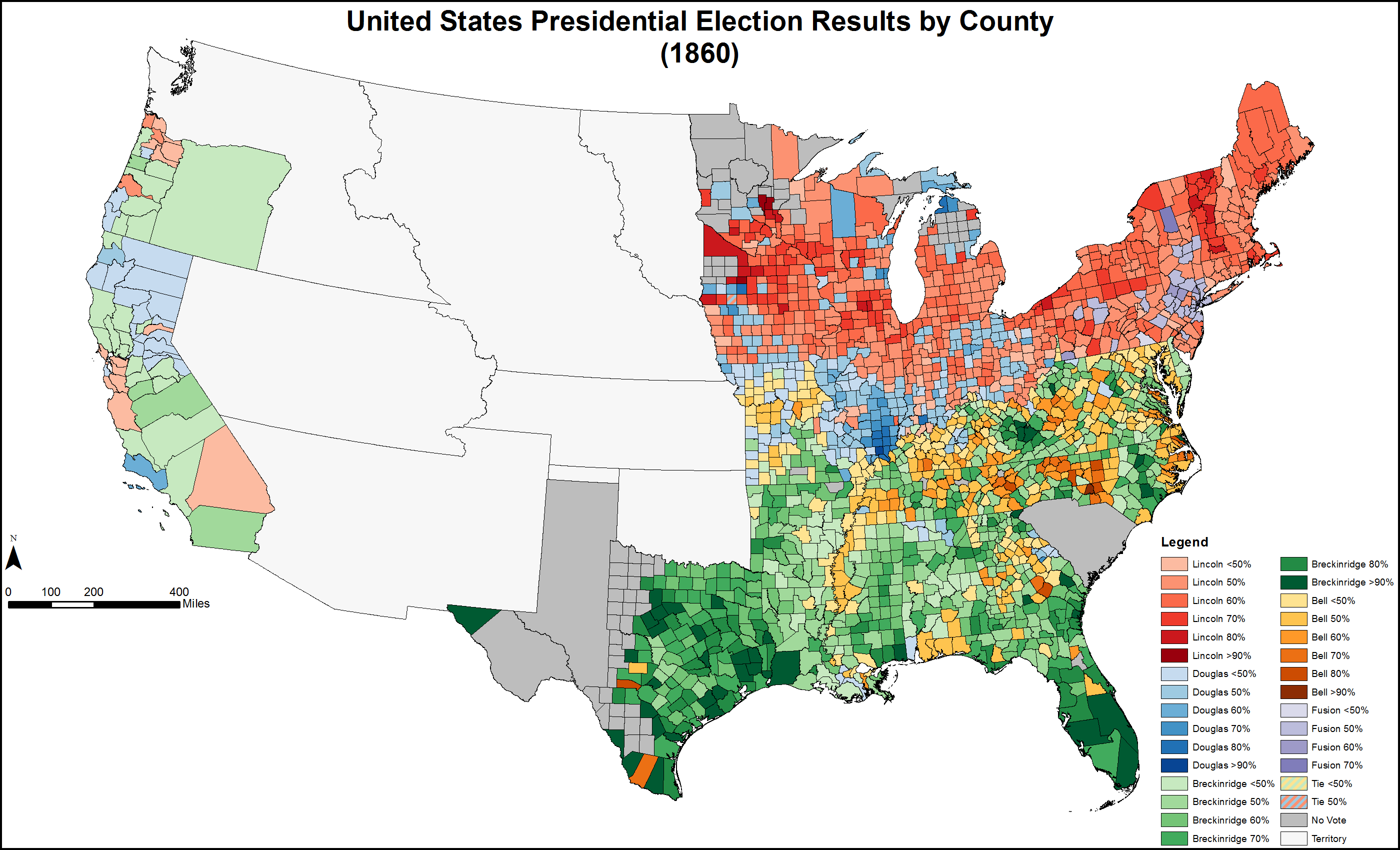
I was looking over this map of the 1860 presidential election, and I was surprised by how many counties voted for Breckinridge out on the west coast. I then looked at the actual returns, and I was surprised to find that Breckinridge only had a few thousand fewer votes than Lincoln and Douglas respectively. I had always thought that support to Breckinridge was confined to the deep south and some border states, so why did such a high percentage vote for him in California and Oregon?
1 Answers 2016-05-20
Today:
You know the drill: this is the thread for all your history-related outpourings that are not necessarily questions. Minor questions that you feel don't need or merit their own threads are welcome too. Discovered a great new book, documentary, article or blog? Has your Ph.D. application been successful? Have you made an archaeological discovery in your back yard? Did you find an anecdote about the Doge of Venice telling a joke to Michel Foucault? Tell us all about it.
As usual, moderation in this thread will be relatively non-existent -- jokes, anecdotes and light-hearted banter are welcome.
18 Answers 2016-05-20
We hear stories about allied soldiers taking Lugers off German soldiers and Samurai swords and flags off Japanese soldiers. Was there anything the allied soldiers had on them that the soldiers of the Axis would take?
3 Answers 2016-05-20
Sebastian Junger makes the claim that currently reported PTSD in veterans is related more to the return to a cold and selfish society from a life in which one is highly interdependent and feels an indispensable part of their in-group.
This claim is predicated on the fact that psychological trauma is not the cause of PTSD. To back up his thesis he claims that violence of the sort that we would associate with psychological trauma did not cause anything resembling PTSD in hunter gatherer societies. I was wondering if this claim has actually been evaluated historically or if it is more of a romanticized interpretation.
1 Answers 2016-05-20
Who was runner-up?
3 Answers 2016-05-20
1 Answers 2016-05-20
By logic, Turkey should be home to the most prominent Byzantine scholars but I cannot think of any Turkish Byzantine expert who is taken as an authority in the field. In fact, even the historiography of the Sultanate of Rum is highly underdeveloped in Turkey. What are the reasons for this neglected state of Byzantine studies in Turkey?
2 Answers 2016-05-20
I understand they are weapons that can scar people for life. but shrapnel to the spine can do the same (or worse). as i understand it the media coverage in the time was limited to say the least so you didn't have the movements the governments had to please during the Vietnam war. also flamethrowers and napalm where never banned although the effects are comparable to that of the gasses used in WW1. I looked around a bit on the web but couldn't get farther than ''Gasses are bad so they where banned'' understandable but you might as well ban war if thats your thought process. also tear gas is legal.. where do we draw the line?
2 Answers 2016-05-20
We know that he was the architect of the Holocaust but when Eichmann showed up each day during the height of the Holocaust, what was his day like? What were his phone calls and meetings like? What was a day in the life of Adolf Eichmann?
1 Answers 2016-05-20
1 Answers 2016-05-20
2 Answers 2016-05-20
I've been watching Band of Brothers and I'm interested in learning more about what kind of training these and other US soldiers were put through to prepare them for war. I'm planning on reading the Band of Brothers book, which I'm sure will have some more information, but I'd also like to hear from others on this sub. What kind of physical training they were put through, classroom lessons, what their day-to-day schedules were like, what books or papers they were assigned to read, food available in the training camps, tactics they were taught, how they were tested etc. I'm keen for any information, and also if there are particularly interesting things about other nations' military training programs during WWII, I'd be interested to hear about that as well.
1 Answers 2016-05-20
This is Wikipedia's summary of casualties in the Napoleonic Wars:
http://i.imgur.com/9tZdq7e.png
So there were 11 + 7 = 18 million soldiers, and 2 + 2 = 4 million casualties, both military and civilian. That's a lot of deaths, of course, but it's proportional to the huge scale of the fighting.
But this is the summary of the Thirty Years' War:
http://i.imgur.com/aP8kGZN.png
There were 149 + 135 + 77 + 6 + 60 + 20 = ~450 thousand soldiers, 2.5% as many, but there were twice as many casualties! Since the number of casualties is so much greater than the number of soldiers, I assume the large majority were civilians. Are Wikipedia's numbers accurate here, at least approximately? If so, what made the Thirty Years' War so much bloodier than later conflicts, up until World War I?
1 Answers 2016-05-20
Was it like New York with Burrough councils and representatives?
1 Answers 2016-05-20
Were there ever any wars in Mexico or Canada, or other parts of the world, that happened to take place on land or territories of the United States? Wars or skirmishes that the US wasn't officially apart of?
1 Answers 2016-05-20
I was browsing through Wikipedia and exploring the history of political turmoil in France and I noticed that on occasion, notably the July Monarchy (1830-1848) the monarch styled themselves as "King of the French" rather than "King of France". This title seems to be associated with liberals in this period and a less controlling monarch. What is the significance of this seemingly semantic change in title?
1 Answers 2016-05-20
1 Answers 2016-05-20
Apparently each sailor was given a pint of rum each day. Since the rum was 95.5 proof, each sailor was given the alcoholic equivalent of 12.7 shots of Bacardi Superior. Did they drink it mostly within a certain period of the day, or was it spread out over three meals? Wouldn't this mean they were essentially constantly buzzed?
Side note, before the rum ration, they were given a gallon of beer. What alcohol percentage was the beer generally?
1 Answers 2016-05-20
I’m asking specifically about the period from the mid-1960s to the mid-1980s, as there are quite a few posts on this sub about the early years of the Soviet Union, as well as about its collapse.
For what it is worth, my source for USSR having to buy food abroad is Collapse of an Empire: Lessons for Modern Russia, by Yegor Gaidar.
Thanks in advance to everyone who comments on this post.
1 Answers 2016-05-20
Furthermore, why is the outrage of the Confederate flag, or rather the Robert E. Lee Battle Flag suddenly hate flag? I know the Klan kinda ruined that one but I don't get why it came to a head now.
1 Answers 2016-05-20
How many times the normal daily requirement did soldiers need while fighting in the jungle heat?
1 Answers 2016-05-20
I was watching CNN's documentary series about the 1970's, and being about the 70's, Nixon is, of course, heavily featured. It got me reading about his years after his resignation. He started working heavily on a "come back" in 1974, and worked tirelessly on rebuilding his political ties and public image. He met with world leaders , wrote memoirs and gave interviews. He became a best selling author, and his interviews became some of the most watched program in television history at the time. He supported Ronald Regan, and appeared in campaign adverts. From what I can tell, by the time he was meeting with Bill Clinton in the oval office in 1993, he was regarded as a respected elder statesman, with a great political mind and an excellent memory.
Nowadays, however, any portrayal of him in movies or television has him as this bumbling , sweaty, cowardly imbecile. He may have committed huge mistakes during his time in office, but he was never considered stupid, and he may have been paranoid during the investigation , but he always had a pretty domineering personality. He was clearly respected when he died, and his service was attended by 42,000 people , including Clinton and former presidents Ford, Carter, Reagan, and Bush. I'm just wondering how a man that had spent the last decade of his life redeeming himself could have such a negative public opinion today.
2 Answers 2016-05-20
Since the idea that, generally, vegetables are good for people predates modern science, I found myself wondering when and how that idea came to be.
Was it lucky guess, that just gained momentum and has been supported by today's science? Or was there early, simple evidence?
2 Answers 2016-05-20