Hey everyone, this is for a research paper and I'm struggling a little bit. My assigned topic is the Russo-Japanese War, and the argument I'm making is why this war can be considered the first modern war, as was suggested by my teacher. So far I was thinking that a couple reasons could be that (1) there were a lot of new advancements in technology, (2) it had a worldwide impact that changed how the world viewed the East, and (3) it was the first widely spectated and documented war. If I could get some assistance, maybe with revising my points and / or leading me in the right direction that would be extremely helpful, thank you! :)
1 Answers 2016-05-20
I'm looking for a book or series of books basically explaining historical events from the 1400s to present day.
If this isn't the correct sub for this post could you suggest one?
2 Answers 2016-05-20
Were the Japanese people distrustful towards Europeans? Were they racists? Just looking for more insight, thanks! :)
1 Answers 2016-05-20
I'm a fan of the metal band Sabaton, whose songs are almost exclusively about events from World War 2. The band does a lot of research and makes their lyrics as accurate as possible, so you can actually learn some from their work.
My favourite song by them is "Resist and Bite", (click link to listen) which is about the Chasseurs Ardennais infantry unit during the Battle of Belgium. The song suggests that they were outnumbered and surrounded with no reinforcements or supplies, yet never gave up their fight.
From what I've heard, people say they were basically "forgotten" in the fog of war by Belgian command and instead of retreating they held their ground and fought as long as they could; however, I cannot find any information to substantiate this claim.
I tried looking it up, but all I could find was information on the unit itself, not about what happened to them in that specific battle that inspired this song.
Can anyone who's knowledgeable about the European Theater listen to the song and see if you might know the story behind it? I'm really curious about this. Whatever actually happened, they sound like they were fierce as hell!
1 Answers 2016-05-20
I just don't see a scenario where a fencer could beat somebody with a sword in played armor.
1 Answers 2016-05-20
One of the salient points made by Jared Diamond in his (sometimes reviled) Guns, Germs, and Steel is that humans living in close proximity to livestock will develop, over generations, better immunity to the diseases this practice encourages. In contrast, when more nomadic and less agriculturally inclined populations are subsequently exposed to those same diseases they have catastrophically low immunity.
This got me thinking. If the two lifestyles create such different levels of immunity, it suggests that transitioning from hunter-gatherers to more advanced societies must have radically changed the landscape of human disease.
What did early humans deal with in terms of diseases? Did they have fewer diseases to contend with, perhaps as a result of a much lower population density? How long has malaria been around for in humans, for example? Did disease go up dramatically as a cause of death when societies started to domesticate? Did the number of human diseases continue to rise until the advent of medicine, or was there an initial spike at domestication and then plateauing, or even a decrease in number as the more successful diseases adapted and thrived?
I realise this is a very broad question, and I don't ask for too much detail, but I can't help but feel that it's a hugely important topic that I know almost nothing about. Any info people can provide would be greatly appreciated.
3 Answers 2016-05-20
1 Answers 2016-05-20
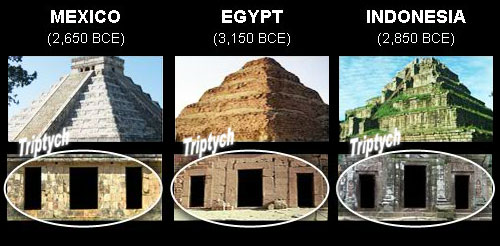
Occasionally I will see a picture floating around the internet that shows the Mayan, Egyptian, and Indonesian Pyramids, each with the same 3 doors. Are these pictures accurate, do they really each have these similarities? Or is this fake?
1 Answers 2016-05-20
I've often wondered why a few languages in the world developed "silent letters" instead of simply writing the word without the letter. For example, pterodactyl... but the p is silent. why not spell it terodactyl. knife... but the k is silent.. why not spell it nife? hola... but the h is silent. why not spell it ola? There are many, many cases of words like this in English and Spanish. Perhaps other languages too.
So it begs the universal question. Why? Why "silent letters" were ever created? What are the rules for their use when creating words? Why use them at all? Are there any languages that don't use "silent letters?" Has there ever been a historical attempt to rid the language of these words?
Of course you have words like debt, witch, numb, castle... which have "silent letters" within the word itself. why not spelled det, wich, num, or casle? But my primary focus is really on the silent letter at the beginning of a word.
(as an amusing sidenote, you'd be surprised how many times auto-correct changed the words in this message forcing to type over and over again...)
3 Answers 2016-05-20
1 Answers 2016-05-20
Maybe a better question would be, what need was not being met by the religions already being practiced?
2 Answers 2016-05-20
Did they think of 'the 70s' in their particular century like we do?
1 Answers 2016-05-20
Diocletian is famous for growing cabbages in his palace in Split in old age among other things, but were there any other emperors who voluntarily retired?
I seem to remember that his fellow Augustus Maximian also retired but stubbornly came out of retirement after some time, but we never hear about his palace or what kind of gardening he liked to do.
So were there others who willingly gave up the purple and retired? For the sake of this question let's also include Byzatine emperors.
1 Answers 2016-05-20
To me the idea of Empire is about diversity- but how did empires actually deal with diversity? I'm particularly interested in the Islamic Empires (Ottomans, Safavids, Mughals), China, and European maritime empires in the same area (the Portuguese, Dutch and British, for example). Any ideas of references or information would be great, or a sense of how somewhere changed it's policies over time? Or about anywhere else really... my knowledge of global history is sorely lacking.
1 Answers 2016-05-20
I recently found an old cookbook in my grandmothers collection. It's from the 1930's, and most recipes amount to "get a turtle, cut the head off, put it in boiling water for about an hour, add salt". Or "take three chickens, take out their livers for later, boil them in a pot and add tomatoes when they are close to done". It's not the kind of recipe you'd find on the food network.
When and why did our method of cooking change?
1 Answers 2016-05-20
It seems like they had positive effects on the hosting cities so why did they just stop happening?
3 Answers 2016-05-20
1 Answers 2016-05-20
1 Answers 2016-05-20
1 Answers 2016-05-20
I was listening to a BBC history podcast about the Popish Plot in 1678 and it was mentioned offhand that only 1% of the English population would have been practicing Catholics. This seems like a really big shift considering the Church of England had only been around for 150 years. Was this conversion top down,were people converting out of their own convictions and decisions or something entirely different?
1 Answers 2016-05-20
Interested in knowing if we have any historical evidence of German people protesting or attempting to stop Hitler's rise to power and what became of them after he took complete control?
1 Answers 2016-05-20
Also, how legitimate are the claims that Tesla would have/was close to devising a mechanism that would have supplied electricity for free?
This question might potentially upset a lot of people since the Internet just adores Mr. Tesla! However, I just want to know more about this topic as it has been on my mind since long. So, apologies in advance. :)
2 Answers 2016-05-20
I keep learning little things about how Iran is not like the rest of the Middle East, or is not really a part of it. My previous assumption that it was just grouped in there and was similar to many of the other Middle Eastern countries. Things such as 'wrestling and weightlifting are big in Iran, but not so much in the rest of the Middle East'. And my sister told me how Iranians aren't as dark skinned as the rest of the people in ME countries. And then she went on to say that its not even technically part of the ME. It seems like there's a decent amount of differences and things that set it apart from the ME. Does anyone know why? Or does anyone mind just telling me about more differences in general? I'm fascinated.
3 Answers 2016-05-20