I was researching the French Revolution and read about how the violent liberalism growing within France at the time scared many conservative neighboring powers. We can see that many Europeans responded negatively towards the matter (e.g the Declaration of Pillnitz), and that got me wondering how the United States felt about the whole situation being both a republic and an ally of France. Did the U.S actively support the formation of a French Republic? If so, were Americans pro-Jacobin or pro-Girondist?
1 Answers 2016-05-06
2 Answers 2016-05-06
I often see people reference the peace at westphalia as the birth of the nation state due to all the leaders redrawing the borders of europe. But im a little confused as to what that means excactly. Did nation states not exist prior to that. Like did the french people not view themselves as one people in a country or was the peace just the first instance of recognition of the nation state?
2 Answers 2016-05-06
At the moment I can only think of porridge and bread, but recently I learned that bread was never that popular until recent times. So what did Western Europeans eat for staple food before 1492?
1 Answers 2016-05-06
From what I have gathered, the Habsburgs were in a pretty bad situation after the Franco-Austrian war and the Austro-Prussian war and many historians stated that 'Hungary could have easily achieved independence'. In addition, from the compromise, Hungary took on an enormous amount of Austria's debt. I am studying this current time period for my extension history major work and coming across this has me some what stumped. Is there something I am missing about the Hungarians? Did the Austrians have something they needed extremely badly? Any help would be extremely grateful!!
1 Answers 2016-05-06
I spent a lot of time near the Mississippi river and just wondered if native Americans used the river as a source of drinking water? Its quite polluted now, but it seems like it would have been muddy back then too. Any thoughts?
1 Answers 2016-05-06
3 Answers 2016-05-06
1 Answers 2016-05-06
1 Answers 2016-05-06
That is to say, the American colonies used the cry of "No taxation without representation" merely as an excuse for independence, rather than being particularly interested in said representation. Is this true? I have to say, I've always been a bit skeptical of the Revolution, so I'm probably biased.
2 Answers 2016-05-06
The Soviet Union had been around for a decent amount of time, 23 years at the time of the end of WW2 (1922-45). 21 years of which had been under Stalin's rule. So in a sense the bad times outweighed the good, no? Im sure Lenin really couldn't influence much in the time he had been Leader of the USSR, with his illnesses toward the end, etc. Anyway, for 21 years there were purges, famines, forced labor, the gulags, etc. Then, the Nazis come and Hitler catches Stalin off guard. Proving his ineffectiveness as a leader essentially. It was only until Hitler's military mistakes was there an opening for Stalin to "do the right thing" basically. Which he interpreted as throwing everything they had, including unarmed men, at German fire. Then to top it off, if you tried to retreat or go back to gain cover with no weapon in hand, they killed you or threatened to do so. So up until February of 43, the surrender of the German 6th army, millions have died. Civilians included. The soldiers knew this, etc. After the victory over Nazi Germany in Berlin, why did the people of Russia not try to change leadership or political association? Communism failed them in peacetime and in wartime.
2 Answers 2016-05-06
Today is Holocaust Remembrance Day in Israel and many countries around the world. It's a somber holiday (not to be confused with the UN's Holocaust Memorial Day which has passed) that is noted in many Jewish communities around the world.
In light of the day, I thought I would ask users to post stories that have personally impacted them, stuck with them, or otherwise are important to them that relate to Holocaust history. I think it would be great for users to spend at least a minute thinking about this today, reading stories, and seeing accounts of the Holocaust.
My question was inspired by this story, whose authenticity I don't know about, though I found it touching. One authentic story that has always stuck with me was the story of Sir Nicholas Winton, who helped organize the Kindertransport and saved over 660 Jews from the Holocaust. The video of him being honored by them has made me cry many, many times.
One other image has always impacted me that stands out at the moment. It was this image, which shows a "Jewish Brigade" soldier fighting on the side of the British in WWII. He is carrying a rocket (?) that has on it, in Hebrew, "Hitler's Gift". It really contrasts with the usual pictures of Holocaust victims, showing how Jews were more than victims; they were fighters too, trying to stop Hitler.
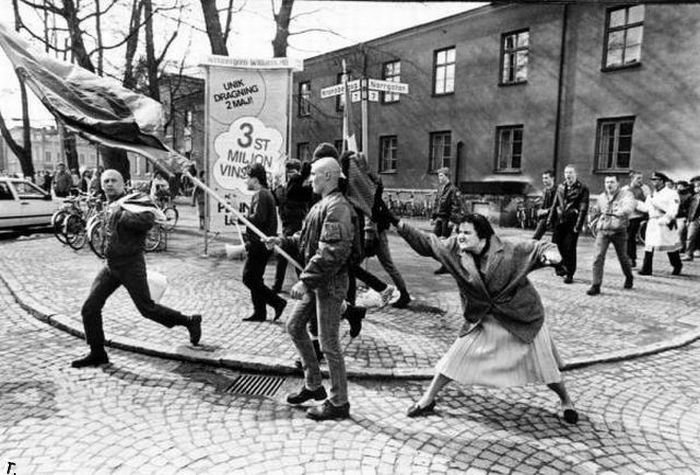
One more, neo-Nazis who a Holocaust survivor took a swing at. Following her rushing in to attack them, a mob formed that swarmed the neo-Nazis, who had to lock themselves inside bathrooms and be extracted by police.
What about you? Pictures, stories, what has stuck with you?
I’ve submitted this with mod-preapproval, and they ask me to remind everyone that as is the case with previous Floating Features, there is relaxed moderation here to allow far more scope for speculation and general chat than there would be in a usual thread! But with that in mind, we of course expect that anyone who wishes to contribute will do so politely and in good faith.
4 Answers 2016-05-06
Further questions: Did this lead to command issues? I would imagine coordination between Luftwaffe and Heer troops would make things needlessly complicated. What were the qualities of Luftwaffe field troops compared to those of the Heer?
1 Answers 2016-05-06
Were any tribes formally involved in combat? If they weren't, did any Native American leaders express opinions regarding the war?
Also as a related question, I don't think I've ever heard anything about Lincoln's opinion of the Native Americans. What do we know of his public and private opinions? Did he ever order any relocations or massacres of the Native Americans?
Edit: The title should obviously say "Native" not "Natice". My apologies for the misspelling.
1 Answers 2016-05-05
My friend and I had a discussion today on this very topic and what he had purposed went against my understanding, so I turned to Reddit for help.
He told me that he had learned from his professor of history that the emancipation did not technically free the slaves. This is due to the document stating that only slaves in the union where free and if your state cut ties with the US, you are out of luck. He went on further to say that this document was more political to move the war to be more about slavery in an attempt to end European interest in helping the south. This is due to slavery being dead and gone in that part of the world.
This goes against my understanding which is the following. The emancipation was more of a military strategy to gain more troops for the union. And Europe never had any interest in aiding the south.
I hope someone can help clear up this confusion!
Thanks!
3 Answers 2016-05-05
Hi!
So far, the only words I know that kinda applies are very specific: would be a Halbderdier, Scytheman, Pikeman and Spearman, but no real general word that would apply to them all.
And even if we do use the specific terms, what do you call someone who uses a Billhook? A Guisarme? a Glaive? A Fauchard? A Voulge? Or were there no specific words ever used?
Let's say even we go by Victorian historians (with their fetish for categorizing and naming everything, despite sometimes getting things wrong), was there ever such a word? Poleman?
Thanks!
1 Answers 2016-05-05
I ask because many seem to claim that having a path to human salvation of some kind, defined pretty broadly, is something that pretty much all major religions in the world today have, whether it is Buddhist enlightenment or Heaven in Christianity. However, did Roman and Greek paganism have any sort of widespread doctrine or belief about salvation after this life?
1 Answers 2016-05-05
I'm thinking of specifically the world wars and whether or not it was because other world powers depended on them.
2 Answers 2016-05-05
"Every seven seconds a german soldier dies in Russia. Stalingrad is a mass grave." I the one O've heard of, but I can't find a source. I've also heard they would play music, or messages telling troops to surrender.
Know anything about this? Any sources on stalingrad in general, I'd love to read more about it, fascinating situation to me.
1 Answers 2016-05-05
1 Answers 2016-05-05
3 Answers 2016-05-05
Did Xerxes not have the majority of the advantages? How was he not able to defeat the Greeks?
1 Answers 2016-05-05
Why was China so devastated by colonization whereas Japan was never colonized (or at least to the extent China was)?
2 Answers 2016-05-05
Hi, I was wondering if there were any historical factors that explain why the west has become more secular/ less religiously affiliated compared to places like the Middle East. Has it got something to do with the religions themselves, or have certain historical events played a part.
Sorry if this question is too vague, if it is, message me and I'll try to rephrase it.
2 Answers 2016-05-05