I find contradiciting answers when I search for it online.
1 Answers 2016-05-03
I'm researching the Yom Kippur/6th of October war and am stuck in a couple of points, logically.
It is more or less certain that Sadat's initial goal was nothing more than to pierce the Barlev line to regain some of the Egyptian "honor" lost during the Six-Day-War.
Now, I've read time and time again that he refused the offer for a ceasefire early on, even directly after Barlev, before the subtle nuclear threats by Israel (Example). Why would he do that? I don't understand the logic behind it. Was it because of the momentum he'd gained?
1 Answers 2016-05-03
[deleted]
1 Answers 2016-05-03
2 Answers 2016-05-03
I'm assuming there were many reasons, but why did they convene to do that, had it been done before, or has it happened since?
1 Answers 2016-05-03
How was this possible? Its not like the Indian regions was in the New World or some thing, they have been critical players in the world since the medieval era. Their lands has always been known for their rich trade resources like spice. What happened? Why was the English empire so much stronger that they were able to Colonize them? Was this a testament to the strength of the empire or was the Regions weak at the time?
1 Answers 2016-05-03
2 Answers 2016-05-03
I know the language isn't the same, but was the Catalan demographic dominant before the union with Castille?
1 Answers 2016-05-03
I'm talking way back. What was the solution to this? Was it even practiced?
3 Answers 2016-05-03
I don't really know a lot about power would transition from a conquered ruler to the conqueror, but assuming that the king of the conquered nation survived the war, what would be done with him? Would he be put to the sword as a general course? Be allowed to live out his life in exhile? Considering how closely related certain rulers tended to be, both in terms of blood, and their status amongst the commoners, would he be allowed to retain some measure of power under the new king?
2 Answers 2016-05-03
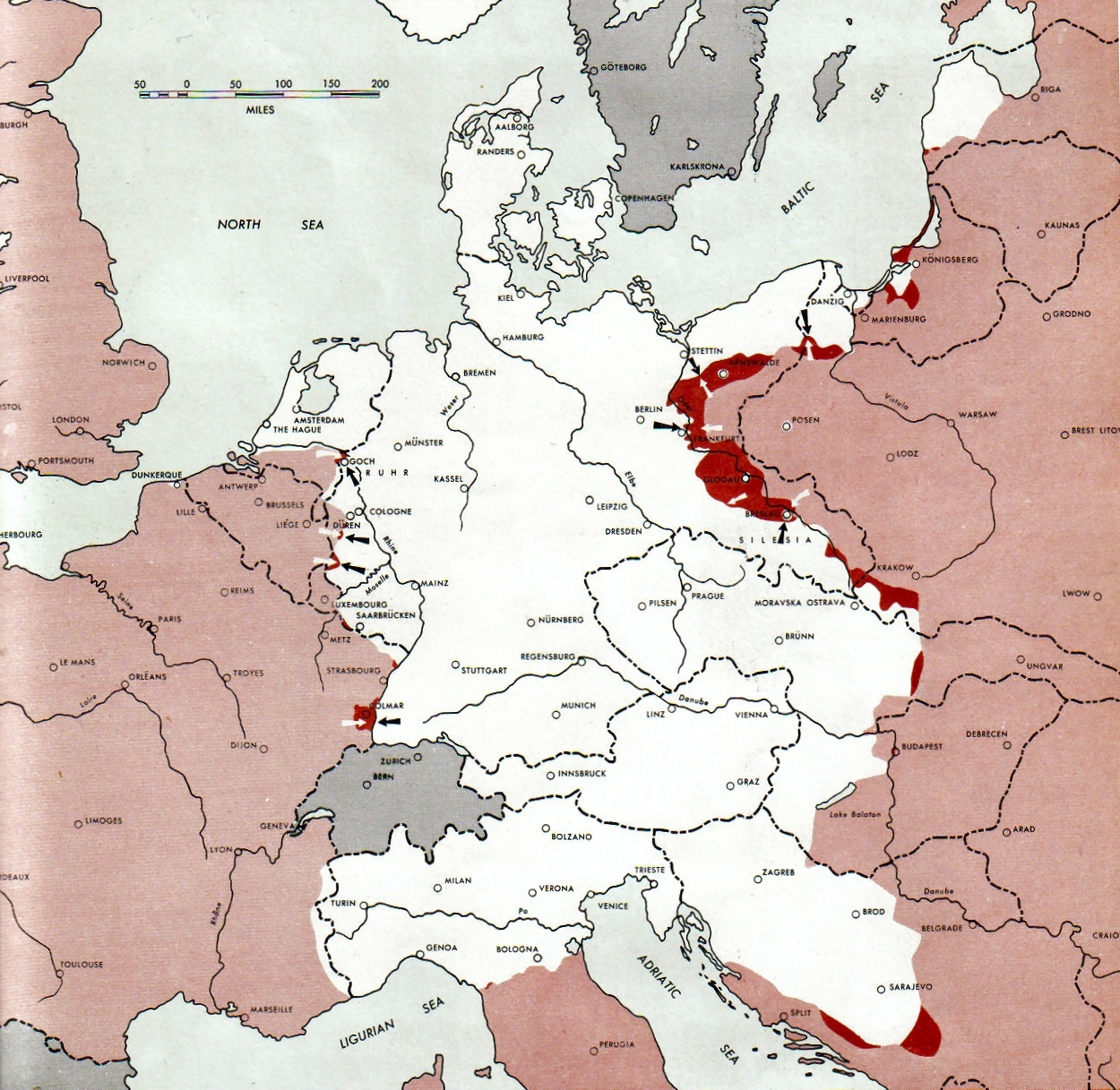
I was reading about the bombing of Dresden on wikipedia and found this map of the situation in February. It looks like the Soviets are about to take Berlin! How come they moved so slowly towards Berlin at this point while they and the western allies moved so quickly in other areas?
1 Answers 2016-05-03
Given that the treaty is mentioned as a pretext for the roots of the second world war, would something less onerous caused less angst with the German government(s) that followed WWI? How could the major combatants on the Allied side craft a treaty to create a lasting peace between France and Germany?
1 Answers 2016-05-03
Greetings. This is a topic that has greatly interested me as I've continued to research western colonialism in Africa. I understand the events, motives, and actions, but for the life of me, I can't seem to wrap my head around why Germany goes to great lengths in avoiding the term 'genocide'.
Could anyone give me a hand? I've heard of some states using the defense that it's actions were committed pre-Geneva, so it wasn't considered Genocide then, but this doesn't apply to Germany. So what's the defense for them?
1 Answers 2016-05-03
Lycurgus and Solon are often discussed as being heavily influential in inspiring the individuals who formed what are now modern democracies. How was Lycurgus and Spartan law instrumental in informing someone like Alexander Hamilton for example?
2 Answers 2016-05-03
The votes are in, and the winners for the 'Best of April' award are decided.
Taking the "User's Choice" Award is /u/shlin28 for the answer to "What happened to the city of Rome after the fall of the Roman Empire?"
The "Flair's Choice" Award goes to /u/agentdcf for the Theory Thursday post on how he "see[s] environmental history as a way to think about periodization and especially to date modernity".
As always, a bit congratulations to the winners, and a big thanks to everyone who contributed to the subreddit in the past month!
For a list of past winners, check out this Wiki page!
3 Answers 2016-05-03
Touchy question, I know. I guess I'm looking for a reason why they remained so tribal and never advanced beyond spears/slings or in other technological areas like architecture or education.
As I see it, after ancient times Africa was mostly left alone as the middle east, southeast Asia, China, Japan, and Europe developed some amazing technology. All the places had plenty of people and resources, Africa being rich in many valuable resources to iron and bronze age peoples. They all also had warfare as a driving force for advancing technology. Why did they not develop advanced skills or trades to produce high quality weaponry? Why didn't they develop better building materials, why didn't they learn to exploit valuable resources?
What reasons are accepted by historians for the low technological state that Europeans found among the African tribes at the beginning of the Scramble for Africa (early 19th century).
Note: I realize Egypt and parts of northern Africa were technologically advanced from an early part as parts of the Greek and Roman empires. I'm more referring to sub-Saharan Africa.
2 Answers 2016-05-03
Simple question above. My confusions described in painful detail as well as some follow up questions below.
I read on Wikipedia that: *By the end of 17th century in Great Britain, the "colonel of a regiment" was often a titled person who had been given Royal Assent to raise it for service and command it in battle. As such, he was required to cover all costs of the regiment's equipment, uniforms and wages as well select its officers. Until the late 18th century most British regiments were commonly known by the name of the colonelcy, for example Lord Churchill's Dragoons (1683–1685) or Elliot's Light Horse (1759–66).*^1 *On 1 July 1751 a royal warrant was issued declaring that in future regiments were no longer to be known by their colonel's name, but by the "Number or Rank of the Regiment".*^2 *By the start of the American Revolutionary War most English and Welsh regiments in the standing army of Great Britain were named numerically, although some independent Highland regiments — such as MacLeod's Highlanders — were raised in the name of their colonel for service in West Africa and India.*^1
All is fine, until the paragraph continues with: *The change from a colonelcy based on patronage was because the British Army's administration had been reformed into three administrative bodies.*^1 I don't see what that has to do the naming convention (bad writing on the article's side confuses me), but I understand that at a certain point the patronage system was reformed. What did the changing of the naming convention for regiments have to do with patronage colonelcy?
*The reforms meant that the British government was now financially responsible for the pay, clothing and equipment of the troops in the service of the British Crown. Colonels were also no longer permitted to profit directly from the sale of officer commissions in their regiments. A lieutenant-colonel commanded the regiment in battle. By the beginning of the Napoleonic Wars, the title "colonel of the regiment" had become a sinecure appointment for distinguished generals and members of the royal family or British nobility.*^1 So did the change take place before the Napoleonic wars?
*From 1798 onward, structural, training and logistical reforms implemented or authorized by the Duke of York.*^4 Was this the reform that got rid of colonelcy by patronage?
In another page I found: *The system of Sale of commissions determined the selection and promotion of officers in the infantry and cavalry. Once officers gained their first commissions through a combination of recommendation and purchase, subsequent promotion was nominally determined by seniority, with officers purchasing their successive ranks.*^3 So was the sale of commissions a different practice from the colonelcy by patronage, and was still done until the Cardwell and Childers Reforms?
*By the end of the 19th century, the reorganisation of the British Army through the Cardwell and Childers Reforms had established a colonel as a professional rank with senior administrative responsibilities in regiment or brigade.*^1 OK, so something else changed during these reforms. Between them and the one I presume took place before the Napoleonic Wars, Colonel was not a military rank?
^1 [Colonel (United Kingdom)](https://en.wikipedia.org/wiki/Colonel_(United_Kingdom))
^2 [30th (Cambridgeshire) Regiment of Foot](https://en.wikipedia.org/wiki/30th_(Cambridgeshire)_Regiment_of_Foot)
^3 British Army during the Victorian Era
^4 Recruitment in the British Army
1 Answers 2016-05-03
2 Answers 2016-05-03
I'm particularly interested in England and Ireland if possible. Thanks!
2 Answers 2016-05-03
What was the usual routine for your typical Roman soldier ? What sort of training was encouraged within the ranks to make the Roman solider ready for combat and hardship ?
Also i am curious as to the particular diet of a Roman solider, were they particularly well fed ?
Any answers will be appreciated as it will help me with some research i need to do !
1 Answers 2016-05-03
Hello all,
Reading the Wikipedia page of the Comte Bernadotte, I ran into the mention of a peace agreement offered by Himmler to the Allies suggesting that Germany would surrender fully to the West but would be allowed to keep fighting the Soviet Union, hopefully with help from the Western Allies.
This is something I had never heard of before, so I was wondering if any historian could provide some info or some context about this!
On a follow-up question on the same topic, I was wondering if the German high command perceived the coming hostilities between Eastern and Western allies, and if they thought it could be a leverage to potential negotiations ?
Thanks a lot for your time!
1 Answers 2016-05-03
1 Answers 2016-05-03
I've recently developed an interest in early British history and there's one question that's recently struck me.
Correct me if I'm wrong but the last roman legions were ordered to leave Britain in the early fifth century to defend the empire elsewhere and by the end of the century the first Anglo-Saxon kingdoms were forming in England.
My question is what was the political state of Britain in the time after Roman rule but between the Anglo-Saxon era? What factions/ people were in power? Was there organised resistance against the invaders? etc.
4 Answers 2016-05-03
I understand his post-conversion contributions to the church according to the NT. But what I'm wondering specifically is how he went from persecuting Christians to being one of their greatest champions. If he was indeed persecuting Christians, he would need to build a huge amount of trust after the conversion. How did the early Christians trust him post-conversion, especially if he really was persecuting them? Was the persecution not as bad as it sounds? Was he a really good "politician?" According to Acts, he was a strong preacher and had other apostles and disciples such as Ananias vouch for him. Was this all he needed to dissipate mistrust?
Do we have any outside of the Bible sources that can get us close to what actually happened regarding Paul's acceptance in the early church (in the context of his persecution and conversion and assuming the historical figure is close to who we read about in Acts, etc.)?
3 Answers 2016-05-03