I've been watching great war videos recently and got to the topic about trench warfare. I'm currently wondering if ancient people did something like trench warfare? What are great examples of trench warfare pre-greatwar?
1 Answers 2016-04-27
I know there were exceptions in both time periods. Basically I'm wondering when Mediterranean polities decided on being less cruel in their warfare, being able to adapt to the people they conquered instead of always destroying them.
4 Answers 2016-04-27
I'm a little skeptical of the claim myself, hence the question. The main thing that bothers me about it being that I can't really see how the Germans could send letters to the USA while at war with them, considering these are physical things that would need to be transported on a boat or plane.
1 Answers 2016-04-27
I did some research about the reasons for why the Japanese invaded the Philippines. A big reason for Japan's occupation was that it was an ideal base in the south. Why was the Philippines an ideal place to occupy?
1 Answers 2016-04-27
Was Dante more concerned with the ancients in Inferno or more interested in the contemporary history of Europe in the 13th century?
1 Answers 2016-04-27
I was watching West Wing today, and saw the episode where the President invoked the 25th amendment and recused himself from his duties pending his kidnapped daughter being found and returned safely. John Goodman played the Speaker of the House, who was made acting president while the president vacated his office to the residence.
GW Bush twice recused the presidency to Dick Cheney for a colonoscopy, and Reagan did once for colon surgery. I am curious if someone who served as acting president for a period of time qualifies as a former president?
Do we call them "President" in address after they return to normal duty?
Are they entitled to lifetime benefits under the Former Presidents Act?
Are they entitled to secret service protection for life?
At which point are they entitled to these benefits? Ever? After a number of days?
1 Answers 2016-04-27
Shouldn't the total revised count be around 3 million Jews now?
EDIT: Let me rephrase the question.
After Auschwitz's revision, 4 million estimate was brought down to 1 million. So that means before the revision the death toll of jews were estimated at 9 million?
2 Answers 2016-04-27
1 Answers 2016-04-27
Leo Frankowski's Conrad Stargard books depict an engineer from late Soviet-era Poland transported to 13th-century Poland ten years before the Mongols invade. In that time he has to make a name for himself and industrialize his country to save it from the hordes.
From what I recall, Frankowski—himself a mechanical engineer—does his homework when it comes to adapting modern technology to a medieval setting, laying out in explicit detail how Conrad uses his limited resources to create rudimentary aircraft and radios. But I'm more curious about his credentials as a historian. In particular:
In short, how did popular views on sexuality in 13th-century Poland differ from Church teachings? How stable is the Polish language over seven centuries? And given the limitations of long-distance communication, could an ecclesiastical official potentially be promoted to the very office he wrote to before the letter reached it?
1 Answers 2016-04-27
I know this is the Jazz Age, but I'm wondering who were the outlaws in music of this era?
Was there any "hurried" jazz during this time?
What was the heavy metal of the early 1920's?
1 Answers 2016-04-27
1 Answers 2016-04-27
1 Answers 2016-04-27
I've heard that the British were supporting the Confederates indirectly, but were other European opinions on the American Civil War?
3 Answers 2016-04-27
This might be a bit UK focussed, I am not sure if they are a thing outside of my borders. In the UK when you join university, there will be societies you can join. There is usually one for your course, and then societies for particular interests, such as sport, culture or ethnicity. I have a few questions about the origins of these groups.
So, as my question states, what is the history of university 'society culture' and how did it come to exist in universities? Why a university society instead of just a regular club? Was it the exclusivity? How long have societies such as these (not dining clubs, just standards societies, dining clubs I will touch on later) been a part of university life? Do we know what the earliest known university society was?
Dining clubs time. For those who are not aware, a dining club is similar to a society, however, they have selective membership usually based upon a common trait among its members, such as wealth or cultural capital. For example, current UK PM David Cameron was once a member, as are many of his cohorts, and the members of the club go quite deep, including high level businessmen, politicians and royals. Sometimes they are about drinking and rampages (such is the history of the Bullingdon club), other times they could be academic in nature. What is the history of university dining clubs? Historically, were they always elite in nature? Why did dining clubs seem to turn into fraternities and sororities in the US, but remain in the UK? Were these clubs originally started as a sort of leisure activity for the elite while at university, or were they instead started as a means by which the elite can make other high level contacts?
1 Answers 2016-04-27
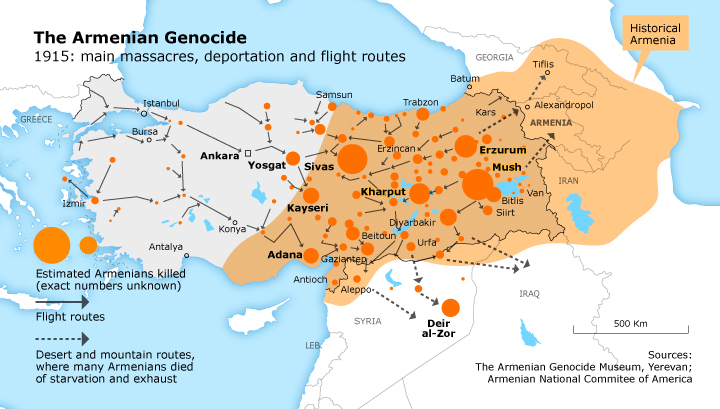
I keep seeing a lot of maps mostly coming out of unknown sources, some like this one showing "historical Armenia" basically stretching between Caspian, Mediterranean, and Black seas.
If "historical Armenia" existed, what was the time period, and the geographic range of it?
Considering the claimed geographical range, why is there so little recorded interactions between "historical Armenia" and the Umayyad/Abbasids/Seljukes or any other known civilization? Additionally what was there interaction with these groups that can be confirmed with solid historical records?
I would apperciate the questions answered with use of primary/historical sources, and without use of Armenian sources/writers/historians. (For example, with the Seljuks and Byzantines, there are clear non-Seljuk/non-Byzantine sources for battle of Manzikert, proving that not only such a thing as "seljuks" and "byzantines" existed but also and giving a rough idea of their bounderies based on location of the battles. Just as an example, there are old french manuscripts depicting the battle of Manzikert. Just based on that we know Byzantines existed, Seljuks existed. The key point here is that there is third party sources from that time period which survived till today for us to examine to see confirmation of the existence of these two groups.) Is there such historical third party confirmation of existance of "historical Armenia" as a geographic entity with roughly known bounderies?
1 Answers 2016-04-27
This thread made me think of this. Did the Founding Fathers give us room to essentially recreate the US government the way they did?
1 Answers 2016-04-27
Travelling to the Archives in Quebec City or Montreal is not really the most convenient method, so is there a way to access primary documents for the place and period that are accessible through a database of some kind? I'd love to be able to access letters, censuses and the like.
1 Answers 2016-04-27
1 Answers 2016-04-27
It just hit me that there must have been a start to that standard and it probably wasn't done by Jesus' disciples since they weren't such great historians themselves.
1 Answers 2016-04-27
Unless I'm mistaken, a common battle strategy during trench warfare was to charge over the top of the trench, and run across no man's land toward the enemy. How likely was a soldier to survive this charge?
1 Answers 2016-04-26
Did the Germans repurposed it to be used against the invading American troops?
3 Answers 2016-04-26
1 Answers 2016-04-26
So I was watching 100 Years of Beauty: Iran. The model shows the progression that women had in expressing themselves through makeup etc. The video shows that in 1910 women were fairly (visually anyways) conservative.
Through the 1920's - 1970's the video shows Iranian women being able to be more expressive in their makeup & clothing. By 1980 they go back to wearing the hijab, here's a gif I've made showing this. What is the reason for this regression? What was the background for the cultural expression between the 1920's - 1970's to the culturally repression of the 80's?
Thank you for any answers :)
1 Answers 2016-04-26
In any period.
1 Answers 2016-04-26
I'm planning on getting my Doctorate so I can become a history professor. I'm not at the point where I need to start on my thesis but I've been trying to think of what I would want to do it on when the time arises. Any advice is welcome!
Edit: This turned into more of an advice column than I had originally intended. I actually do want to hear the subjects that people have researched. I know I have a looooooong time before I need to worry about choosing my own thesis, but the advice so far has been very helpful.
15 Answers 2016-04-26