In another sub, some people were discussing why kids can't just sign up for college classes, but instead must go through the admissions process. That got me thinking what admissions were like historically.
Anyone with insight into other time periods or countries is welcome to chime in.
1 Answers 2016-01-28
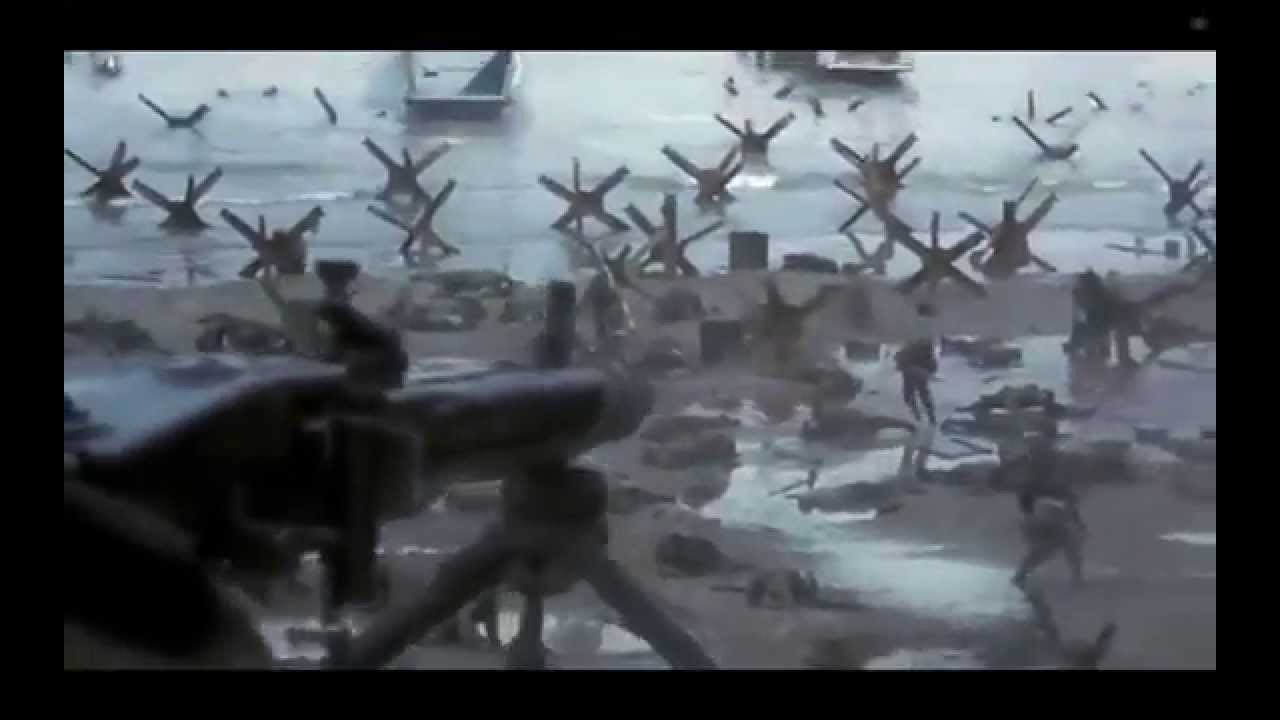
So the film portrays the beach as about 100 meters of sand, a long shingle wall, and two towering bunkers with a few scattered sandbags between.
Film shot of the shingles beneath the towering bunkers
Film shot of the bunkers from inside firing at Americans
Now, for the meat of my question: I know these bunkers existed along the coastline. An example here; however, I can find NO example of one of these particular towering bunkers existing at Omaha Beach.
The photos of Omaha that I find show a long, low tide stretch of beach, with relatively low, flat bunkers set much further inland, like in this image here.
The bunkers and slope of the beach is so far away that you can't really even make out the bunkers. Certainly none of them are towering over the beach.
When I google search for bunker photos, I definitely get some imposing structures, but none of the towering ones seem situated along the landing shoreline
TL;DR: What physical descriptions of Omaha beach in Saving Private Ryan are authentic, and what are redesigned? Were those towering iconic bunkers that show up in every single video game inspired by Saving Private Ryan really there, or were they placed there in the film for the sake of the drama?
1 Answers 2016-01-28
I searched the FAQS and search this sub in general and found nothing. If there some info previously stated here, I would appreciate a link and apologize for asking this.
I remember reading an article about the theory that the Titans were most likely the gods of a nearby people that when conquered had their pantheon absorbed into Greek Mythology. If this were the case, one could assume it was similar for the Giants or even the Vanir God [in Norse Mythology]. There's stories about the great battles between the Aesir and the Vanir or Giants.
So my question is, is there any evidence of this? Is this assumed by most academics? Can you point me towards some resources on this?
Thanks, I love this sub and you folks are amazing.
Edit: forgot stuff
2 Answers 2016-01-28
1 Answers 2016-01-28
Did any leading Nazi refer to themselves as a Fascist
1 Answers 2016-01-28
This question came to me after reading a few threads on how we can track the ages through fashion.
1 Answers 2016-01-28
The Shinsengumi was a ruthless militia. They were the enemy of the Meiji revolutionaries and fought on to the very end, long after the Shogun surrendered. They killed more of their own members than revolutionaries during their stint patrolling the streets of Kyoto, and caused quite some disturbance during that time.
So why are they usually given a heroic treatment?
1 Answers 2016-01-28
The fatal duel took place on the Weehawken dueling grounds, across the river from Manhattan, the same place where Hamilton's son had been killed mere years prior. (Please correct me if I'm wrong.)
Burr was known to be an excellent marksman, but Hamilton both (1) made known that he intended to miss the first shot, and (2) took every step to provoke Burr, from wearing his glasses to sighting the pistol before the duel.
These seem like contradictory acts -- either Hamilton intended to throw away his shot, or he wanted to make sure he had the best chance of firing an accurate shot.
One theory reconciles all these intentional acts: Hamilton intended to martyr himself on the spot where his son was killed.
He told friends that he had no intention to kill Burr to preserve his own legacy. He feigned concern for his own aim so Burr would take a well-aimed shot himself. And he picked a meaningful place to die.
Is there any merit to this theory, or any flaw in my assumptions? (For example, if there was no other dueling ground, the choice of Weehawken becomes less obviously intentional.)
1 Answers 2016-01-28
WWI seems to be a bloodbath with little regard for human life from at least a few staff Commanding officers. With more than 10 000 per day in average, countless assault and multiples cases of mutiny, is there any documented case of punitive assault ordered to a military units as a punishment for their behavior (mutiny, fraternization, pacifism, socialism ...)?
1 Answers 2016-01-28
I'm teaching 10th grade history and the text keeps saying 'the industrial revolution created the middle class'.
I understand prosperity is relative. Comfortable people will still get terminal diseases, but the text really doesn't qualify with details of the actual experiences of the middle class.
When did a majority of the population enjoy their needs being met? What was their relative experience?
1 Answers 2016-01-28
In his long review of the book the Party Decides and its application to the current election cycle, Nate Silver talks a little bit about the origin of the modern primary election cycle. The cases the book looks at are the ten competitive nominations between 1980 and 2004, but Silver criticizes the book for bracketing the weird cases in the 1970's, namely McGovern and Carter's runs as both managed secure the democratic nomination despite being factionally supported candidates ("My main objection is in how the authors tend to treat 1972 and 1976 as transitional cases that aren’t all that relevant to the current party system.").
The new system is apparently dependent on the recommendations of the McGovern-Fraser commission, which was formed in the wake of the imfamously tumultuous 1968 Democratic Convention in Chicago. The Wikipedia says:
One of the unintended consequences of McGovern-Fraser reforms was an enormous surge in the number of state party presidential primaries. Prior to the reforms, Democrats in two-thirds of the states used elite-run state conventions to choose convention delegates. In the post-reform era, over three-quarters of the states use primary elections to choose delegates, and over 80% of convention delegates are selected in these primaries. This is true for Republicans as well.
I was wondering if anyone could give more about this change, about how the nominating contests started to take this format, and particularly how Republicans ended up moving almost in tandem with the Democrats (though the first competitive Republican nomination was held in 1980, as the Republican nominees in both 72 and 76 were incumbents). How was this change an unintended consquence? Why did this system ended up getting chosen? I'm just looking for more history on the origins of the contemporary U.S. presidential candidate nominating process in general.
2 Answers 2016-01-28
Without getting into fights over the current political climate or recent events...
While certainly some media outlets like Pravda, during the Soviet era (no commenting on the current era!), were directly controlled by the government or political parties in some nations, we seem to have a notion of the independent and impartial newspaper.
While an examination of historical newspapers/magazines etc., show that some outright have been named after political parties like "Democrat" or "Whig", and reading some of their articles certainly shows no inclination of impartiality to political stances, as well as their role in local politics; for example, the burning of Abolitionist newspaper presses and outright murders of editors! We also have the history of muckrakers and Yellow Journalism as evidenced by the apocryphal story of Hearst saying "You provide the picures, I'll provide the war."
However, how much influence or control have political parties had over independent media organizations? This just doesn't pertain to newspapers, but also magazines, newsreels, and radio and television.
2 Answers 2016-01-28
I am doing a project on Pegasus bridge and Point du Hoc however I am finding it difficult finding reliable sources like newspapers, speeches or first hand accounts. Can anyone help me out or give some recommendations.
1 Answers 2016-01-28
2 Answers 2016-01-28
After all, the Ghaznavids were Sunni and ruled pretty much the same general area as the Seljuks for quite some time but never got asked to save the Caliphate from the Buyids? What made the Seljuks seem like a better prospect for rescuing Sunnism to the Caliph?
1 Answers 2016-01-28
2 Answers 2016-01-28
15 Answers 2016-01-28
I'm attending a Model UN conference next week wherein I will be a member of a Hannibalic War committee. My delegate is a member of the Fulvii family and the committee begins in 239 BC. My questions to consider are these:
Should Rome accept the island of Sardinia into the Republic? a. What would the repercussions of Roman territorial expansion in the region be? b. How would Carthage react to the incorporation of Sardinia into the Republic?
What should be done about the war in Carthage; should Rome intervene? a. Would intervention be a stabilizing or destabilizing force given the regional geopolitical situation? b. What is Rome’s rule in future regional conflicts?
I don't expect you to answer these questions precisely at all but I am more looking for some background on what sort of political stance the Fulvii family would've been inclined towards. Any help would be hugely appreciated! Thanks!
1 Answers 2016-01-28
I know right? It's a Tarantino film; they're not meant to be realistic. But seriously, it approached slavery as a morally gray area that sounds very plausible to how society functioned over 150 years ago. I'll break this down to 5 questions.....
'Mandingo fights' were pure fiction right? Or could something like that have existed, in more underground fashion if there were rumors?
House slaves were real? They never worked in the fields?
Were there really black 'socialites' who worked (or really just dined with) in the inner circles with their white owners in the southern states?
Did a state where slavery was still legal recognise that a former slave was free (given that former slave had documentation to prove it)? And on that note: did the slave states even provide documents showing a black person was a free man?
Was there even such a thing as a black slaver in the States?
1 Answers 2016-01-28
I realize that Cortes might not have burned them intentionally on arrival in Mexico. I'm just curious about how boat repairs would have happened on long expeditions and if boat building was common knowledge. Would a ship full of soldiers have been able to build a ship from local materials and sail back to Spain?
2 Answers 2016-01-28
This week, ending in January 28 2016:
Today's thread is for open discussion of:
History in the academy
Historiographical disputes, debates and rivalries
Implications of historical theory both abstractly and in application
Philosophy of history
And so on
Regular participants in the Thursday threads should just keep doing what they've been doing; newcomers should take notice that this thread is meant for open discussion only of matters like those above, not just anything you like -- we'll have a thread on Friday for that, as usual.
2 Answers 2016-01-28
Settle an argument, what weapon killed more in total?
1 Answers 2016-01-28
Did the Stasi files prove that the USSR sponsored terrorist organizations around the globe as Michael Leeden claims in this article from the National Review?
He said, "Almost everything Claire (author of The Terror Network) said was borne out by the Stasi files." But my understanding is that the bulk of the evidence cited in The Terror Network was black ops propaganda that had originated in the CIA. So how could the Stasi files possibly prove the bulk of her evidence showed a link.
I've searched through the wikipedia on Stasi, and can't find it there, and TBH, I'm not really sure how to search the actual Stasi files directly. Meine Deutsche sind nicht so gut.
I hope this question is within the bounds of your rules - first time poster in r/askhistorians.
3 Answers 2016-01-28
Hi r/askhistorians can someone help me in understanding how different cultures used different bows, for instance Longbow used by the British and Flatbow by the Native Americans. Why were these types more effective in certain places and not the others? It would help if someone could tell me about the bow and arrows used in medieval ages in the Asian countries.
1 Answers 2016-01-28