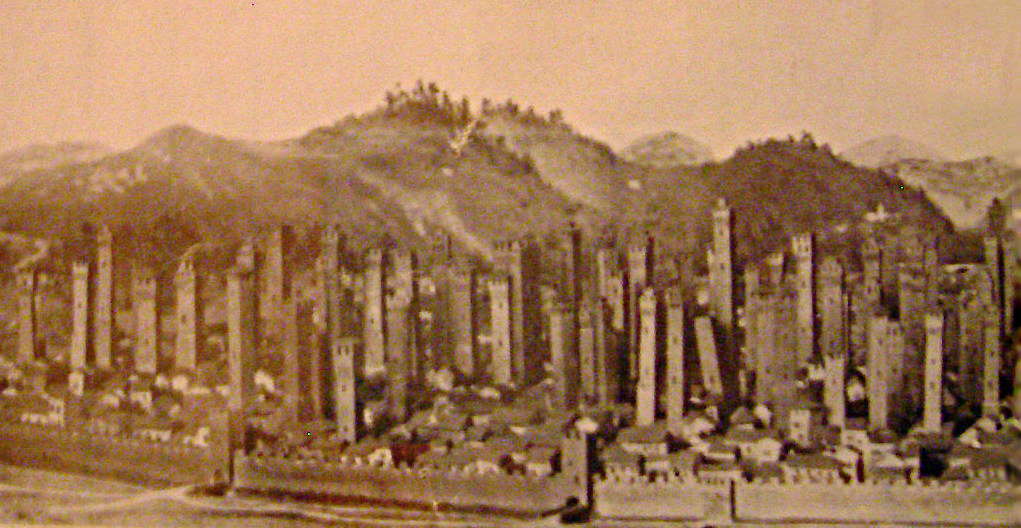
Apparently there were up to 180(!) towers build in Bologna in the 12th and 13th century. (artist rendition)
The Two Towers are the most prominent ones that still stand today.
Did this trend really develop, just because rich people and guilds wanted to one-up one another and have the "biggest one"? Did they have no other purpose at all? Maybe in terms of personal security or defence?
It just seems like such a waste of money otherwise, doesn't it?
3 Answers 2015-10-30
Why did it take another hundred years or so for civil rights to be equal between black and white Americans?
As an example, I'm baffled by the fact that the US fought against fascism in World War 2 while simultaneously still segregating black soldiers from white soldiers such as making black pilot squadrons land in their own separate airfield (Source: World War 2 in HD documentary)
3 Answers 2015-10-30
[deleted]
1 Answers 2015-10-30
1 Answers 2015-10-30
1 Answers 2015-10-30
2 Answers 2015-10-30
Or is this a common misconception? Ive seen some evidence of some human races in history that had larger bones, perhaps indicating greater strength; especially upper body strength.
2 Answers 2015-10-30
When you watch les Miserables, or read Dickens it is striking how much of the population in Europe still lived in poverty in the 1830's. It is my perception (but I could be wrong), that by the start of WWII extreme poverty (hunger), was no longer a large-scale problem in France and England. Around what time did poverty end, and what was the major factor? Was it social laws? Or increasing wages/ the industrial revolution?
1 Answers 2015-10-30
1 Answers 2015-10-30
5 Answers 2015-10-30
6 Answers 2015-10-30
Alexander the Great's campaign to topple the Persian Empire seemed to have a great deal of propaganda supporting it. On multiple occasions he is said to be doing it to free the Greeks, or to get revenge on the Persians for Xerxes' campaign. How did this message impact Greek mercenaries in the armies of Darius and his satraps? It appears that Alexander encountered a few Persian forces of which Greek mercenaries played a large part, so was his notion of a panhellenic crusade really even effective, or did it just attempt to provide justification on his end?
2 Answers 2015-10-30
1 Answers 2015-10-30
Today:
You know the drill: this is the thread for all your history-related outpourings that are not necessarily questions. Minor questions that you feel don't need or merit their own threads are welcome too. Discovered a great new book, documentary, article or blog? Has your Ph.D. application been successful? Have you made an archaeological discovery in your back yard? Did you find an anecdote about the Doge of Venice telling a joke to Michel Foucault? Tell us all about it.
As usual, moderation in this thread will be relatively non-existent -- jokes, anecdotes and light-hearted banter are welcome.
12 Answers 2015-10-30
I'm especially curious about older crests. I know lions had a much larger home range before extending across North Africa into Turkey and across lower Greece. It seems like an animal that would not be collectively known by the average European after the Romans and not again until exploration and the sciences re-emerged. Yet, medieval backwater peasant towns in France and even countries like Sweden (getting as far away from lion territory as possible) have lion crests. Is there some historical precedence for this, did they simply like the design or grandiose associations of lions, or am I wrong entirely and they have always known what lions were? Thanks
3 Answers 2015-10-30
Nazis were intent on creating a "people's community" throughout their rule but how did their propaganda change when it was clear the war was lost and enemies surrounded them? How come people fought til the bitter end despite realising the flaws in their leadership and their dream of utopia shattered?
Happy to read sources if you guys know of any
1 Answers 2015-10-30
I've read about the clashes between pike and shot armies in Europe throughout the Thirty Years War etc, but did they face other opponents?
By all-infantry I mean something like a native American force (which I know the Spanish encountered, but I'm not sure how they dealt with them) and by all-cavalry I mean something like a Mongol horse archer army.
3 Answers 2015-10-30
Ok, the information I am going to provide as to why I am asking this question, has no historical significant what-so-ever.
I was playing The Witcher 3.. and.. there is a horse riding mechanic in the game called "Horse Fear". it is a meter measuring how frightened the horse is in-game from by-passing enemies. If the meter reaches its limit, the horse panics and throws you off.
Blinders can be bought to make the horse less afraid of these foes.
But, I have seen some TV-shows set in medieval times, working horses seemed to be using blinders as well. Why?
Just in general of horses, why do they use blinders? Side question; who came up with the idea of blinding horses?
1 Answers 2015-10-30
2 Answers 2015-10-30
If you open a book on 19th century British folklore, the hazel tree is always mentioned as being magical. It was used for dowsing; St. Patrick used a hazel rod to cast the snakes out of Ireland; it is used by witches / used to drive off witches (etc).
How far back can these folk beliefs be traced? Do they turn up in any Anglo-Saxon texts? Do classical authors talk about hazel as a magical plant? Was hazel used in archaeological contexts that suggest ritual / magical properties?
I've only been able to trace it to the late middle ages, but I'm hindered by the profusion of neo-pagan / wicca literature that muddies the waters; because this is a little outside my speciality, I'm struggling to cut through the noise to any real sources that might exist.
I'm specifically interested in what hazel might have meant in 6th century England, but since we don't have any written sources from that century to help us, I'm happy to settle for a more longue duree view of the wood's magical powers.
What do we know about hazel's social history?
1 Answers 2015-10-30
[deleted]
2 Answers 2015-10-30
My textbook states that they would draw attention to prejudice in the US and claimed black people would be treated as equals in Germany, though none ever surrendered. Would the Germans have kept their word?
1 Answers 2015-10-30
"The halberd (Naginata?) is inferior to the spear on the battlefield. With the spear (Yari) you can take the initiative, the halberd is defensive. In the hands of one of two men of equal ability, the spear gives a little extra strength. Spear and halberd both have their uses, but neither is very beneficial in confined spaces." - Miyamoto Musashi.
This quote is what inspired me to ask my questions. I feel like I have a good understanding what kind of doctrines, strategy and tactics were used on European battlefields. But how did they form in an almost isolated country? Were battles fought differently? Did different Japanese weapons (Naginata and Yari) fill different niches?
How much did the introduction of the Matchlock influence the established military doctrines?
1 Answers 2015-10-30