In the western world, the Soviet defense of the USSR and defeat of Germany is usually portrayed as something like Zap Brannigan from Futurama. Stalin just threw “wave after wave of my own men at them.” Is this a fair assessment or were there any innovative or impressive tactical maneuvers on the Soviet side?
1 Answers 2021-10-12
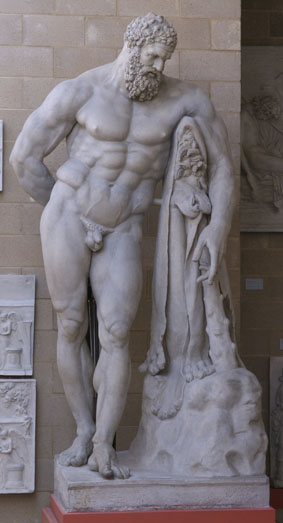
The statue that begged this question is the Farnese Hercules, as such a body would be hard to obtain even with todays knowledge about fitness and nutrition. Bodies such as portrayed in the [Discus Thrower](https://thumbs.dreamstime.com/b/discobolos-de- discuspottenbakker-rome-itali%C3%AB-89077360.jpg) seem far more believable to me because he seems far leaner and less muscular, which is something I can imagine a reasonably fit man obtaining without very specific resistance training and diet. My question therefore mainly focusses on the kind of body we today associate with bodybuilding, lifting and the fitness community in general.
2 Answers 2021-10-12
Many video games, movies, TV shows, etc. depicting fictionalized Medieval Europe have wooden sign posts at intersections and forks in roads. I'm sure you know the kind - wood posts with pointed boards on top with arrows pointing each direction and the name of the next settlement on them.
I know "Medieval Europe" is really broad in time and geography, but is there a historical record of these signs existing along country roads and highways? As a follow-up, if they did exist, who was responsible for erecting and maintaining them?
1 Answers 2021-10-12
Hello! I’m looking for some good books on the Holy Roman Empire, specifically the time before the Habsburgs took power, and I could not find any in the book list on the subreddit sidebar. What are some good recommendations for this? And is there anything specific I should know before reading up on this topic more? Thank you!
1 Answers 2021-10-12
Here in the USA, we memorialize Christopher Columbus through place names, (District of Columbia, Columbus, Ohio), educational establishments (Columbia University), and even a federal holiday (Columbus Day), amongst other ways, despite the fact that Columbus never even set foot in North America. Why is this?
1 Answers 2021-10-12
1 Answers 2021-10-12
1 Answers 2021-10-12
1 Answers 2021-10-12
When I was in school I learned that the stone age, was followed by the bronze age, was followed by the iron age. I took this as an evolution from inferior tsuperior materials.
However later I learned about the Bronze Age collapse and the dark age that followed. I now have the following questions:
Did the Bronze Age civilizations know Iron working?
And if yes, did they consider Iron as an inferior material for e.g. weapons (see the Illiad)?
And if bronze age society did not know Iron working how, when and where during the dark ages did iron working evolve?
I am primarily interested in the western civilizations (so not China or India). This is not a dig at these civilizations, it's just that I have minimal knowledge and I can't contextualize any answers.
Thank you very much.
1 Answers 2021-10-12
#Join us during the AskHistorians Digital Conference for our live networking and social sessions using Gather.town!
Each day, we'll be hosting two live sessions to let conference participants and guests meet each other, talk shop and chat about history. In our networking sessions, the focus will be on all things history - meeting colleagues, asking questions and sharing knowledge and ideas. Our social sessions will be a bit more relaxed, and designed to help you get to know each other (and AskHistorians!) a little better.
The session types and times are staggered across the conference to accommodate the largest number of international guests - we hope you'll be able to make it!
Use this registration page to sign up for any or all of the following sessions:
Make sure to secure your spot by registering now. And to find out more about all the conference events we have lined up, check out the conference webpage.
2 Answers 2021-10-12
It seems to be widely accepted in folklore that Elizabeth Bathory was a murderer, but would it have been possible in that time period for her to murder so many young women with impunity for that length of time? Were the charges against her trumped up in order to imprison her and usurp her property/titles?
1 Answers 2021-10-12
There is an argument happening on Twitter right now with regard to a woman claiming her grandfather, a German soldier in 1940, was shot for refusing to report on his Jewish friends. She further claims that this was uncovered by the family in the 1980s.
I have my suspicions that she could very well be reporting a falsehood in good faith, since this appears to be in the category of family legend. I'm also inclined to wonder if this can be regarded as the strain of WWII history that tries to cast everyday Germans as equal victims of Nazism.
But what I'm wondering about is the prevalence of punishing German rank and file soldiers for sympathizing with Jews, real or imagined.
I've read Browning, so I know that it was widely recognized that the SS had very real psychological trouble serving as direct kill squads, and that it was general practice to try to accommodate that reality.
But was refusal by a soldier to turn in Jews given the same leniency? Or was that something that common soldiers could expect to be shot for?
1 Answers 2021-10-12
In his book Debt, the First 5000 Years David Graeber writes that 'First-year Roman law students, for instance, were made to memorize the following definition: slavery is an institution according to the law of nations whereby one person falls under the property rights of another, contrary to nature.' Using the quote to argue that even in societies that made wide use of slavery it was still seen as unnatural and unpleasant.
How true is this? Did normal Romans see slavery as a daily fact of life, something deeply unpleasant, or somewhere in between?
1 Answers 2021-10-12
I've heard that before the Meiji period, the two religions of Japan were almost indistinguishable, but I'm unable to find an explanation of how. Did Buddhists and Shinto-worshippers use the same temples? Where Buddhist monks considered the same as Shinto priests?
In what ways were they intertwined that they aren't today?
1 Answers 2021-10-12
Hi! I've been listening to the podcast Blowback recently, and have been enjoying the hell out of it
What are the main things (if any) that they may have gotten wrong, or oversimplified?
1 Answers 2021-10-12
Title is self explanatory. Do you know of any interesting books about the greek tragedian Sophocles or his work?
1 Answers 2021-10-12
I spotted the unexpected flag in a snippet of stock footage at the end of 'The Imitation Game'.
I found this image online:
link to article with the flag/image
https://www.hertfordshiremercury.co.uk/news/hertfordshire-news/ve-day-2020-full-speech-4116451
The speech was given from the ministry of health in Whitehall.
Can anyone explain what is going on?
1 Answers 2021-10-12
As a teacher, there is a principle that comprehension is often more important than accuracy, and in some cases an oversimplification or other heuristics is a great starting off point in learning something new. And as you learn more, the corrections in accuracy become more and more important.
Since most of you are academic writers, I understand that there is a very strict mindset one must have in order to be as accurate as possible (lest you be destroyed by your colleagues). This is why the intense policing of this sub is so incredibly scrutinized, and the result is it does provide for some of the most comprehensive and exhaustive answers I've seen on the internet.
But where do people go who just want to ask a question where they might not know what information it is they're seeking? If I'm trying to get an understanding of what kind of life a Greek mercenary that fought for Xerxes would have been after the Persian invasion was thwarted, I don't even know what exactly it is I'm trying to learn. And that's where this subreddit seems to break down, and instead the focus turns on only answering questions that have a clear answer. Because after ten years, every one of these kinds of questions has already been asked and answered.
I think this subreddit should actually try to reach out to subs like r/history or r/AskHistory (at the very least, link them in the FAQ, wiki, or about section so casual buffs can head there), or work with them to both ensure misinformation isn't being spread on theirs and redirect academic answers to here.
Something tells me, however, that at least one historian will reply with, "We don't care about raising general knowledge and interest in history. That's not the job of a historian, and if you don't like it, you go somewhere else." But that's kind of what I mean: where should we go to start?
TL;DR This sub is perfect for what it wants to be, but for the sake of raising standards of the general public and the quality of comments in this sub, please work with the other history subreddits to help build the knowledge of all or at least redirect people.
63 Answers 2021-10-12
I am in a D&D campaign where the DM is allowing me to take out insurance policies since adventurers don’t exactly have too high chances of survival long term. The DM is allowing this, but is having me find the insurance premiums of the equivalent time period, the 1100s, on my own, that I will need to pay in game. However, despite my best efforts looking up things such as Roman burial clubs all I can find is that the people of any era paid “an amount of money for funeral services”, what that amount actually was, is apparently somehow impossible to find despite the best efforts of me and a number of friends who have all tried their best with their vast knowledge of history.
Additionally if the rates were higher for soldiers (or in my case adventurers) I’d like the numbers for insurance premiums on civilians as well, since there’s clearly a week-month long time loop/Groundhog Day thing going on in the campaign and I’d like to take advantage of such a situation as much as possible.
Do not worry about converting the amount of money to D&D money, just focus on converting it to modern day money which is all I need to have accurate numbers for the game.
I know the answer for most things in D&D is typically "ask your DM", but this is the result of me asking the DM.
1 Answers 2021-10-12
1 Answers 2021-10-12
1 Answers 2021-10-12
1 Answers 2021-10-12
1 Answers 2021-10-12
1 Answers 2021-10-12
Considering the history of the US Democratic Party with regards to race, particularly in the lead-up to and during the Civil War, but also well into the 1960s during the Civil Rights era, why did it become known as the more ‘liberal’ and progressive party? And why did the Republican Party, the party of Lincoln and fighting against slavery in the 1860s, come to be seen as conservative and not especially progressive on racial issues?
I’m hugely generalising of course, and thinking of perceptions as much as realities, but as a non-US observer it baffles me that these two parties essentially seem to have ‘swapped roles’ at some point during the twentieth century.
Happy for my question to be reframed or to clarify if necessary.
1 Answers 2021-10-12