Before the Age of Imperialism, exactly which Black-majority African countries/areas other than Ethiopia had a Christian-majority population or at least a population which is close to being Christian-majority? Were there any such Black-majority African countries/areas (before the Age of Imperialism, obviously)? Or is Ethiopia the only Black-majority African country/area which qualifies for this?
Any thoughts on this?
1 Answers 2015-07-23
1 Answers 2015-07-23
Islands in Europe, Africa, and the Americas seem to have been settled relatively late in human history. Madagascar, Madeira, Iceland, and Jamaica were all settled only in the past 2000 years, despite being relatively close to continents.
In Asia, Taiwan and the Philippines seem to have been inhabited for tens of thousands of years. Why were they discovered so much earlier than islands elsewhere?
1 Answers 2015-07-23
I've been going through a self study class about on the history of ancient Egypt, and they briefly touched on Napoleon's expedition to Egypt with a group of scholars and scientists of all kinds. This really interests me, and I'm trying to find a book that goes into more detail about the expedition itself, but most of them focus on the military campaign rather than the beginning of Egyptology. Does anyone have a suggestion for a book that focuses on the historical aspects of Napoleon's expedition?
So far, I've looked into "Napoleon in Egypt", "Mirage: Napoleon's Scientists and the Unveiling of Egypt", "Napoleon's Egypt: Invading the Middle East", "Memoirs of Napoleon's Egyptian Expedition 1798-1801", and "The Discovery of Egypt: Vivant Denon's Travels with Napoleon's Army".
The last on that list is the most promising because it follows who I think is the "lead scholar", but there are very few reviews for it.
1 Answers 2015-07-23
Were there any murders of rulers or people in power that were well known during the middle ages? What was the reaction to these assassinations? If not, was there any particular reason for no medieval ruler to be assassinated? Or is the act of assassination more of a modern concept that doesn't fully fit with the medieval world?
1 Answers 2015-07-23
My grandfather died in 1982 of lung cancer. His kids (including my Dad) knew he fought in World War II, but he wasn't fond of talking about it and never told stories. I never met him, but by all accounts he was an amazing man: kind, funny, soft-spoken, just thoroughly good.
In the late 1990s my dad learned through his father's old letters that he had been in the First Division around the time of D-Day. We requested his service record (just separation record, since most of the records we wanted apparently burned) and got some more detailed info. It seems his company was part of the early invasion. Unfortunately, we're having trouble combing information about the movements of different companies at Normandy, so we're still curious about exactly where he was, or what a soldier with his experience might have been doing. Basically, how can we see it through his eyes?
I never met my grandfather, who was the only servicemember in my immediate family, but the Army has become a part of my life anyway. Five years ago I met my future husband, who was between two deployments to Afghanistan at the time. He inspired me to join the culture that shaped who he is, and I commissioned as an officer two years ago. The more time I spend with soldiers, the more curious I am about the grandfather I never knew, the one who apparently experienced one of the most terrible days of the war, and who came home and built his family and wanted to leave his service in the past.
I'm hoping there are some D-Day experts who would be able to give my father and I some idea what a soldier in my grandfather's company, with his kind of MOS/experience, would have been doing specifically on that day. (Not to say we're not interested in the other parts of his record; I just hoped to narrow it down.) If you can refer me to another subreddit or something that's fine. Also, I wish I had his platoon info or the name of anybody he served with, but I don't. My grandma passed away several years ago, and didn't know very many specifics either.
Here is what we know.
Service:
Jul 1942 - Nov 1942: Co B 2nd QMRTC, Fort Frances in Warren, WY (Basic)
Jan 1943 - Nov 1943: Co F 16th Infantry. Position: Crewman (also listed: ammo carrier, asst. gunner, gunner, acting squad leader)
Nov 1943 - Jun 1944 (post D-Day): HQ Co 16th Infantry. Position: Military Police (not sure what circumstances would have caused big duty switch so soon after invasion, unless lots of men were doing it)
Jun 1944 - Jun 1945: HQ Co 16th Infantry, Clerk
Jun 1945 - Oct 1945: B Co. 18th Armed Inf Bn, Clerk
BONUS: Recently we found a speech my grandfather gave to his church when they asked him to talk about his experience as a returning soldier. Here is some: "Fellows, I'd like to have you remember this: no matter what the pulp magazine and the movies would have you believe, there is nothing glamorous about war. It's about the dirtiest, filthiest thing there is. War is hell. Pure unadulterated hell. There are no dashing, slick-haired heroes on the battlefield -- just tired, haggard, unshaven men, shooting, crawling, and living and dying. ... Although there's many men on the battlefield, a person never feels quite so lonesome. It's just as though he were out in the middle of a desert with not a soul within a hundred miles. That's when it's an awful comfort to know there's a God watching over me. I'll say in all sincerity, that I've never been as close to God as over there in Africa."
3 Answers 2015-07-23
1 Answers 2015-07-23
I know that there were some Muslims in sub-Saharan west Africa during the time of the slave trade, but I don't know much about them, or if there were any Muslims among the populations who were being enslaved.
1 Answers 2015-07-23
It's a work of historical fiction that is about a fictional spartan soldier's account of the battle of Thermopylae. I understand that most of the character and sub plots are made up, but how well does the book portray Spartan culture, and the actual battle itself.
1 Answers 2015-07-23
I know they were pretty successful together, but why was Czechoslovakia even formed in the first place? Wouldn't it make more sense to have two countries right off the bat?
2 Answers 2015-07-23
On average, how many troops could the big players like the Holy Roman Empire, the Italian City-states, Spain, etc. raise for a war?
1 Answers 2015-07-23
People often talk about the wars between the Europeans and Native American tribes, and what an atrocity it was, but where there any atrocities committed between Native American tribes? What would they generally fight over and how often? Do we know how many native Americans died from these battles?
1 Answers 2015-07-23
1 Answers 2015-07-23
First off, apologies for asking a video game inspired question in case that annoys anyone.
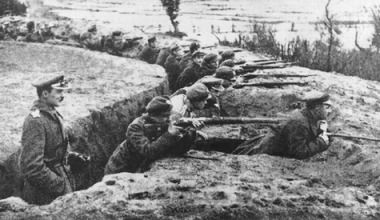
I have a question about the construction of trenches in WWI. Not the layout, but the actual "architecture".
Basically, in the various WWI video games coming out that involve trenches, the trenches are being built differently. In some, like Verdun, they're just just long depressions in the ground with gradual curves. In others, like Battle of Empires : 1914-1918, they're build up on the edges like this, but then they're also considerably wider than what's in that photo. I've also seen photos of them built like this where it's closer to a 90° angle.
I've worked as a game dev before and understand issues of flow and playability of maps. I'm not asking about that. I get if they're bigger than what was actually done for the sake of playability.
What I'm asking about is how they were actually constructed, regarding the following points:
I'm also happy if anyone can provide some solid diagrams and visuals that might show the degree of variation. Of course in Googling I've seen some, but I'm trying to get a sense of the larger picture.
Also, please include sources in answers here. I know it's not a requirement on /r/AskHistorians unless someone asks, but I want to do some reading on it later so this is me asking.
1 Answers 2015-07-23
1 Answers 2015-07-23
1 Answers 2015-07-23
1 Answers 2015-07-23
I've read a couple of books on World War I and I keep getting contradictory stances on this. Some say there were mass atrocities as the Germans marched through, and others say that it was isolated incidents that were then used as propaganda to make Germany look bad. So having trouble knowing which one it is.
1 Answers 2015-07-23