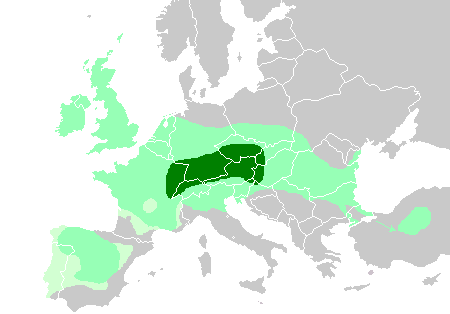
I'm mainly referring to this map: http://upload.wikimedia.org/wikipedia/commons/f/fd/Celtic_expansion.PNG from wikipedia's 'Pre-Celtic' page.
Dark green = Celtic distribution by 500BC
Light green = Celtic distribution by 250BC
1 Answers 2015-05-21
1 Answers 2015-05-21
1 Answers 2015-05-21
7 Answers 2015-05-21
2 Answers 2015-05-21
1 Answers 2015-05-21
Or in general, what kind of sword would a Spanish caballero of the medieval period have wielded in battle? Would it have been some kind of side-sword, or a broadsword?
1 Answers 2015-05-21
1 Answers 2015-05-21
Considering he is an academician (though not an anthropologist or historian) I find it curious if he didn't address any criticism directed at GGS. If he actually did, my Googling result has not yielded anything useful. Or maybe it's just my Google-fu being weak.
Just in case someone reading this not familiar with GGS and its fault, there are lots of useful threads on it in this sub.
9 Answers 2015-05-21
I've been to a lot of historical reenactment places such as Williamsburg, Greenfield village, Conner Prairie, etc., and these were a couple of the things I remember hearing from them. Men wore long socks and "put their best foot forward" to attempt to attract ladies with their sexy sexy calves.
1 Answers 2015-05-21
1 Answers 2015-05-21
If traveling by land, would travelers have found existing or well worn trails? Would there have been inns along the way where money could be exchanged for food and shelter, or would travelers be expected to forage for themselves and camp out along the way? How common was travel on foot relative to travel on horseback or by buckboard stages of that era?
My interest in this is because the fledgling Latter Day Saint movement envisioned a "New Jerusalem," which was to be settled in northwestern Missouri, near present day Independence. They prepared an expedition and left Kirtland, Ohio (near present day Cleveland) in the spring of 1831. They traveled the approximate 800 miles in about 90 days. I've read the "boots on the ground" report from a participant, Ezra Booth. The return trip was said to have been somewhat easier because they returned via the Missouri and Ohio rivers. Steamships made it possible to travel upstream. Still, the description of men walking paints a picture of hearty individuals. I am not sure why they didn't go on horseback. Any help or corrections will be appreciated!
2 Answers 2015-05-21
I read this article earlier, which claims that opposition to austerity measures was a major driving factor in the colony's decision to separate from Great Britain. http://www.nybooks.com/blogs/nyrblog/2015/may/20/1776-revolt-against-austerity/
My question is: how accurate is this article? I have never heard this interpretation before, but it seems to make some sense to me. It is a very politically loaded subject though, which makes me doubt it a bit.
1 Answers 2015-05-21
1 Answers 2015-05-21
1 Answers 2015-05-21
This week, ending in May 21 2015:
Today's thread is for open discussion of:
History in the academy
Historiographical disputes, debates and rivalries
Implications of historical theory both abstractly and in application
Philosophy of history
And so on
Regular participants in the Thursday threads should just keep doing what they've been doing; newcomers should take notice that this thread is meant for open discussion only of matters like those above, not just anything you like -- we'll have a thread on Friday for that, as usual.
1 Answers 2015-05-21
So yeah, what happened to the country economically/socially? I know that, due to nationalist propaganda, they demonized Americans. What happened to all that hate, and famous Japanese honor (suiciding before capture, and all that) after they surrendered?
Edit: not sure if I made any mistake, but obligatory apology for bad English.
1 Answers 2015-05-21
1 Answers 2015-05-21
By different i mean how are they able to have the highest happiness per citizen, some of the best GDP's, lowest corruption , and the best education system in the world? When less than a thousand years ago the vikings dominated that region and plagued much of western Europe with their raids.
2 Answers 2015-05-21
1 Answers 2015-05-21
Maybe I've been watching too much Crash Course World History (great youtube channel, by the way, for just quick reviews of entire periods, but endearing nonetheless), but they keep saying that the Holy Roman Empire was precisely the opposite of what it stood for. How was it not holy, roman, and not an empire?
1 Answers 2015-05-21
My grandfather was a World War II veteran. He was stationed in New Guinea and the Philippines. He always told me that he kept a journal during his time overseas but before he got to come home, his unit had to destroy anything that they had written about their time there. This always bothered me and it bothers me even more now that my grandfather has passed away. I can't seem to find any other situations where this happened and I haven't heard this from anyone else. Is it possible that he destroyed it on his own accord because he wanted to leave the war there, so to speak? Are there any recorded instances of WWII veterans being forced to destroy their journals? Please help point me in the right direction if you have any reading that I can do on this subject.
1 Answers 2015-05-21
Hi, I am a history student from ULPGC (Canary Islands) and I am very interested on ports' history, everything refer to that. I am searching ports' history in general or specifically one port (e.g. Port of Hamburg or Copenhagen).
I want to know more about ports, society, its life on it and around, economy, what suppose to the territory (or country) that port... If anyone can share me some books about it, I will be thankful.
Edit: sorry I forget write it on the post. If it is possible, my bigger wish is find any resource or book related with the ports' developing on the Contemporary period (I am study history on Canary Island, and this period refer generally to 1789-1945~; in United Kingdom the contemporary history began on the beginning of the XX century if I am not wrong, right? Correct me please if I am wrong).
Regards
2 Answers 2015-05-21
Was it because of the later creation of the office? Was it due to the office of president's foreign focus?
Edit:I mean in English in Ireland, probably should've specified that in the title just to be clear...
1 Answers 2015-05-21