A close friend rationalized their racism by asking this question in different words and then made alarming suppositions. I was taken aback and stammered while excusing myself.
There's vitriol behind this question that isn't mine. I apologize. I'd like to be able to explain what has held them back and why they aren't as developed as, say, Japan.
2 Answers 2015-03-20
I am planning on diving into Anne Applbaum's Iron Curtain on the post-WWII Soviet occupation of Eastern Europe. It got me wondering, though - are there any monographs in book or paper form (in English) on Soviet reconstruction post-WWII? Thanks!
2 Answers 2015-03-20
Was it frustration? Pride? Did he stand to profit from the new territories?
Thanks
1 Answers 2015-03-20
Flails have always seemed like a fairly goofy weapon to me. I just don't see something that you have to swing around in wide arcs terribly effective, especially if you're in a group with allies. It seems like you'd end up hurting yourself/your friends more often than an enemy. Please correct me in my wrongness.
Also, were flails more of a peasant's "grab anything you can that might hurt someone" type weapon, like other tool-type weapons that were pressed into wartime service (I'm thinking sickles, hammers, pitchforks, and their ilk) or were there legitimate battle-hardened warriors who actively trained in perfecting the use of this odd weapon?
5 Answers 2015-03-20
1 Answers 2015-03-20
3 Answers 2015-03-20
I ask this question because I am studying the Pacific Theater of World War II and read that there were battles in New Guinea, but were limited to the Northern and Eastern Coasts. I am aware that New Guinea contains peoples that have traditionally been isolated from the rest of the world, but I may be making a generalization and please correct me if I am wrong. A more specific question I ask is, Is it possible that many peoples who lived in New Guinea's interior were not aware of the occurrence of World War II? Thanks and I hope I am not reposting, please let me know if I am. Also, Please feel free to post information concerning other groups who did not have any knowledge of World War II's existence. Source: Shi, David E. "MacArthur In New Guinea." America: A Narrative History. By George B. Tindall. 8th ed. Vol. 2. New York: Norton, 1984. 905+. Print.
1 Answers 2015-03-20
The kings of europe during the middle ages seemed obsessed by creating alliances thru marriages. I can think of a few examples where this spectacularly failed, and examples where it apperantly did work. But has anyone actually tried to do a statistical analysis to see if countries actually did have fewer conflicts when allied thru a marriage?
1 Answers 2015-03-20
I've always wondered. The Thule Society was a secret society in Nazi Germany that I hear was neo-Pagan and the Wikipedia Article has a bunch of members in it, some look like high ranking officials forgive me if Im wrong. All I want to know is how big of a part did this secret, neo-Pagan society play in Nazi Germany?
1 Answers 2015-03-20
2 Answers 2015-03-20
Style isn't really the right word but you know what I mean.
1 Answers 2015-03-20
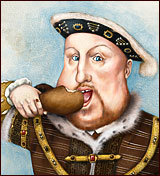
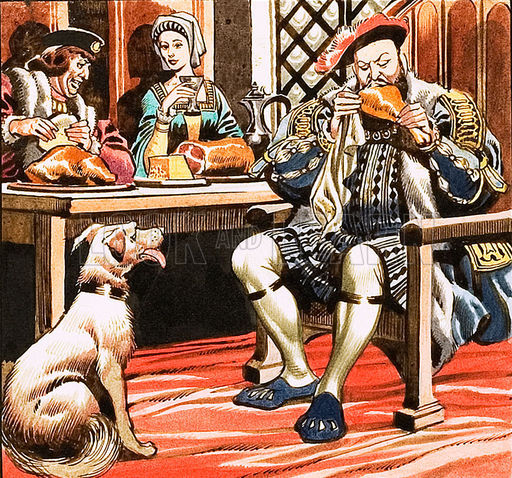
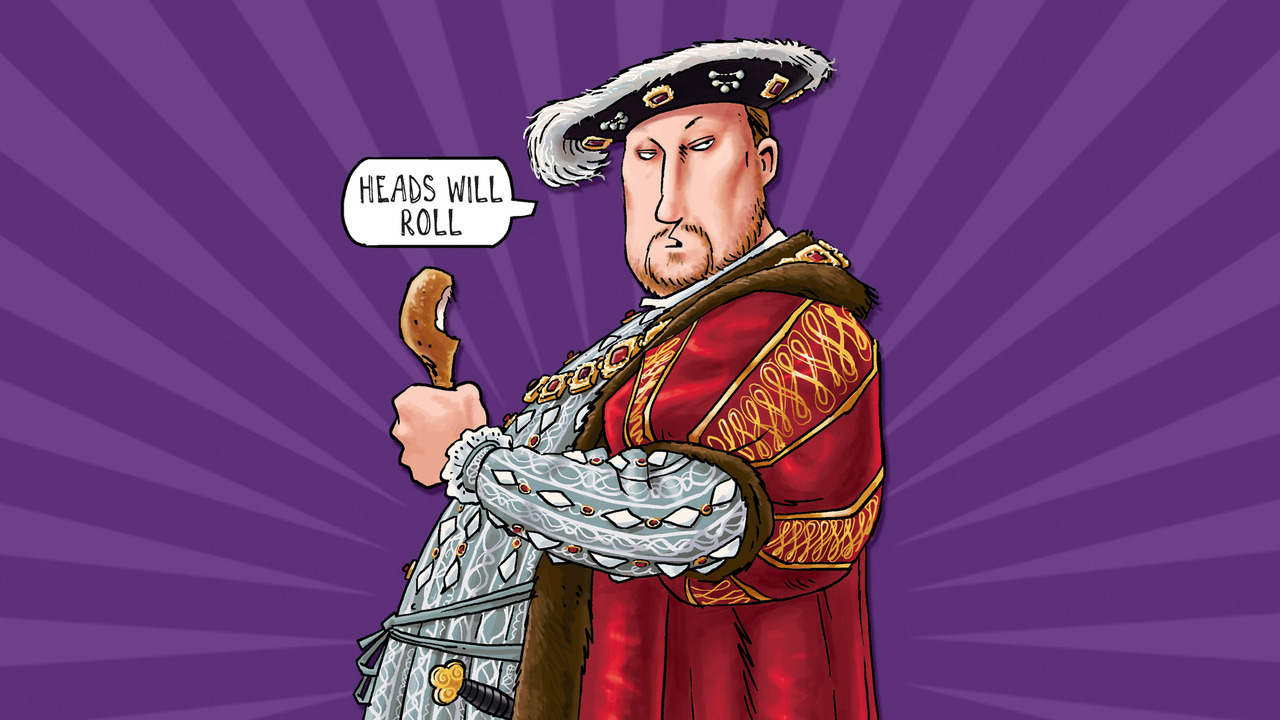
Many popular contemporary depictions of King Henry VIII show him holding a turkey leg in one hand.
[Example 2] (http://40.media.tumblr.com/f11b6990b352ffcdc4aaaa4c17223762/tumblr_nlhf66vNNg1qzstw9o2_540.jpg)
There are lots of contemporary written examples too:
So I went to the Renaissance Fair today and while eating my turkey leg I got to thinking about Henry the Eighth. You see a picture of that guy, chances are you're looking at a picture of a guy with a turkey leg in his hand.
Turkey drumstick in one hand, lady parts in the other -- that's how we like our H8.
Now, my question is, what set the precedent for this depiction?
I myself believe I have a memory of seeing a renaissance era painting of Henry VIII holding a turkey leg in one hand. Many other people believe they remember seeing such a portrait as well. (Link to article on mandelaeffect.com) But no one seems to be able to find any such painting.
Many people have pointed to the 1930s film The Secret Life of Henry VIII which contains a scene where he devours a chicken, but that is a whole chicken, not a singular massive turkey leg.
As an aside, some people have tried to allege that turkeys did not exist in England during Henry the VIII's reign. At least, if britishturkey.co.uk is to be believed...
Henry VIII was the first English king to enjoy turkey, although Edward VII made eating turkey fashionable at Christmas. It replaced peacocks on the table in Royal Courts
TL;DR: Does there exist a renaissance era painting depicting Henry VIII holding a turkey leg, and if not, where does this popular depiction come from?
1 Answers 2015-03-20
Could a Roman have made it to or have been living in China or north-eastern Russia (Vladivostok direction) at the time? What about Japan or Australasian islands?
If nothing can be proven, what would the likely answer be?
1 Answers 2015-03-20
1 Answers 2015-03-20
I'm thinking maybe one of Greece's philosophers and mathematics. But you guys know better than me.
Sorry for my bad english, I'm from Argentina.
Thanks in advance.
2 Answers 2015-03-20
Through my reading so far it seems that Muslim strategy essentially mirrored Muhammad. Razzia tactics and the holding of water sources remained, and some Caliphs implemented reforms such as Abu Bakr, Umar I, Marwan II.
It seems crusaders had no strategy outside of, "fight to the death for the holy places of Christendom; to refuse to be ransomed if defeated; to accept every combat, no matter what the odds; to refuse quarter or ransom to the infidel; and to defend any Christian molested by infidels”. So I decided to give up on trying to find a doctrinal strategy for crusaders. Instead focusing on tactics of individual battles; Ascalon 1099, Dorylaeum 1097, Arsuf 1191, Iconium 1190, siege of Lisbon 1147 and Navas de Telosa 1212.
If anyone has any knowledge of a 'universal' strategy for crusaders (bar the use of knights) it would be very much appreciated. For now I'm focussing on the tactics of specific leaders e.g. Richard I, Godfrey of Bouillon, Alfonso I of Portugal, Alfonso X of Castille.
2 Answers 2015-03-20
1 Answers 2015-03-20
If you were to ask a Roman whether they truly believed in the gods, would they understand what you meant? And likewise, how literally did Roman rulers themselves take their own historical myths? Would Augustus have earnestly believed that Julius Caesar was a descendant of Aeneas?
EDIT: To elaborate a little, I'm an undergrad taking Latin to fulfill a language requirement. We're reading Book I of the Aeneid, but since Latin is my only Classics course, I don't have access to much historical context other than the discussions we have in class. I first questioned about this aspect of Roman religion when I read Edmund Spenser's Faerie Queene, a fifteenth century epic poem, highly allegorical, which amalgamates Roman and Christian myths, because I was wondering why a Christian poet like Spenser would appropriate (often literally) Roman figures into a Christian poem.
In addition, I'm a little confused on how to take Virgil's use of personifications, such as in this verse:
...the gates of War, grim with iron, and narrowed by bars, will be closed: inside impious Rage will roar frighteningly from blood-stained mouth, seated on savage weapons, hands tied behind his back, with a hundred knots of bronze.
Is this "Rage" figure to be taken literally alongside figures like Aeolus, Jupiter, and Juno, or is Virgil merely using colorful and metaphorical language here? Is there a difference? I find this question especially interesting when I consider the "meta" (for lack of a better term) elements of the poem, such as Aeneas' reaction to the murals depicting the Trojan War at Dido's temple in Karthage.
2 Answers 2015-03-20
The standard answer I've always read has just been 'Napoleon did it'. But it's got to be more complicated than that. An institution almost a millennia old has got have build up some vested interests/enemies.
Why would France/Napoleon want to dismantle it? Were there any French in favour of maintaining the HRE?
Were German people and/or states happy to see the HRE go? Were there some who wanted it to stay/come back after Napoleon's defeat? What was the position of the last Holy Roman Emperor in this? Also, what happened to the old imperial institutions, were those people suddenly out of a job?
Were there any major long-term repercussions? Like things that wouldn't have been able to happen had the HRE remained intact?
1 Answers 2015-03-20
What reading I've done on it has been of the Barbary coast pirates, with some notes on the Knights of Malta carrying on their own slave raiding.
Did other Christian powers engage in slave raiding on North Africa? To what extent? Where did they sally from and where would they attack? Were these acts encouraged by the monarchs of these territories? What about the Church?
1 Answers 2015-03-20