Say the EP (emancipation proclamation) was just passed. Now what does the average preslave do? Does he/she or the family just get kicked out? How does he find work? Obviously being in the dead south doesnt make life any easier. Are the they constantly threatened by violence? In short how is immediate life for a previous slave? Were they even told they were free to leave? Did some chose to continue their servitude towards their previous owners?
1 Answers 2014-12-02
The dichotomy between the relatively militaristic bent of the US and the total lack of military parades is somewhat strange. In many countries (including other democratic countries) it's normal for everything from tanks to ballistic missile launchers to get trotted out in the hundreds on national holidays, but the US simply doesn't do this. On the other hand, there is the weird tradition of warplanes flying over football games, so it's not like the US is averse to open displays of military hardware. I don't get it.
3 Answers 2014-12-02
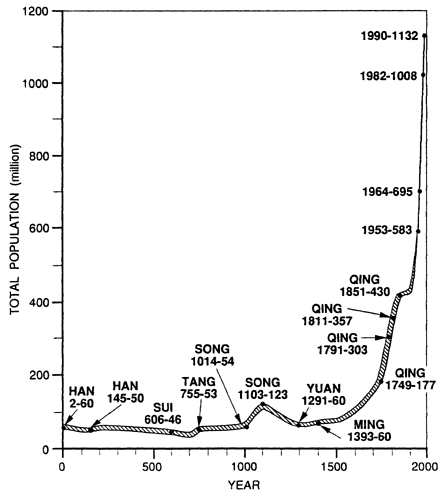
Looking at graphs like this, China's population shot up massively in a very short period. How did China adjust to this growth or even manage to feed these people?
2 Answers 2014-12-02
Basically, was Belisarius as great of a commander as strategy books depict him? It's almost hard to believe the things that he did and the wisdom he showed at such a relative young age.
2 Answers 2014-12-02
This is more of a what if than anything else and probably should not be here. We know that Germany and Japan in WW2 never was a looking at each others as allies since both sides did not talk to each other about there plans like the invade of the USSR, or the bombing of Pearl Harbor and such. How would the war change if they did talk these plans over to each other informing the other side as to what could work best? Would the war be about the same as we know it or would it be more costly in term of human lives. I know that both the Japanese and Hilter wanted to built their own "Empire" as to speak.
2 Answers 2014-12-02
The title practically says it all. I'm just asking about the economy of the United States. If a person were to be labelled as "rich" in the 1920s, what would their bank account amount to?
I'm trying to get a feel for how rich a character needs to be for a project of sorts. He's a fairly wealthy man.
Thoughts?
1 Answers 2014-12-02
1 Answers 2014-12-02
2 Answers 2014-12-02
(The title of this theme is cribbed from one of my favorite history books. And this theme definately wasn’t thought up while pissily doing housework.)
Previous weeks' Tuesday Trivias and the complete upcoming schedule.
What sort of work was done by women in your favorite time and place? It can be about work traditionally done by women in that society, or it can be women doing work outside of their traditional purview (like maybe Rosie the Riveter stuff), or it can be how certain gendered work either switched which gender it “belonged” to, or became ungendered. Or any other interpretation of “women’s work” you can come up with is good really.
Next week on Tuesday Trivia: Siblings! We’ll be telling stories of historic siblings.
8 Answers 2014-12-02
1 Answers 2014-12-02
2 Answers 2014-12-02
Trade along the so called Silk Road was so good in antquity that the ancient Romans had to pass sumptuary laws against silk and spices. Yet, according to a BBC Four "Medieval Mind" program, by the Middle Ages, contact with the East was incredibly weak. Europeans believed dog headed men and other mythical creatures lived there, and Marco Polo became famous for travelling there. How did this decay in contact happen?
1 Answers 2014-12-02
Broadly, I've always been interested in the topic, in a somewhat sideways manner, but have never made the effort to educate myself on it. This needs to be rectified. I'm hoping to get some direction towards a good starting point.
Specifically, I ran across yet another inane "knight versus samurai" thread in a different subreddit, and while those are mostly devoid of any value, it made me realize that, while I know that European metalworking was more developed than that in Japan for a given time frame, I don't know why. This ignorance irks me.
Also, the petty and spiteful part of me is hoping that this thread will end up being handy to link to for the purposes of debunking the "glorious Nippon steel" crowd the next time I see one of those asinine circlejerks.
Thanks in advance for your replies.
4 Answers 2014-12-02
Hi all! This is my very first post on Reddit! So excited :D
I was doing some reading on Late Antiquity this evening, and this question suddenly popped up in my mind: "What happened to Slavery after the fall of the Roman Empire"? I did some preliminary research (read: Googling) and it seems that slavery did not disappear overnight, and that there seems to be some connection between slavery and serfdom.
Could anyone elaborate on this and explain further? Are there any materials which you can recommend me if I want to learn more about this? Thanks.
2 Answers 2014-12-02
I'm watching the new Hurcules movie and there is a montage about a 1/4 of the way through showing an army marching, rank and file, for days. There is no interaction between each individual soldier, they're carrying only their fighting equipment (spear, sword, shield) and they're marching in unison as you would see a modern infantry unit during a military parade.
Yes, I know they are Greek soldiers in the film and, yes, I know it's only a film but it got me wondering about how soldiers travelled long distances in ancient times. I ask about Romans in particular to narrow the question down.
2 Answers 2014-12-02
Any region, any period. I think that it would be very difficult to prevent ingrowth and other problems without precise clippers or scissors. How did people do it?
2 Answers 2014-12-02
Any help greatly appreciated :)
1 Answers 2014-12-02
I've been seeing a lot of pictures on reddit of the Rhodesian war and selous scouts and im curious about race relations at the time. It seems like white infantrymen fighting besides black infantrymen was common. Were the black soldiers coerced or equal in the service?? It seems fairly egalitarian as there are both black and white privates but it would be interesting to know what those involved were fighting for and why the black soldiers especially were fighting for what i assime was a repressive state?
1 Answers 2014-12-02
I know there are more and more guns being carried by British Police all the time, but for a long time they were unarmed. How long as this been true for? Why aren't they armed?
As I was thinking about this question the entire notion of the British police system started making less and less sense, Why is London's police called Scotland Yard? Bob doesn't sound very Scottish, but still they're all called Bobbies? Are there other police forces around the country or is it unitary like their parliament? And if they're so good why does Sherlock Holmes seem to solve all the really tough crimes in London? ^^^^^^not ^^^^^^an ^^^^^^entirely ^^^^^^serious ^^^^^^question, ^^^^^^but ^^^^^^the ^^^^^^origin ^^^^^^of ^^^^^^my ^^^^^^interest ^^^^^^in ^^^^^^the ^^^^^^subject
and where does the Sherriff of Nottinham come into play? Seriously if he's around with King John, there aren't any parliaments around to make laws, and really he doesn't seem like a law man, more like a tax man to me.
Really it's all very confusing.
Basically, I'm interested in the history of Police in Britain, I love reading what the fantastic contributors here have to say, but I also like reading, so there's that if you have sources that are fun and interesting
3 Answers 2014-12-02
I'm wondering if they had static defences like bunkers and costal artillery or if they planned a mobile defence?
4 Answers 2014-12-02
1 Answers 2014-12-02