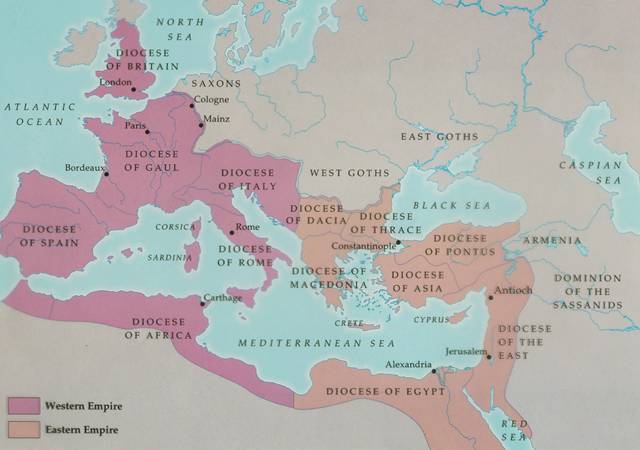
Maps such as these are often used to represent the division of the Roman Empire in the 3rd and 4th centuries:
http://www.littlejohnexplorers.com/jeff/history/twoempires.jpg
My question is: when travelling from Western to Eastern Europe, was there ever any equivalent to a sign that said "now entering the Eastern Roman Empire" (something less obvious than that, of course)? At one point did you stop being under the authority of the Western court and answer to Constantinople? Were there "border" towns? Was there any physical border marker between the two jurisdictions?
Another, tangentially related question: are there any signs put up today to mark the historically recognized dividing point between East and West (an equivalent to Hadrian's Wall)?
1 Answers 2014-11-20
Several left-wing politics have criticized the new Ubisoft game. In their opinion, it exaggerates the violence of the French people and presents them as blood-thirsty monsters, while the King and some aristocrats are seen as heroes.
Of course it's just a game and we should not be too worried about that kind of things, but what interests me is the claim that in the last years there is a lot of propaganda aiming to minimize the place of the Revolution in French identity in favor of presenting France as mainly a white Catholic nation.
Sources (in French): Alexis Corbiere, Jean-Luc Mélenchon in Le Monde, a thread in r/france
My apologies for the grammatical errors.
6 Answers 2014-11-20
I know that Stalin was concerned about the future security of the USSR. After all, the USSR lost almost 20 million people. However, the USSR was communist and didn't Roosevelt and Churchill want to stop the spread of communism?
2 Answers 2014-11-20
In the early 19th century, it seems like black is almost exclusively worn by Protestant priests, whereas the worldly formal attire seemed rather liberal and colorful, but at the eve of the century, it seems like it's one of the most, if not the most popular color for formal attire. How and why did this happen?
1 Answers 2014-11-20
1 Answers 2014-11-20
I am trying to remember the name of a culture I learned about, I believe from an exhibit several years ago at the Metropolitan Museum or maybe the Museum of Natural History. All I can remember is that their currency was, I think, a single large coin that they would display on the exterior of their property. I think I remember that it was a South American culture, but I could be wrong. The memory is quite fuzzy. Can anyone help?
1 Answers 2014-11-20
Why is the Texas Revolution called a revolution when it was more of a civil war? Texas at the time was a state of Mexico and the people in Texas had different opinions on issues such as slavery and government, much like the American Civil War. It was not the overthrow or government it was a war between citizens of the same country so shouldn't it be considered a civil war and not a revolution?
1 Answers 2014-11-20
Were the wealthier soldiers put in the back to ensure safety or was it just luck of the draw that determined a soldiers place in the battle line? I'm curious about this all the way from Roman times to the Napoleonic era.
2 Answers 2014-11-20
1 Answers 2014-11-20
1 Answers 2014-11-20
As Loyalists by definition, were they not satisfied with top-down British rule as it was in the Thirteen Colonies? This pro-democracy mindset would resound more with that of the rebels/patriots. So why be a Loyalist in the first place?
1 Answers 2014-11-20
1 Answers 2014-11-20
I was a bit surprised to learn that this corpulent king was actually quite dashingly good looking in his youth. However all images of him in public consciousness are always this obese guy. He was also quite the athlete from what I have gleaned from the histories. I know he must of liked to eat but is there anything, like a event or something that led to this change in attitude?
What happened?
Edit: clarification
1 Answers 2014-11-20
I was reading about the East India Company the other day and the article described how the company effectively governed most of the subcontinent. I was wondering why they would bother, governing and upholding laws does not seem like it's really a profitable enterprise. To boot they educated and trained large amounts of soldiers etc... Why did their stockholders support this?
1 Answers 2014-11-20
I'm interested in really the whole period: the lead-up to the revolution, the revolution itself, and then the rise of Napoleon. I imagine a great deal has been written about this, so what I'm really looking for are good pieces that give an overview of what actually happened for the layman. I've studied a lot of political theory that has to do with the period but don't feel like I have a strong enough grasp on the facts at this point.
1 Answers 2014-11-20
Outside of dietary restrictions through religious doctrine, do we have a rough idea of when abstaining from meat and/or meat products became something regular people chose to do personally? And when it became significantly popular?
1 Answers 2014-11-20
Hi all,
I have always had an interest in Viking history and general 'Dark Ages' history in England and Scandinavia. So far, most of the information I get on the topic has been from either the internet or historical fiction books/TV shows based in that era (a particular favourite is Bernard Cornwall's Saxon Stories series).
Recently finding myself with more time on my hands, I was hoping to do some more in depth research on the topic and I need your help. As suggested by the title, I am looking for some good resources which I can use to learn more about this topic. Any sort of media is fine (books, podcasts, documentaries, etc...).
Thanks heaps in advance.
Cheers, Valkyrie
3 Answers 2014-11-20
I've looked into the matter in a very general sense and it seems like they mostly had a positive impact in that they were able to secure roads and fortresses for the crusader states, but I know they also had some problems with one another in the area. So my question is what negative consequences, if any, did the orders bring about that might not have happened had they not been around?
1 Answers 2014-11-20
I mean in brief, how come these ex-criminals, found a civilization in remote isolated continent ??!! and now a civilized and powerful (regional power in area and have good economy) country.
and on the other hand, how come African countries did not do anything from the beginning of World ??
I mean once Middle East and Far East find a great empires and states but never in africa.
3 Answers 2014-11-20