A family acquaintance, an extremely experience and well educated career military man, claimed that the USSR suffered one million casualties in the race to Berlin. This is a far larger number than I’ve seen claimed elsewhere.
He further claims a full 100,000+ of those casualties were caused by intentional friendly fire as general Zhukov and Konev raced to the city. This acquaintance claims that he has read first hand accounts of full scale battles between these two generals men as they competed to get there first. In my limited research, I’ve seen zero evidence of this outside of more “typical” friendly fire insistence caused by mistake or miscommunication.
The ONLY reason I don’t IMMEDIATELY call bullshit is because he is generally very well read on history, but I don’t have enough sources on hand to be sure. That being said, his only source was basically “bro trust me”.
1 Answers 2021-07-11
There aren't many resources that really dig deep into the specificities of the ethnic composition of the empire. Event though that is understandable, considering the state of first-hand sources about the empire, I'd really like a comprehensive description of the cultures and peoples of the empire. This topic is in general a bit of a mystery to me, so all answers are appreciated!
1 Answers 2021-07-11
I recently read a short blurb about the anarchist "Black Guards" / "Black Army" in Ukraine that formed during the February Revolution and subsequently allied with the Bolsheviks in the Russian Civil War where they allegedly won a decisive campaign against Denikin's southern army forcing him to abandon his final push for Moscow, thus saving the Red Army from defeat.
But shortly thereafter, the relations between Bolsheviks and Makhnov almost immediately collapsed and the Black Army fought against Red and White armies until they were completely ground up.
Now I wonder how much of this is actually factual. Did Nestor Makhnov and his Black Army really save the Bolsheviks in the nick of time? And did they really repay him with almost immediately turning on him and crushing the anarchist forces? If so, what led to this rapid collapse of the alliance? Ideological differences? Questions of power/self governance? Personal differences?
1 Answers 2021-07-11
Ive been looking into becoming more into history and be able to communicate how things played but i was wondering where do historians get their sources from and how do they get access to it🤔
1 Answers 2021-07-11
Why does somebody turn traitor? Often it's motivated out of greed or self-preservation, but sometimes it's motivated out of bitterness, a lack of gratitude on the part of the leaders they serve under.
Benedict Arnold is remembered as a traitor while the leg he lost at Saratoga is forgotten. Ironically, if he hadn't been a great patriot, he never would've lost his leg and been assigned to defend West Point.
So my question is: was Benedict Arnold treated fairly by the Congress, the press and General Washington? Was his contributions at Saratoga recognized enough? Did many others share his belief that he had been slighted?
1 Answers 2021-07-11
I was reading a biography of Alexander Solzhenitsyn and it mentioned that his father arranged for his fiance to meet him at the front during WW1 and they were married by the chaplain there.
My question is, was this common in WW1 or other wars? Really any info about wives/families travelling with soldiers to the front lines would be interesting.
1 Answers 2021-07-11
I know there were laws passing anti-Semitism in Nazi Germany, but was the Holocaust in itself legal?
1 Answers 2021-07-11
Why did the United States declare war on the Empire of Japan on the 8th of December when Japan already gave them a declaration of war? Was it to show public support or to try to recover some morale?
1 Answers 2021-07-11
Historically, the Czech lands were called Bohemia (even though it also included Moravia and Silesia) but at some point during Austria-Hungarian ownership it started being referred to as Czech. What caused this change in name? And why, after the creation of their own country, did they not become Bohemia again?
1 Answers 2021-07-11
Relevant text: Jerking out these words like a hoarse sigh, the driver went out and soon after returned with another bag, then went out once more and this time brought the postman's sword on a big belt, of the pattern of that long flat blade with which Judith is portrayed by the bedside of Holofernes in cheap woodcuts.
It occurred to me that perhaps this isn't a part of the postal worker's equipment per se, just something this one dude happens to carry with him. Even so, it seems like an anachronistic thing to carry for a someone in the late 19th century.
1 Answers 2021-07-11
I've looked on Google Images and compared it against the thing I see (on the side of my dad's refrigerator) and I hope it's not one. It's different enough that I'm holding out hope, but ... well, I definitely want to confirm what it is before I take action (rip that sucker off).
Edited to add an image link: http://imgur.com/gallery/hugDixC
1 Answers 2021-07-11
The Qing dynasty was blessed with two incredible founding rulers, Nurhaci and Hong Taiji, who consolidated the Jurchen/Manchus and laid the foundation for Qing dominance.
However, after Hong Taiji, the Qing had two child emperors: Shunzhi and Kangxi, both with regents who eventually consolidated much power to themselves (Dorgon and Oboi). If you're a Chinese dynasty and your founding figure was succeeded by a child, that typically meant that you were ripe for usurpation/disruption of your dynastic line.
Yet despite the power struggles of various individuals, the Qing managed to conquer Beijing, and eventually pacify all of China. How did they managed to complete such an arduous task, where so many previous dynasties were doomed by young/unprepared monarchs?
1 Answers 2021-07-11
I get that chemicals like Chilean saltpeter would cause problems for the war effort, but I don't get how the blockade would starve Germany out so badly. Were nitrates and phosphates so important that they also played an important part in the agricultural effort in Germany (so no chemicals being imported meant they would have reduced crop yields)?
1 Answers 2021-07-11
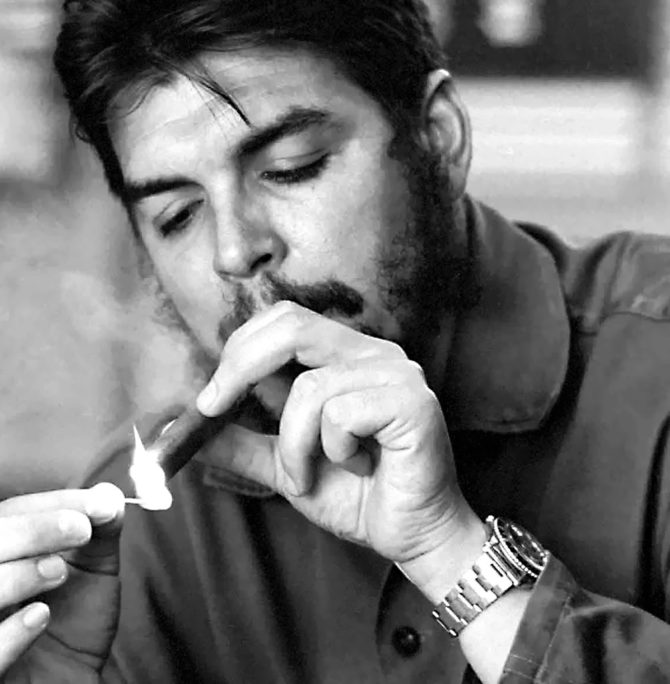
This photo seems like it could have caused issues. My understanding is that Che eschewed most material goods and wasn't a fan of luxury generally, but I am curious if anybody attacked him for this.
1 Answers 2021-07-11
Today:
Welcome to this week's instalment of /r/AskHistorians' Sunday Digest (formerly the Day of Reflection). Nobody can read all the questions and answers that are posted here, so in this thread we invite you to share anything you'd like to highlight from the last week - an interesting discussion, an informative answer, an insightful question that was overlooked, or anything else.
3 Answers 2021-07-11
Or is note-taking a relatively new occurrence in the history of academia?
1 Answers 2021-07-11
7 Answers 2021-07-11
1 Answers 2021-07-11
This is shown in many movies and tv shows as i'm sure you know, Was just wondering if this is something that actually happened on a wide scale or whether it was just hollywood making shit up for dramatic effect.
1 Answers 2021-07-11
At my local IKEA, they had a video playing inside bragging about how ikea created the concept of Flat Packing and efficiently packing boxes to revolutionize the process of transporting goods(...in like 1956?).
This struck me as ... a lot more recent than I would have figured.
There are mathematical models and this is a well-studied concept (efficiently shoving as much crap into as small a space as possible).
Is this true? Did the concept of shipping products in small boxes really not get started until IKEA figured out this basic concept in the 1950s?
Hell, we already fought two world wars which involved the shipping/transport of likely TRILLIONS of pounds of stuff around the planet very quickly.
1 Answers 2021-07-11
1 Answers 2021-07-11
India also scores higher on many other metrics such as quality of life, GDP per capita. What could explain this?
1 Answers 2021-07-11
It seems incredibly difficult to me to know what you can actually do in negotiations especially if the state was ruled by a lot of elected officials like Roman Republic or UK to some extent. Sending a message to London from Calcutta and waiting months for a response does not seem very conducive to an effective system.
1 Answers 2021-07-11
I'd like to read about the ancient populations that combined to make up the modern day Indian population i.e. Ancestral North Indians(ANI)/Aryans and Ancestral South Indians(ASI)/Dravidians (although afaik all of those terms are misnomers to a certain extent). I also think we know of some East Asian admixture in modern-day East and North-East India so I'm interested in that too.
I'm interested in their culture, politics, religion (Dravidian religion in particular since there's so little information about it online), food and the ways in which the populations interacted. I'd also like to learn about the relationships between these populations and non-Indian ones. For example, the Aryan religion is said to have similarities with other Central Asian and European religions so that's an interesting topic to me.
This is a pretty politically charged subject so even though I've found some promising books online, I'm a little wary of political agendas of any kind. I'm also open to research papers but of course I prefer books for readability. If you take the time to actually write out answer on any of the topics, I'll be incredibly grateful.
1 Answers 2021-07-11