I have seen random fiction writers maintain such lists all over on Twitter/Goodreads etc.
I was curious if I can follow a list like that?
I know this sub has a Goodreads accounts. This is an additional list I would like to follow.
1 Answers 2021-06-30
1 Answers 2021-06-30
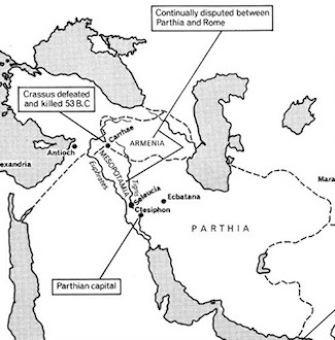
Alexander the Great's path of expansion, I don't have a proper pic of the path Crassus took, but this general map of location of Carrhae seems to get the point across. It seems a bit odd to point fingers at Crassus so much for his choice of path when it had actually worked for the greatest military expedition in history a few centuries back.
Yes, things had changed and all that, but it wasn't like he was crossing the Alps with giraffes or sth...
1 Answers 2021-06-30
The exact phrasing is attributed to first NATO Secretary General Hastings Lionel Ismay, who is credited as the first to claim that organization was created to "keep the Soviet Union out, the Americans in, and the Germans down".
This was said in the immediate post-War environment when the idea of Germany as a destabilizing force in Europe was fresh on the minds of European (and American?) leadership. Did such fears about (West) Germany really exist as the Cold War dragged on? Did later 20th century NATO policy really intend to "keep Germany down"? If so, how?
On a related note, how did West Germany's arms industry rebuild after the 2nd World War and what restrictions did they face? I've heard that FN (a private company in Belgium that works closely with the Belgian state) was happy to sell arms to the German military in the 1950s but refused to enter in any partnerships or share technical data that might help German arms companies rebuild their industry. Would something like this be a result of official restrictions or economic/political prudence?
Thank you!
1 Answers 2021-06-30
As of late I've been wondering on the subject of dual weilding melee weapons, specifically related to fantasy depictions on the subject such as dual axes.
I am aware that the most functional and we'll recorded dual weilding style is relate to sword and dagger, but on my research I came across Viking sagas speaking of certain vikings actually picking up two axes and the Chinese melon hammers style (I am not sure if that's the correct name). This made me wonder how practical these techniques are and if there are other unusual dual weilding styles I'm unaware of.
TLDR: Are there other less known styles of dual weilding melee weapons similar to Sword and Dagger and how practical are they?
Just as an example: weilding a dagger on one hand and a mace on the other.
1 Answers 2021-06-30
I found this post very interesting. Basically, it claims that the Toltecs and their religion destabilised most of mesoamerica and it wasn't until the Aztecs came around that they began getting rid of some of the most extreme part of the Toltec 'religious cult' and bring stability back to the area. How much of this is true, and where can I read more about this?
1 Answers 2021-06-30
I've heard it said from different people that, because of the huge amount of Catholic Church holidays, medieval peasants only had to work 120 to 150 days a year. Now this is purely anecdotal on my part, but I feel like most people I know if given the option to work so few hours would actually prefer to work longer if it meant making more money, and from what I've seen in subsistence agriculture in the modern world generally the farmers try to find ways to supplement their lifestyles and increase their productivity when they can. I've also heard some people say that the restrictions on working were not optional, that the peasants wanted to work more but were forced not to. And I've heard other people say that the 120-150 days of work were just the days they had to work on their lord's land, and they still had to spend the other "free days" working their own land to feed themselves.
Honestly I don't know if any of what I've just said has any basis in truth, I'm just trying to figure out, if the whole "working only 120-150 days" thing is true, why most peasants would choose to work so little.
1 Answers 2021-06-30
Unternehmen Barbarossa and Fall Blau are two cases I've come across where the Soviets had repeated and reliable warnings about Nazi German military plans, and yet Stalin refused to believe the reports and denied his military the authorization to act on the intelligence.
So... uh... why?
2 Answers 2021-06-30
Remember, it is said that the Hurricane is slower than a Spitfire, Hurricane's were mostly used to shoot down Dive Bombers and Bombers, mostly, Spitfire's would be the perfect match for the Me-109's, so what would the Hurricane pilot do if he got into a Dogfight against the Me-109, Me-109's were certainly faster than a Hurricane, they can outrun the Hurricane in terms of speed, so what did British Hurricane Pilots do to dogfight against a Me-109?
1 Answers 2021-06-30
I figured this would have died out decades if not centuries ago, but as I have recently been doing research on the native Americans, I find several documentaries and articles still referring to them "American Indians" or something similar. This bothers me for several reasons. One, because it makes it more difficult to look up information on them. And two, far more importantly, they're not Indian. They're not even directly related. So why have we not phased that term out? Other misnomers and/or offensive terms have been, so why not this one?
2 Answers 2021-06-30
I was reading a book a while back and it talked about how in a major battle, the Americans were firing so many shots so fast that the Germans believed a fully automatic howitzer had been created. It got me thinking as to why we didn’t have any. Would single shot batteries be cheaper and easier? Anyways thanks for the help.
1 Answers 2021-06-29
1 Answers 2021-06-29
I’ve seen two different pieces of “evidence” of a “hoax”, and I’m sitting here going “Surely, there are ways to debunk this.”
1.) The aerial photos showing smoke coming from the smoke stacks of crematoriums do not have certain shadows projecting from the smoke stacks
2.) The soil texture in the concentration camps were not deep enough for mass graves
1 Answers 2021-06-29
I’ve heard two very simplified answers to this question.
A. France had a big population. That surely can’t be the only answer or else russia would’ve also conquered Europe.
B. Artillery and cavalry. But these two had been part of armies for centuries right? What had Napoleon done differently?
1 Answers 2021-06-29
It seems that St. Louis was a major city in French Louisiana, but unlike New Orleans, it seems that St. Louis lost much of its French heritage. How come New Orleans has managed to stay more French than St. Louis? Did substantial Irish and German immigration to St. Louis during the 1830s play a part in diminishing French influence in the city, and if so, how come New Orleans retained its French influence despite also having Irish and German immigration in the 1830s?
1 Answers 2021-06-29
1 Answers 2021-06-29
I hope this question isn't too broad. To give some leading questions, I'm curious as to what the strongest world power was back then. What were the strongest powers in each continent? What was life like for the average citizen? Did kingdoms hold special celebrations for the year 1000?
1 Answers 2021-06-29
Hi, don't know if this is the right place to ask, but... My grandad was a tanky in ww2, he died last January. The lads he was close with died (we think in Belgium) when their tank was hit, my Grandad was the only survivor, and he wanted his ashes to be with them eventually. Could anyone advise me how I would find out where this event happened, so that we can complete this for him? Thanks, and apologies if this isn't the right place to ask. X
1 Answers 2021-06-29
Why was he not allowed to stand for consul in absentia in 50 BC? They had been willing to break tradition for Pompey in more unprecedent ways when he was made sole consul, why not just let Caesar run for consul?
1 Answers 2021-06-29
So obviously, it might seem like this question is better suited for r/askphilosophy, but since q's there have to be distinctly philosophical, and what I'm asking is definitely more of a historical account than a call for opinion, I figure I'd ask it here.
I'm researching the history of Thales, the man credited with being the "first philosopher," and namely his concept that all things have a principle substance (an 'arche') which he believed was water. However, I cannot seem to find any direct account of this being his belief other than a mention in a work of Aristotle, who was born 200 years after Thales died.
What I'm wondering is, are there any more sources besides Aristotle claiming that he said this? Such as someone who lived earlier than him, who may have a more direct account? And if not, how reliable can Aristotle generally be considered as a historian when it comes to the classical era? I am pretty sure that this is not the only time he is cited as a primary source on a historical account, so is he seen as someone who cared about the truth and can be believed? or rather someone who enjoyed giving interesting yet false narratives for the sake of poetic interest? I would not think him to be someone who dedicated himself to history, but when it came to the history of philosophy, which was still new and fresh at the time, he might have taken a more disciplined and focused approach
1 Answers 2021-06-29
It seems like carbon dating and DNA sequencing human remains would be a good way to make a "family tree" and timeline of Indian tribes. If you then compared the spread of genes to linguistic connections, you might discover another dimension of tribal relationship that could possibly corroborate oral histories or indicate new connections to be studied. (Though a timeline of genetic movement across pre-Columbian North America seems like a worthy end, unto itself.)
Related: Is there a secondary cultural dissonance, wherein the relevant Indian leaders don't value historical knowledge/view epistemology/[articulation of a concept along those lines you find palatable] the way Enlightenment (albeit perhaps rose-tinted)-(intellectually-)descended academics* do? And/or a general resentment against becoming a "subject" to be studied by outsiders? (A resentful tribe could, in turn, send an interested member to OxBridge to become a physical anthropologist specializing in Anglo-Saxon history, but, of course, the British might consider this a complement.)
*I hope that makes sense - "Enlightenment values/tradition" are/is varied/nebulous, but there is an academic/intellectual/pedagogical lineage by that name.
2 Answers 2021-06-29
I've noticed historically speaking the Jewish people are often the target of scorn. I can make sense of contemporary hatred as it seems rooted in evangelicalism, however, why would for example, the Argentine Military Junta pick the Jewish people as representative (to some degree) of the "Marxist threat"?
Is it more often the case this is religious discrimination or ethnic discrimination?
Asking as a non-religious person.
2 Answers 2021-06-29
1 Answers 2021-06-29
From what I can tell Adams was seen as divisive and hard-headed. I mean he was referred to in the Senate as "his rotundancy." I know he was a part of the Continental congress and was ambassador to the UK, but beyond that it isn't entirely clear to me why he was chosen. So why was the fat, divisive, Bostonian who would go on to be the first one term president, chosen to be our first Vice President? and why was he seen as the better successor to the immensely popular George Washington over say, Jefferson, Hamilton, or Clinton?
1 Answers 2021-06-29
Like the title said...what was it that caused Christianity to win out over Norse/Germanic paganism? Was it the message of Christianity or was it political convert or die? Was it some combination of the two? Where can I learn more?
2 Answers 2021-06-29