1 Answers 2014-04-09
Wondering if it was just a small group of elites and merchants in these developed countries that benefitted from imperialism or if the quality of life for an average factory worker was improved
1 Answers 2014-04-09
1 Answers 2014-04-09
I used to work for a company and we would go around doing gladiator reenactments, it was great and fun, however one thing that the boss always said was that if I could find a reference to any gladiator having used an axe, I would be allowed to use one in the fight. Now I have been drawn to fight a Hoplomachus as a Murmillo of a Thracian, but the offer still stands if I can find a reference to using an axe. We like to try and keep is as historically accurate as possible. I am bored of fighting with a Gladius its not as fun. I know that Spartacus (the recent tv adaptation) had their Secutors use axes, however I cannot find anywhere any kind of historical reference to this and wonder if it was just for entertainment purposes. I know that it is traditionally a sword for a Gladiator, but does anyone have anything at all? Help someone out to hit someone else with an axe for entertainment purposes!
asked on /r/history suggested to ask here
1 Answers 2014-04-09
1 Answers 2014-04-09
He was briefly mentioned in this AV Club article, but I can't seem to find much info on him. He has no Wikipedia page and not very many Google hits, which seems strange. All I can find out is that he is apparently living in exile in Cuba. It certainly sounds like a fascinating story.
1 Answers 2014-04-09
How did this vary through different places and time periods in Europe?
1 Answers 2014-04-09
This weekly feature is a place to discuss new developments in fields of history and archaeology. This can be newly discovered documents and archaeological sites, recent publications, documents that have just become publicly available through digitization or the opening of archives, and new theories and interpretations.
2 Answers 2014-04-09
Also what film/game/TV show has given the most accurate representation
1 Answers 2014-04-09
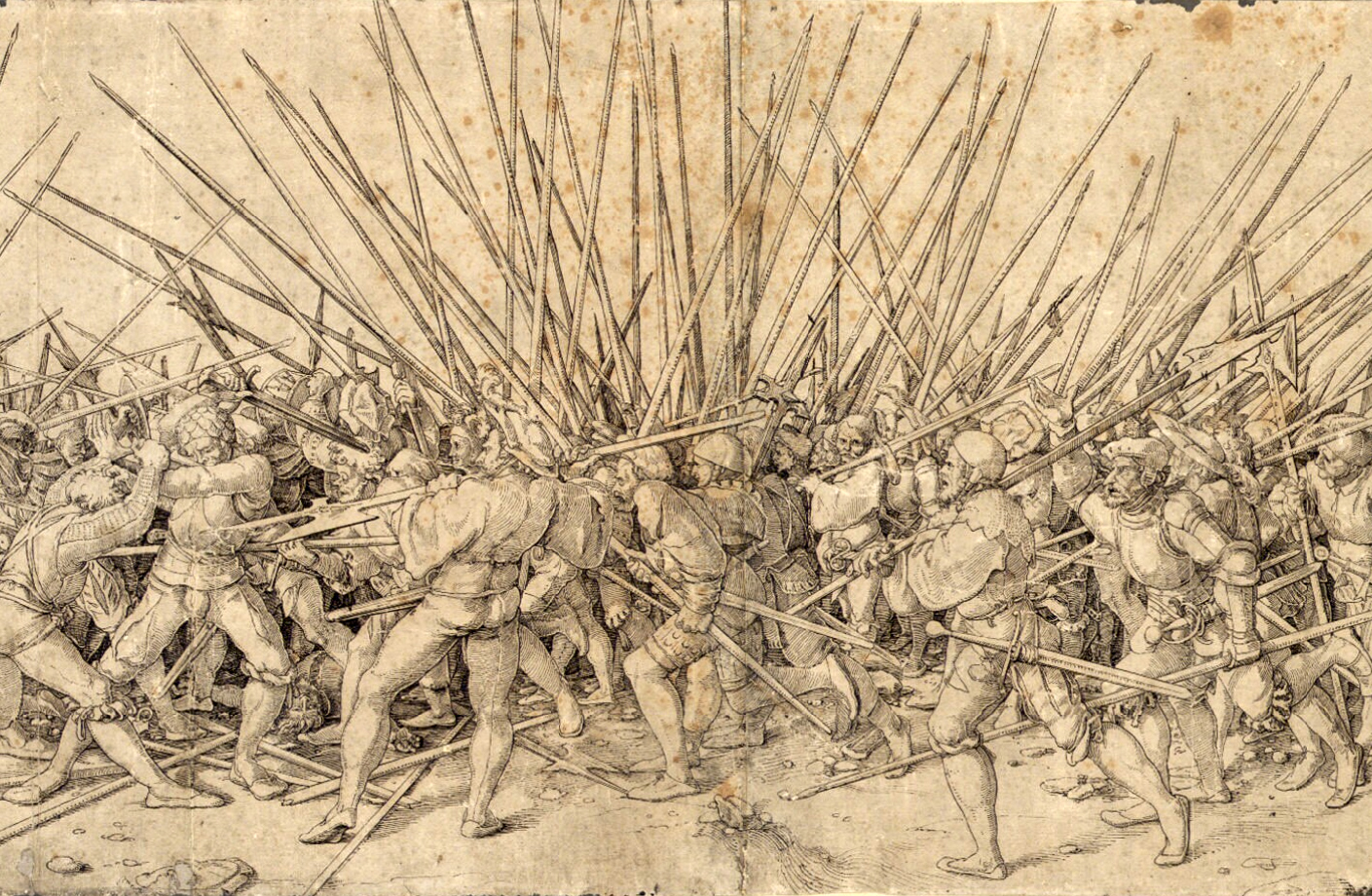
There is a lot of controversy and confusion over this term. It is the moment when just the advance of pike isn’t sufficient to scare the enemy into fleeing for their lives (which was the usual scenario). Against an equal opponent the pikes will not just chase the enemy away, but will actually engage them. Both sides will interlock their weapons, standing at the furthest reach they can, and will try and thrust their own pike at the enemy while avoiding the thrusts of the enemy pike. This is called the 'push of pike'.
'Push' does not mean what it means today of a sort of general scrummage. The original medieval meaning of ‘push’ was to thrust or stab with one’s weapon.
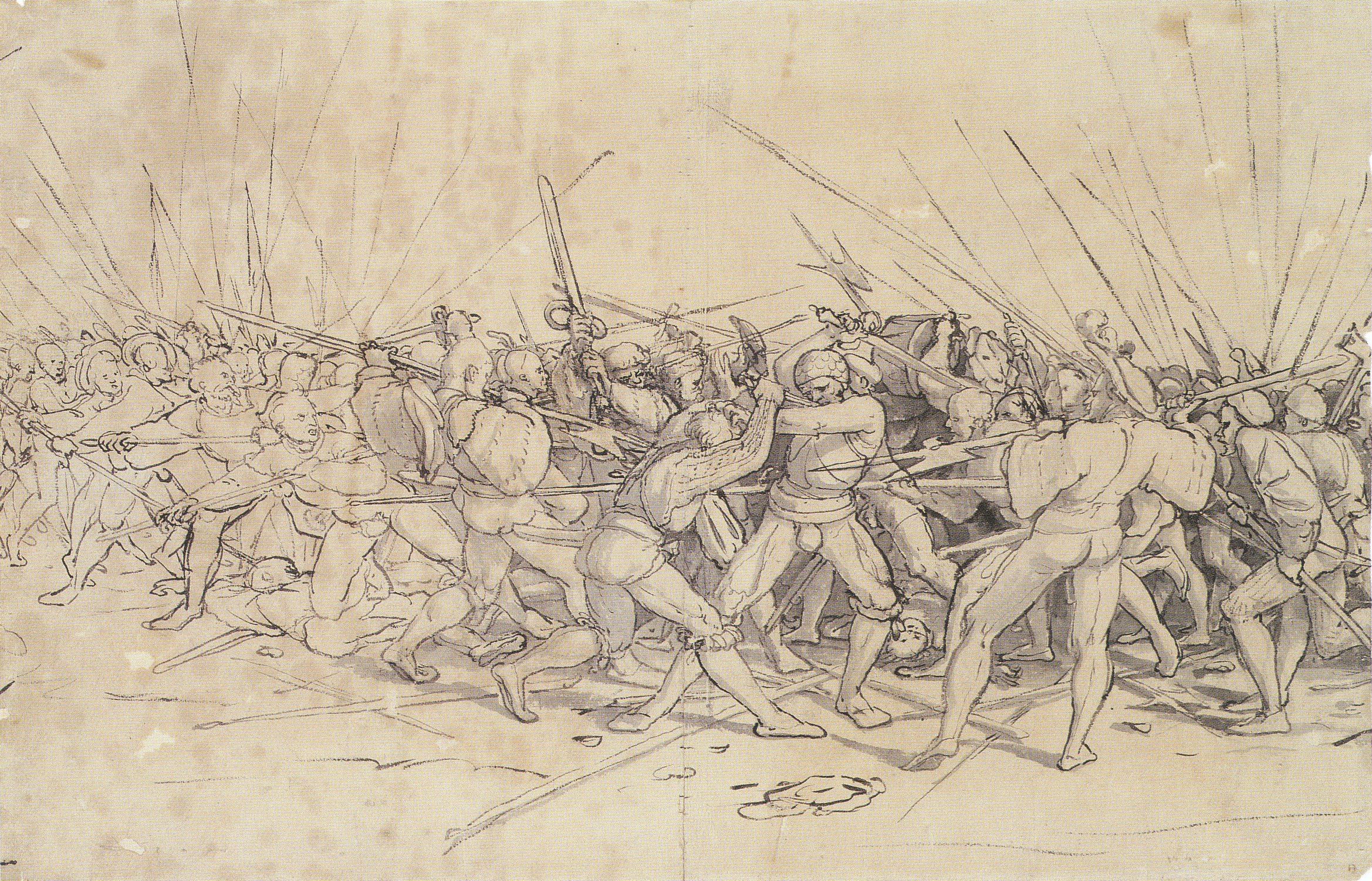
So therefore ‘this is certainly not push of pike, since they aren’t pushing their pikes at the enemy at all. The Wikipedia page uses this image as a representation, which is a reproduction from this image (or this version has some more detail). But this is not push of pike – it is explicitly titled ‘bad war’ which is the moment when the push has collapsed into disorder and the pikes have been swopped for melee weapons.
As I understand it this is push of pike or this image which shows that pike fighting wasn’t a free-for-all but a definite duelling battle between matched opponents in order.
So my questions are these? Does anyone have any more sources on push of pike, any drawings, or primary sources describing them, avoiding the errors I’ve highlighted above? I’ve checked the various previous posts on AskHistorians already so please don’t direct me to them. In addition I’d like to ask:
How long could a pikeman fight for before becoming exhausted? This would obviously depend on the length of pike. As pikes got longer they’d become more dominant in mass formation, but less easy to handle individually. So:
What is the optimum length pike for an average soldier to fight with, assuming they want to be able to fight, and not just hope the enemy runs away (which was always the best case scenario). I know in the English Civil War pikes were supplied at a regulation 16 foot but many pikemen found this too unwieldy and chopped the first few feet off them.
In tercios only around half of the pikemen were fully armoured, and the rest were unarmoured with only a morion style helmet. What was the point of these unarmoured pikemen? Obviously they couldn’t fight on the front rank since they’d be at a significant disadvantage, and they’d know it. So they’d probably run away before throwing themselves unarmoured onto the points of the enemy pikes. Perhaps they were there only to provide depth, but what was the point of having deep formations when most of the men can’t directly engage the enemy.
1 Answers 2014-04-09
So i've been doing a bit of reading for my thesis. and i have a few questions on the early-mid stage of the Israel-Palestinian Conflict .. 1960s
What exactly was the British stand towards Israel? They seem to have support the partition yet they then impose control on number of Jews Immigrant as well as saying things like :"we don't take orders from jews" (sir john shaw). I thought the British had supported Israel from the beginning (Zionists.. WW1+2)?
Also, Why did the jews launch the attack at the King David Hotel against the British servicemen when the British is one of the very few groups that do support them in the beginning? why would they do this when it was the british who helped them migrated to Palestine?? why would the extremist groups attack the 'closest' thing they have to an 'ally' especially when the Jews are developing tensions with the surrounding arab states? What was the point of the attack??
Lastly, after Sadat came to power; it says he want to seek a detente with USA as he removed all Russian advisors, yet he still decides to engage in war with Israel at the same time? Why did he have this policy.. I don't see why it would make sense to seek friendly relations with America while trying to invade Israel at the same time.. Wouldn't it benefit him more if he had stayed with the USSR?
Also, in the peace talks between Israel- Palestine.. Which of the peace talk do you think is the most significant one, and why?
Thanks everyone. If there is something in my question that you need clarified please message me. :)
3 Answers 2014-04-09
They cant have just upped and left - but they were horrific conditions to be in - what happened?
3 Answers 2014-04-09
Was just musing on the relationships between sport and politics in general after the Sochi games (and the upcoming Sochi Grand Prix), and I was interested in the historical aspects. I have a few wonderings on the theme if you'll indulge me...
The earliest examples I can think of of sporting events being leveraged by politicians for political ends are the 1934 World Cup in Italy and the 1936 Olympics in Berlin and Garmisch-Partenkirchen. Any other earlier examples?
In Europe, club football (soccer) teams have sometimes been supported semi-officially by dictatorial governments to various extents including "encouraging" the best players to sign, leaning on referees and financial support (eg Franco's Real Madrid, the Stasi's support for Dynamo Berlin and Steaua Bucharest under Ceaucescu). How well-known was this at the time, and what did fans of the team in question think? Did they resent being "leveraged", or was it OK since they were winning?
1 Answers 2014-04-09
Hello, on April Fools there was this topic with the exact same title as this one. However, there weren't given any serious answers (April fools harharhar). As it so happens to be however, I need to do some research into the history of immigration documentation/visas and I was wondering if anyone could answer the question for real this time! Thank you in advance.
1 Answers 2014-04-09
3 Answers 2014-04-09
1 Answers 2014-04-09
The western, latin-speaking Roman empire was torn apart by barbarian invasions and migrations, yet with very few exceptions people living in those areas still speak latin based languages.
It's my understanding that the eastern mediterranean was largely greek speaking since before the roman empire and then became almost completely hellenized during the Byzantine era. Given that Greek culture was influencing places like Anatolia and Egypt for so long, why did this legacy fade away so quickly after the fall of the byzantines?
Thanks
4 Answers 2014-04-09
A lot of Region nuts seem to think so, I was just wondering if there was any facts to back up the claim.
1 Answers 2014-04-09
Why did it occur? Who was involved? And why in most photos that I have seen are the Rhodesian soldiers all white (Specifically Afrikaans looking)?
1 Answers 2014-04-09
I've been curious as to what would happen if Hitler had actually built his empire in Europe. Would he have to constantly deal with riots or attacks on its borders from say America?
1 Answers 2014-04-09
It seems pretty murky and contradictory at first glance - almost impossible to infer what he actually thought.
1 Answers 2014-04-09
Were meals such a significant social event that it made sense to specify it as their last meal together, and not just the last meeting (that also happened to have food?) The importance of the occasion is its significance to the Biblical story, and not because the disciples ate with Jesus, so is there any particular reason it was named that?
1 Answers 2014-04-09
Okay, so. I'm working on a story set in the 1930's circus kind of era, and I'm finding it really hard to be authentic as far as the language goes. It sounds really modern. Are there databases of linguistics around that I can find, or even television shows that stay relatively faithful to the dialect? Any help would be really appreciated. Thanks in advance.
Edit: Sorry, I should specify, I'm aiming for the southern dialect. I think, I'm not American.
1 Answers 2014-04-09
Are there any standard travel times for tips that stretched the Mediterranean sea eg Spain to Greece or Rome to Alexandria ?
Furthermore would a galley be faster under oar or wind power assuming you were not working rowers to death?
2 Answers 2014-04-09