What was life like for a citizen and did they have a right to trial or what it backwards where they accuse you of a crime like in old England. Did the Byzantines have slaves?
1 Answers 2021-02-18
1 Answers 2021-02-18
How far back could you go and still understand someone?
1 Answers 2021-02-18
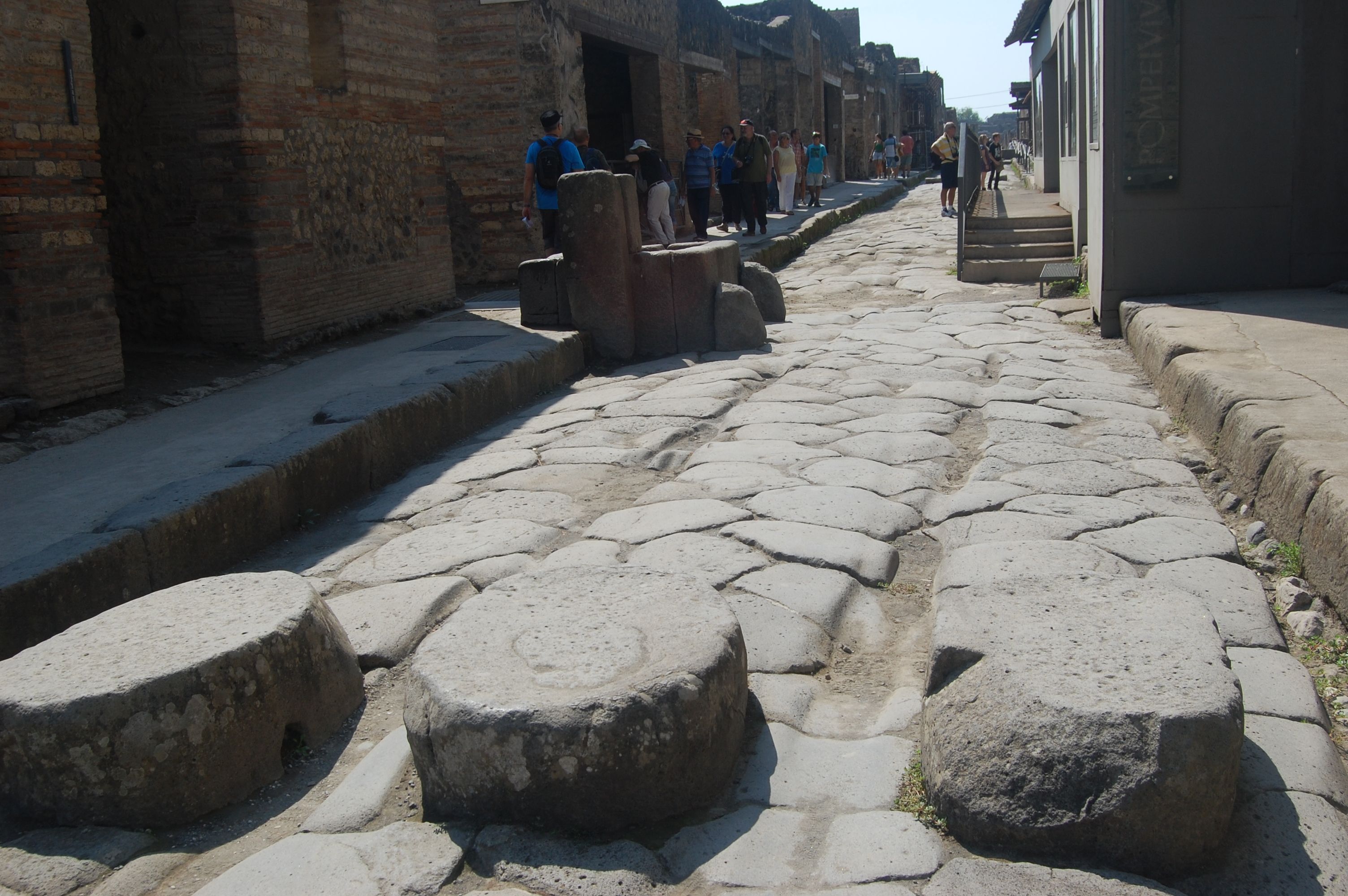
I visited Pompeii as a kid and one of the things that stuck with me the most (after the Priapus wall art and prostitution menu and comment section graffiti) was the elevated sidewalks and giant stepping stones for pedestrians to cross the street. I think it was the tour guide that noted that this was designed so that citizens could cross the street without stepping into the river of liquid shit flowing through the streets. Is that generally accurate?
If “dumping the bucket in the street every morning” was the extent of urban waste removal 2000 years ago, was it common for cities to be designed around always having streets flowing downhill and preventing intersections at a low point that would turn into a shitpond? Was part of the reason that men used to wear heels was to help keep their feet and clothes out of the shitrivers? Would the property values in the city be determined by proximity to major shitcanal, with the worst parts of the city being the lowest? Would there be a designated shitstreet where everyone collectively agreed to limit their waste removal to?
1 Answers 2021-02-18
In the United States, the idea of single payer health care has become a hot topic of discussion. Those on the right flat out reject it, and many on the left believe it must be implemented immediately. A middle ground argument is that we need to phase out the current system while slowly phasing in single payer. This middle argument takes into account how the initial cost would be a huge spike in US spending (at first) and would also render a large part of the US economy, the health care industry, partially obsolete, eliminating thousands of jobs immediately and potentially thousands more in years following.
So my question is: for countries such as the UK with established single payer systems, how long did the implementation of care take to become a truly single payer health care system take? I imagine it wasn't an immediate "this is how much we are spending and you are guaranteed all of this and you will all be taxed this much", but I could just be ignorant.
Thanks for any info anyone can give me!
1 Answers 2021-02-18
From the signing of the Declaration of Independence in 1776 and when Washington became President in 1789, what did the forming government do as to leadership?
1 Answers 2021-02-18
I would have though he would have given Alexander wanted to make Babylon his capital. And why did he found a new city (Seleucia) and force people in Babylon to move there?
1 Answers 2021-02-18
"And the rocket's red glare, the bombs bursting in air, gave proof through the night that our flag was still there."
The American revolutionary war was well before the times of war planes and modern missiles. What were the rockets and bombs of this time period like? We're bombs often blowing up in the air on purpose?
1 Answers 2021-02-18
1 Answers 2021-02-18
I recently learned that tomatoes are native the south and central America, and are not European as I had previously assumed. Given this, I would like to know a little bit more about the use of tomatoes in Italian cuisine. Many popular Italian dishes make use of tomatoes in some way, from a simple marinara sauce to lasagna to pizza. Seeing as tomatoes were only introduced to Italy about 5 centuries ago, how did tomatoes become so prominently featured in Italian food, and how was the landscape of Italian food altered by their introduction?
1 Answers 2021-02-18
When an asian person would go to a segregated movie theater or train station, would they be allowed to sit with whites or would they not be allowed entrance at all?
1 Answers 2021-02-18
I'm just baffled at how Hitler's pet project somehow became the symbol of peace and freedom in the hippie era. What was that transition like? Did they ever publicly distance or acknowledge their origins at all?
1 Answers 2021-02-18
I'm reading Southeast Asia: Past and Present by Nicholas Tarling (1966). It's a fun and relatively concise read zooming through ancient history and then going quit in depth when we come to the European colonization of "the Archipelago."
Tarling isn't quite consistent with his framing, however, and to his credit acknowledges that he's not very consistent in the intro. Though he lists that the first "colonial" influences were India and China, and then Spain and Portugal, and then England and the Netherlands.
Ok. Ok. The Spanish obviously got the Philippines and were barred from the rest of Asian colonization because of Tordesilllas, and the Portuguese did end up with East Timor until the later 20th Century, but why weren't the Portuguese a bigger influence in the region to the point that they could have conquered "the Archipelago" itself before the Dutch?
Tarling's reasons are kind of ticking me off, to be frank. He says that Portugal is(/was) sparsely populated and so they had to rely upon the "black Portuguese" and a lot of slaves from Mozambique to police their empire, and more and more Portuguese and esp. black Portuguese took Asian wives, to the point that they had no concern or even trade with the "fatherland" and so this far fringe of the Portuguese Empire withered before it could truly take off.
Um. What.
I'm not saying this couldn't have been a contributing factor. But the Portuguese conquered Brazil, Angola, and Mozambique in the meantime. And not only that, but managed to hold and fortify Goa until the mid-20th Century. And I thought "OK, maybe I'm underestimating the impact of disease on the indigenous population of Brasil, so maybe the Portuguese had the demographic advantage," but they wouldn't have had that advantage at all in Africa or India, and yet managed to maintain a powerful commercial empire in the region.
Not to mention that the freakin' Dutch have an equally tiny country in both size and population and I just... I find it hard to believe that the Dutch overcame demographic challenges that the Portuguese couldn't.
Am I going crazy? Or am I onto something here?
tl;dr: Why were the Dutch successful in Indonesia while the Portuguese were comparative failures?
1 Answers 2021-02-18
TIL about the Texas State Constitution, Article 1.2, giving Texans a positive and explicit Right of Revolution.
From the Capitol website and the Texas Legislative Council:
All political power is inherent in the people, and all free governments are founded on their authority, and instituted for their benefit. The faith of the people of Texas stands pledged to the preservation of a republican form of government, and, subject to this limitation only, they have at all times the inalienable right to alter, reform or abolish their government in such manner as they may think expedient.
How come this made it into the language at all? Was there any followup or development in positive or case law?
There's similar Right of Revolution clauses in New Hampshire, Kentucky, Pennsylvania, Tennesee, and North Carolina, so there seems to have been a trend of thought at a given time among US lawmakers. Where does this idea come from, and where did it lead in practice?
1 Answers 2021-02-18
I don't want to try to speak for everybody since bodies and lives are different and all, but I'd hazard most of the women I know could not do this for reasons that have nothing to do with willpower. How did this work, exactly?
EDIT: Sorry, guess I was too vague. I'm talking about urination, defecation, menstruation, etc. All of it. Was tgere any restroom access, even in an emergency? What if employees were sick; presumably they'd still be expected to work, right? What menstrual products were available at the time and how long did they last? Etc
1 Answers 2021-02-18
1 Answers 2021-02-18
Is there a book or a series of books that I can read that provides a narrative timeline of Scottish History? I am interested in gaining a broad understanding of the whole of Scottish History and then drilling into specific areas. However, there are very few 'all encompassing' books. I think there can also be a political slant (or claims of political biases) attributed to Scottish history. Any help would be appreciated!
1 Answers 2021-02-18
I've noticed a recent trend in among younger Irish history fans/commentstors (not historians) arguing that the Irish Potato Famine could be considered a genocide (though probably not by Geneva standards). They often point to how colonial Ireland was exporting food at the time and how little the British government did to aid the native Irish.
1 Answers 2021-02-18
I couldn't think of a better sub to ask this, but I'm assuming before WWll there were many Hitler families in Austria maybe or Germany. Are there people who still have it as their last name? If not, which last name did Hitler's family adopted after his defeat? Are there any know descendants of his relatives (even if not close ones)?
2 Answers 2021-02-18
Thursday Reading and Recommendations is intended as bookish free-for-all, for the discussion and recommendation of all books historical, or tangentially so. Suggested topics include, but are by no means limited to:
Regular participants in the Thursday threads should just keep doing what they've been doing; newcomers should take notice that this thread is meant for open discussion of history and books, not just anything you like -- we'll have a thread on Friday for that, as usual.
6 Answers 2021-02-18
My general understanding of Ancient greece and Ancient Rome is that they didn't have the modern concept of race and cared more for their cultures and civilizations than for their genetic similarities.
But i came across this quote while arguing with another person: "Τὸ Ὅμαιμον, τὸ Ὁμόγλωσσον, τὸ Ὁμόθρησκον καὶ τὸ Ὁμότροπον" ----> "Same blood, same language, same religion, same lifestyle" from Herodotus apparently.
So this got me wondering if my previous assumptions were accurate.
1 Answers 2021-02-18
AskHistorians Podcast Episode 169 is now live!
The AskHistorians Podcast is a project that highlights the users and answers that have helped make r/AskHistorians one of the largest history discussion forums on the internet. You can subscribe to us via Apple Podcasts, Stitcher, or RSS, and now on YouTube and Google Play. If there is another index you'd like the podcast listed on, let us know!
This Episode:
In this episode, Seb Lewin ( /u/aquatermain ) discusses Meg Hyland's ( /u/Kelpie_Cat ) research into work songs sung by itinerant herring gutters from the mid-19th to mid-20th centuries. Topics include the similarities between herring work songs and the Tango, the surprisingly not-safe-for-work lyrics, and why one heritage boat captain refuses to led nuns aboard his boat.
In what is perhaps a first for an AskHistorians Podcast episode, we are also treated to a live rendition of one of these songs by Meg.
1 Answers 2021-02-18
Makes it seem like she's married to a son. If there was a king, she'd be a queen but not the other way around?
1 Answers 2021-02-18