So to my knowledge, one of the reasons that gunpowder changed everything was that the firearm was the first weapon that could reliably penetrate plate armor, which made feudal armored cavalry (knights, samurai, Mamluks, etc.) more or less obsolete in the old world. But the slow rate of fire of early guns made them inferior to bows in every other way.
So why would the introduction of firearms by Europeans change anything in Africa and the Americas, where there wasn't any tradition of heavy cavalry warfare? Why would Native American and African tribes be so keen on acquiring guns that they would trade slaves and furs for them? Why were the tribes that gained access to firearms able to defeat and enslave those that didn't?
1 Answers 2018-02-07
2 Answers 2018-02-07
1 Answers 2018-02-07
The passage in question, from Helen Craig McCullough's translation (Chapter 5, section 5):
"If we seek to identify the earliest of our court enemies, we learn that there was a spider at Takao Village in Nagusa District, Kii Province, during the fourth year of Emperor Jinmu's reign. Short of body, long of legs, superhuman in strength, it inflicted many injuries on the local folk. An official force marched against it, read out an imperial edict, and finally killed it after covering it with a vine net."
As a modern reader, I could see interpreting this as a farce with soldiers being sent to kill an actual spider, or as a supernatural story about a Shelob-esque spider-monster. A bit of digging on Wikipedia turned up that "Tsuchigumo" (which I'm assuming is the word used -- I'm reading in translation) can be used to refer to spider-monsters, bandits, or as a derogatory term for certain ethnic groups (or maybe implying all 3 at once?).
So, how would the tellers and listeners of this story have understood this passage at the time? Do we have other, more historical accounts of this anecdote, and if so does the literal history differ from how this rendition was meant to be interpreted?
2 Answers 2018-02-07
All I can find is that it started as state-legislation in Massachusetts and that it became compulsory in every state by 1918. But how did it become publicly funded ("free") in all 50 states? What was that legislative process?
1 Answers 2018-02-07
I'm taking a course on US-Middle East relations, and my professor blamed some of the relative economic underdevelopment of the Ottomans on the lack of banking institutions and the difficulty of financing business. I am curious as to the differences between banking in the Ottoman Empire and in Western Europe, whether these differences are in any way related to Islamic usury restrictions, and whether a lack of banking institutions is a commonly accepted factor in the relative lack of development found in the Ottoman Empire.
1 Answers 2018-02-07
3 Answers 2018-02-07
The real question here is did she popularize nipple piercings in late 14th century France?
I ran into this claim initially on Tumblr and tracked it to here, where the writer cites Eduard Fuchs by way of Hans Peter Duerr's book Dreamtime, but with a lot of caveats. ("The paragraph was patched together by Mr. Duerr using three sources, some written over 60 years apart and in different languages. Until more research is done, one can only deduce that the fashion of the time led to a trend of piercing nipples at some unspecified later time, perhaps months or even years later.")
I know enough about Isabeau to suspect that whatever the ultimate source was, it was attacking her, so I'm reluctant to take older writings at their word on this. So did she really have or encourage having pierced nipples, and, more generally, how did she influence French fashion?
1 Answers 2018-02-07
optional
1 Answers 2018-02-07
The series takes place in the early 70s. Supposedly based on a true crime book written by a retired FBI agent who was a pioneer in psychological profiling.
One of the characters, an FBI agent in the Behavioral Sciences division, says that a decade or so ago, murders used to be simple to reason about, with age-old motives like greed (violent robbery), jealousy (crime of passion), and so on. But that now they were witnessing the rise of a new breed of violent murderers who would kill with no perceived motive, like murdering and mutilating complete strangers without taking their wallet.
The character says this brand of killers was triggered by TV consumption.
Is there any truth to this?
1 Answers 2018-02-07
Hello AskHistorians!
Reading Caesar's Commentaries, I notice that we come across plenty of references to campaign life -- and in particular, the supply of the camp, the state of the soldiers' lives, and their eating habits. Most specifically, Caesar mentions dozens of times soldiers having their 'corn' or eating their 'corn.'
Now, as per the AskHistorians FAQ and my own research, I believe I understand the Roman legionaries were likely to be eating (amongst many other things of a balanced diet) wheat -- whether hardtack ground into flour, or puls porridge, or whatever.
I also know that what I think of as corn -- maize -- is a New World crop, and thus obviously unavailable to the Romans.
So my question is not what did the Romans eat on campaign -- but rather why all of the translations seem to go for 'corn' instead of something like 'grain' or 'wheat' or 'millet'. I suppose the question is a little bit about the etymology of 'corn', but it's also about the shift in our understanding of staple grains and crops. For example, the Northern Italians are famous for (amongst other things) their polenta, which they say is a food and recipe basically unchanged since Roman times -- but these days, they almost ubiquitously use corn maize in their polenta.
So what gives? Has there been a language shift on what 'corn' means ever since the Columbian Exchange? Am I wrong in thinking the Romans had no access to maize? Is someone bizarrely mistranslating 'wheat' into corn? What is the grain that Caesar is calling 'corn' and why is it being called that?!
As ever, thanks AskHistorians; you're the best.
1 Answers 2018-02-07
The image of George Washington praying at Valley Forge is iconic in America. I recently completed the Valley Forge Historic Trail Hike and found that nothing about this famous incident was even mentioned on the 10 mile trek through the site.
I also have recollections (perhaps in error) that Washington had some semi-public conflicts with religious leaders of his day. If that is the case then it seems to bring into question the popular notion of Washington as a pious figure or at least the idea that his piety was conventional.
So my question is do historians think that the existing evidence supports the idea that the famous prayer actually occurred? Does the evidence support that idea that Washington was the sort of man who would seek divine guidance through prayer? I understand that it is highly unlikely that we will have direct evidence of the event, so I am interested in what can best be known with the evidence we have.
1 Answers 2018-02-07
[deleted]
1 Answers 2018-02-07
I understand the reasoning behind French Canadians not wanting to fight for the 'British Imperialists' in WWI and the significant pre-war tensions between Francophones and a British-dominated Canada.
What I don't understand is why appeals to their loyalty towards the French 'Motherland' failed. When Japan attacked Pearl Harbour, Chinese Americans enthusiastically joined the war industry and to a lesser extent the military, despite significant racism towards and marginalisation of Asians . Even before 1941, the Chinese community in the US tried to drum up support for China's war against the Japanese.
TLDR, why were French Canadians so detached from France? I get their resentment towards the pro-British leadership in Canada but was this so great that they fiercely resisted enlisting even when France was being bled white by the Germans?
2 Answers 2018-02-07
I did not know much about Che Guevara and after I did some research, some people see him an icon of revolution against tyranny, while others see him as another example of a different kind of dictatorship where his involvement caused many, many deaths.
So why do we see a lot of T-shirts with Che Guevara's face on it?
2 Answers 2018-02-07
1 Answers 2018-02-07
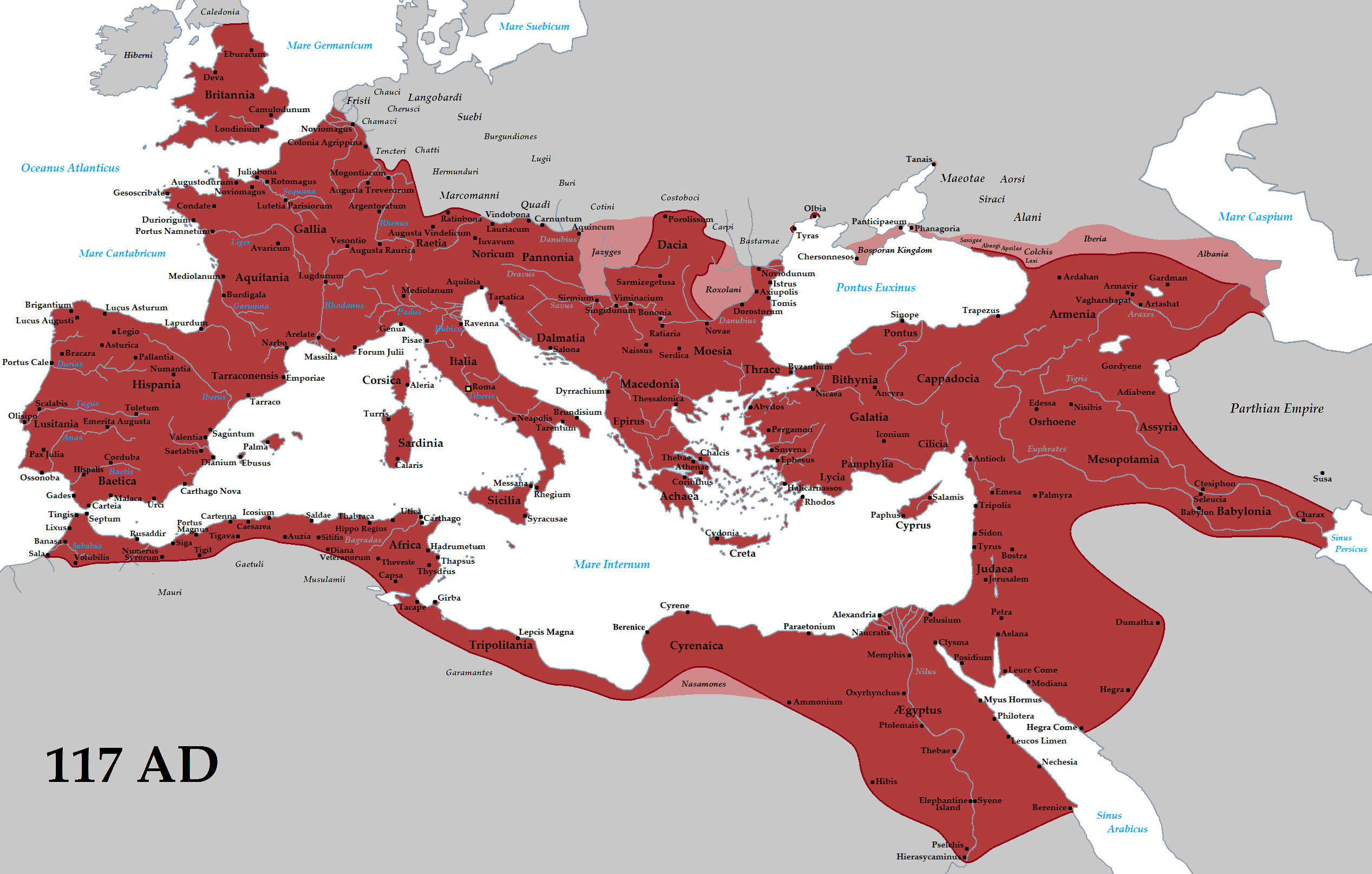
I was reading about Romance languages and upon viewing this map on wikipedia: https://upload.wikimedia.org/wikipedia/commons/0/00/Roman_Empire_Trajan_117AD.png
It seemed to be that Romance languages developed in nearly the entirety of Western Romes provinces after it's fall except for Northern Africa and Britain.
Is there anyway to know why these regions were the exception, or what made Latin stay so prolific in the other regions?
I understand the regions that would go on to be Byzantium as the empire persisted much longer and Greek eventually became the lingua franca. However I can't think of a concrete reason for the rest of the empire.
I thought perhaps it was due to migrating cultures, however during the period of the fall of Rome so much migration and chaos was happening all over so this does not make sense to me.
Then I thought perhaps it was a matter of the regions being newer as to not being assimilated enough but I know Tunis was one of the earlier conquests of the empire.
Even if not a complete answer any insight would be welcome as I have a love for all historical linguistics, cultural migration and development, as well as Roman history!
1 Answers 2018-02-07
I'd love to learn as much as I can about Subotai's military conquest and strategies. What books or sources would you recommend? Preferably reputable sources, not Carlin's badhistory.
I've already read :
Genghis Khan and the Making of the Modern World by Jack Weatherford
The Mongol Art of War by Timothy May
But none of these really focus on Subotai himself. Thanks in advance!
2 Answers 2018-02-07
I am trying to find out some information for a ww2 vet friend of mine. This is all the information I have from a story he told me.
There's a house in Europe (Spain maybe he doesn't remember) that was owned by a Jewish family, they where taken away and the Nazi officer who took them began to live in the house. One day during a bombing run of a near by town a roque bomb hit the home and he was killed inside. The house was the only one hit on the block and he was the only causality.
He went back many years later and the house was still just a whole the town doesn't talk about it like there is some weird huanted folklore to it He believes it's still just a hole to this day.
I know this is vague and impossible if any one has heard of this house or know more about this story please help. He has always wanted more information and I love to find it for him.
3 Answers 2018-02-07
Was there much overlap between the British Suffrage and Irish nationalist movements? How did women who were involved in the latter cause feel about the right to vote for Westminster elections considering their views on the authority of that body?
1 Answers 2018-02-07
So, everywhere I've read about it, encomiendas are described as particularly brutal and exploitative. They are also described as ''right to the labour of ones subjects''. Thing is, this sounds almost exactly as European feudalism as it is almost always thought of today. My question is, what's the difference?
2 Answers 2018-02-07
For some context it is this temple I am talking about Lal Mandir
1 Answers 2018-02-07