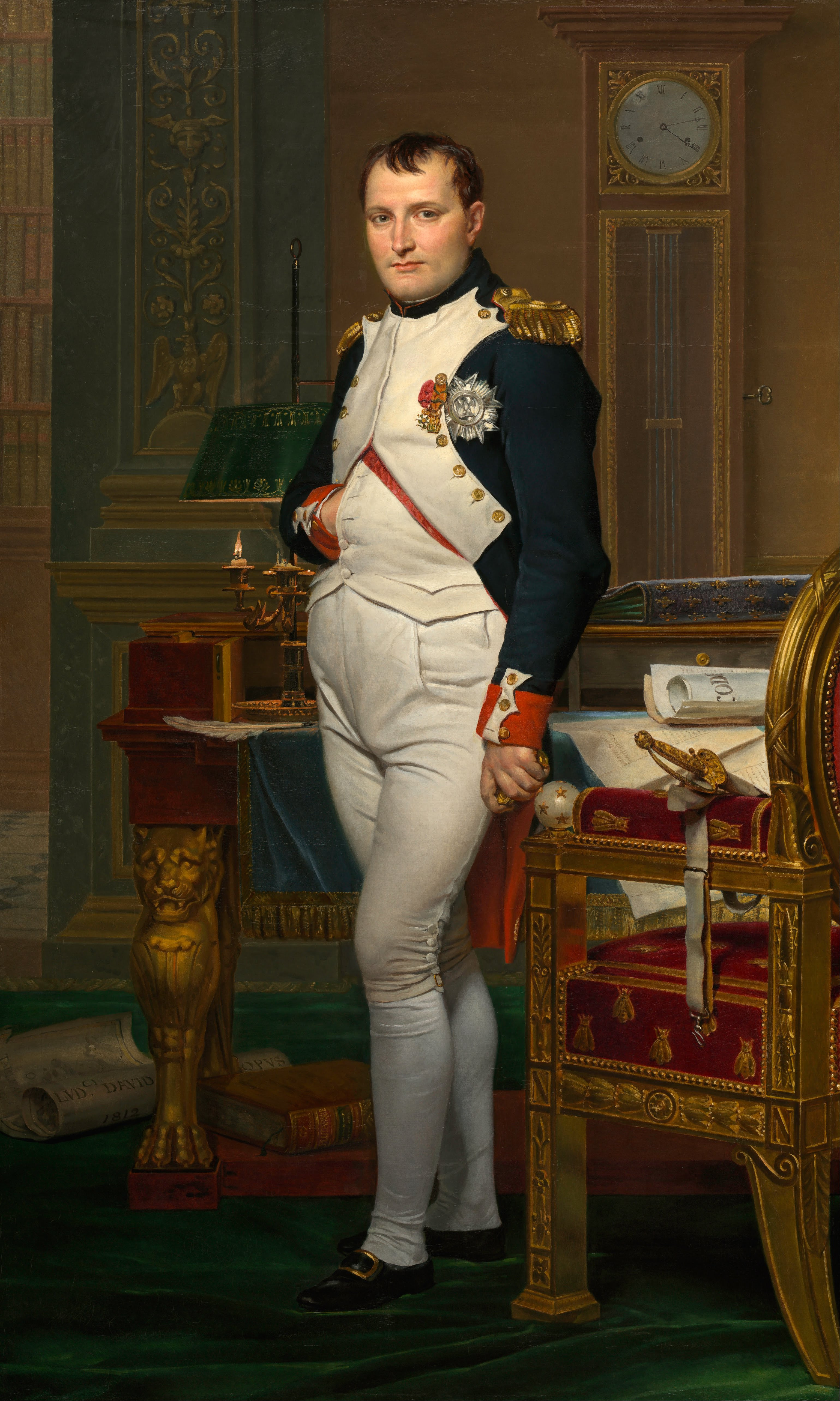
What did Julius Caesar see in Octavius to name him his political heir and heir to two-thirds of his estate?
1 Answers 2017-12-17
In my 8th grade history class, we had a big unit on the American civil war and the events leading up to it. One of the things my teacher made very clear to us was that the civil war was absolutely about slavery. This year in 9th grade history, my new teacher said that the American civil war was absolutely not about slavery at all. I found this very confusing and I was wondering which one is the truth.
1 Answers 2017-12-17
1 Answers 2017-12-17
1 Answers 2017-12-17
I know Hitler did but presumably that was because he was living in 'Germany' at the time.
1 Answers 2017-12-17
In many video games, movies and certain dragon related tabletop games bandits are in every nook and cranny. How accurate was this? Let's say 10-15 years before the Plague as the exact time.
1 Answers 2017-12-17
1 Answers 2017-12-17
Hello, I've recently found a book given to my mother by my grandfather before his passing. Any help in researching its origin or meaning would be greatly appreciated. From the reading I've done, it appears to be written by Spanish monks in the 17^th century. Each page seems to be written by a different monk using similar formats (professing their loyalty from what I understand). Some pages contain elaborate drawings, mostly of trees and birds. While most of the book is written in Latin, some numbers are written out in what I think is Catalan. There are also a few pages written in another language, similar to Spanish. Every page has been signed by the same group of people, some having been mentioned in the writings. A handful of names are mentioned repeatedly, such as Gregorio XIIII (not XIV) and Clement VIII (also the occasional VIIII). A few words have been redacted, whether they be covered in ink or cut out of the page - some pages even fully removed with a clean cut. The top right corner of the pages have been numbered, starting in the high 20s and including some repeated/skipped pages. The inside cover of the book has a circle with a message in French, reading "7034 1 Line manuscript parchment cover." The final page seems to be the only written in print. Please feel free to ask any questions about the book. I've included two Imgur albums with photographs of the pages, as the maximum number of images per album is 50. I've also numbered the pages to make discussing them easier. Sorry for any poor formatting - I'm writing this on mobile. Thank you in advance for any help in learning more about this fascinating book!
3 Answers 2017-12-17
[deleted]
1 Answers 2017-12-17
Ideally an overview of the theory and the practice.
1 Answers 2017-12-17
I want to assume it's more than just 'these two groups can't play nice' or that both sides wanted full control over the city as if we're on the crusading age... Is it the administrative problems that would arise or did negotiations simply break down?
1 Answers 2017-12-17
I just personally feel like whenever war is taught, we learn about the World Wars, a tiny bit about the Korean War and way more about Vietnam. Just wondering why it seems like the Korean War wasn’t as important as the others.
1 Answers 2017-12-17
1 Answers 2017-12-17
1 Answers 2017-12-17
My understanding has changed lately the more I read. It seems Germany's back was broken at the Battle of Stalingrad before the United States' D-Day invasion. So I'm wondering what the consensus is among redditors.
2 Answers 2017-12-17
I’ve lately been trying to explain to my friend that, despite what endless awful History and Discovery channel documentaries seem to think, the moon landings were not faked.
I started to think about conspiracy theories more generally and realised I couldn’t think of any, off the top of my head, that pre-date the Second World War.
Are conspiracy theories common place throughout history, or are they a phenomenon linked to the post WW2 climate of Cold War paranoia?
1 Answers 2017-12-17
I am reading The Prince Who Would be King by Sarah Frasier. She quotes King James referring to hares as saying ".... the brains good to make children breed their teeth with ease."
Breed their teeth?
Thanks in advance.
1 Answers 2017-12-16
I know our carriers were vital to the pacific theater, but I cant remember hearing anything about them involving Europe and North Africa.
2 Answers 2017-12-16
This may seem like a stupid question at first glance (and maybe it is!). However, I'm doubtful of how effective a a stone or metal ball could be on an enemy formation. For the sake of clarity, I'm not referring to flechette or grapeshot fired at close range, and I'm talking about the middle ages in terms of time period. Now, cannons are generally thought of as medium calibre weapons (20-40mm), but the projectile itself usually contains explosive to be effective against infantry. Larger cannons like those on tanks usually see little effectiveness against infantry firing solid shot like APFSDS.
Obviously, the cannonball would have enough energy to go straight through the ranks, but I imagine it could well bury itself more often than not. Was this potential to go through the ranks along with the range of the weapon the only advantage, or is there something I'm missing?
If possible, could you show me any contemporary accounts about the effectiveness of cannons?
Edit: better clarity of the question
1 Answers 2017-12-16
This was prompted by the Dec. 15 discussion about spoilers on the Waypoint Radio podcast at around the 55 minute mark. Is there any historical evidence of humans trying to avoid story spoilers for theatre productions during earlier periods of human history? If I was going to see the newest Shakespeare/Chekhov/Sophocles/Hugo play, would I feel inclined to avoid the public square or market until I watched it for fear of spoilers?
3 Answers 2017-12-16
I feel like the title says it pretty well. Alphabetical order is commonly used for organizational systems in places which use the Latin alphabet for writing, but it seems as though it's just an arbitrary list everybody memorizes rather than following some system like putting the vowels first or listing the letters by the frequency of their use.
How did alphabetical order get decided? Were there different countries that had different orders who had to reconcile those systems?
Also, what's the story of alphabetical order for other alphabets like Cyrillic and Arabic?
1 Answers 2017-12-16
As the second Secretary General of the UN, he was obviously a very influential figure but what did he do that helped make the world come closer together? Way are some things about him that most people wouldn’t know based on initial research?
1 Answers 2017-12-16
I don't read Chinese so I'm not able to refer to the Taizong Shilu and I don't have easy access at the moment to journals or a historical library so this may be common knowledge that I'm unable to look up.
However, I was curious as the accounts I've been able to find of Zheng He's treasure fleets only refer to the ships by their class (bao chuan, ma chuan and so forth) but I am curious if the individual ships were named.
A quick google search indicates that ship names were fairly straightforward in Qing times but information prior to that is obscure.
Would Zheng He or the Yongle Emperor even name their ships? Would a Tang dynasty riverboat captain name his ship? A fisherman in the Yuan period? Did ship naming conventions vary by region due to the vast number of ethnicities and cultures in China? Would a Liao merchant name his ship but a Kashgari Uyghur on the Tuman not?
1 Answers 2017-12-16
Unlikely I know, but what would happen with succession if a monarchs oldest children were twins?
2 Answers 2017-12-16