2 Answers 2017-10-09
Would the family have been even notified if he/she were able to escape? If they died, were they told that they had been killed by their own government, or was it covered up by saying it was some other cause, like the Soviets did with casualties in Afghanistan? Would having a family member try to escape be a crime even if they didn't get help from the family?
1 Answers 2017-10-09
Hi everyone,
I'm interested in writing my thesis about Roman kinship and the way the paterfamilias or patria potestas is structured in Roman Law and Roman writings. I'm aware that there is much evidence on Roman epitaphs, writing between Cicero and his brother, and the laws formulated by Trajan and Justitian about this subject. Still, i'm looking for something of a debate on this matter. I have acces to most of the literature on this subject via my University enrollment. I was thinking something along the lines of the power of the Paterfamilias in accordance with his son (i.e. when the son would leave for military duty), but can't seem to find anything that would lead to a debate here. Any idea's are more than welcome!
1 Answers 2017-10-09
Hello all,
I am trying to do a little research into the military equipment used by the Spanish armed forces in the years from the Spanish Civil War through the Second World War Period.
Most of the information I have found relates primrilly to the equipmkent used by foreign volunteers, rather than the domestic designs or imported items used by the Franco-era military.
Most information I have then picks up in the post-War period with Spain's use of American M47/M48 and M60 tanks.
What small arms, vehicles, and artillery did Spain utilise or have access to during the above referenced time period?
Many thanks in advance!
3 Answers 2017-10-09
I recently watched the movie Downfall, and was informed that many former Nazi officials, like Wilhelm Mohnke, or Hitler's personal secretary Traudl Junge (whom the movie had interviewed) lived long after the war was over.
I was wondering, war it hard for them to reintegrate into postwar society, given their past?
1 Answers 2017-10-09
I study art history and and I have yet to find any painting of a man in a pink outfit. There's absolutely none, so how do people know that the color pink was once for boys?
4 Answers 2017-10-09
I recently started a book about Romania in the First World War and came across all the major events in there being signaled with different dates (15/28 June 1914, assassination of Franz Ferdinand). Normally I thought this was an error in typing, but the same thing is repeated for almost every date in the book. I was unable to find the reason why for this and so I decided to mark it off as some editing error. However, I was browsing Wiki recently and came across the following: "The Second Balkan War broke out on 29(16) June 1913 when Bulgaria attacked its erstwhile allies in the First Balkan War". Never have I seen this before in any other books or videos.So why is this happening? What is the reason for this?
1 Answers 2017-10-09
was just thinking the other day about this and it got me wondering did the European monarchies not care for one another?
I mean their all closely related to the point to were everyone is almost the genetic equivalent of a brother or sister. Why did they not care for each other in a way a modern close family might?
Did they actually want each other dead or where they just playing with the lives of the people who they ruled over? Was it just business and they would have given mercy to each other if captured by one another?
Was their any personal grudges or baggage between them that motivated one of them to be allies with one familiy member over the other?
1 Answers 2017-10-09
On 18 April 1930, the BBC announced that "There is no news today".
What are some events of your field of history that could have been reported?
1 Answers 2017-10-09
The famous woodblock print by Katsushika Hokusai - https://en.wikipedia.org/wiki/The_Dream_of_the_Fisherman%27s_Wife
Aside from the history and description of the work in the Wikipedia article, what was actually going on when the artist was making these woodblocks - was these part of a wider cultural tradition, or just a one-off work to depict a certain scene from lore. How about modern Japanese hentai, is there any relation?
1 Answers 2017-10-09
I've heard conflicting information on this. What I was taught was that the Romans followed the Greek Pantheon with latin names (Jupiter, Neptune, that sort of stuff). However I've also read that many a emperor made worship of them mandatory, or, at least highly recommendated.
When I still had Sunday School (and I do not know how accurate this information is) I was told that the Romans had some sort of "freedom of religion" in their outskirts, which was why Israel still had the ability to have temples.
Being confronted with such a vast array of information, I would like to know which one is the correct one. Was there one single, Senate endorsed religion? I know that the Roman Empire lasted a good couple of centuries (millenia even if you count the holy roman one), does that mean that there were changes in religion for brief periods only?
Thank you
1 Answers 2017-10-09
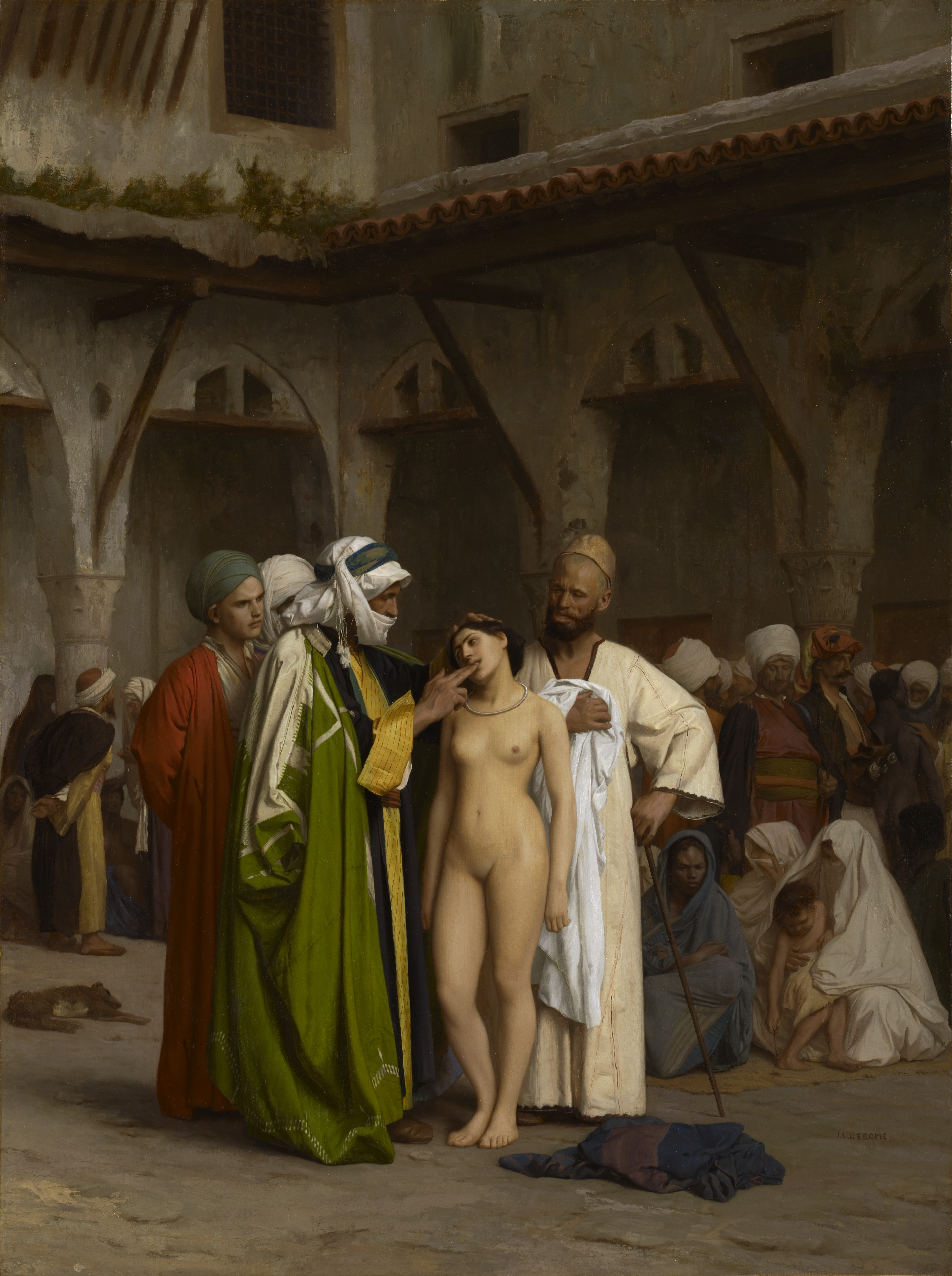
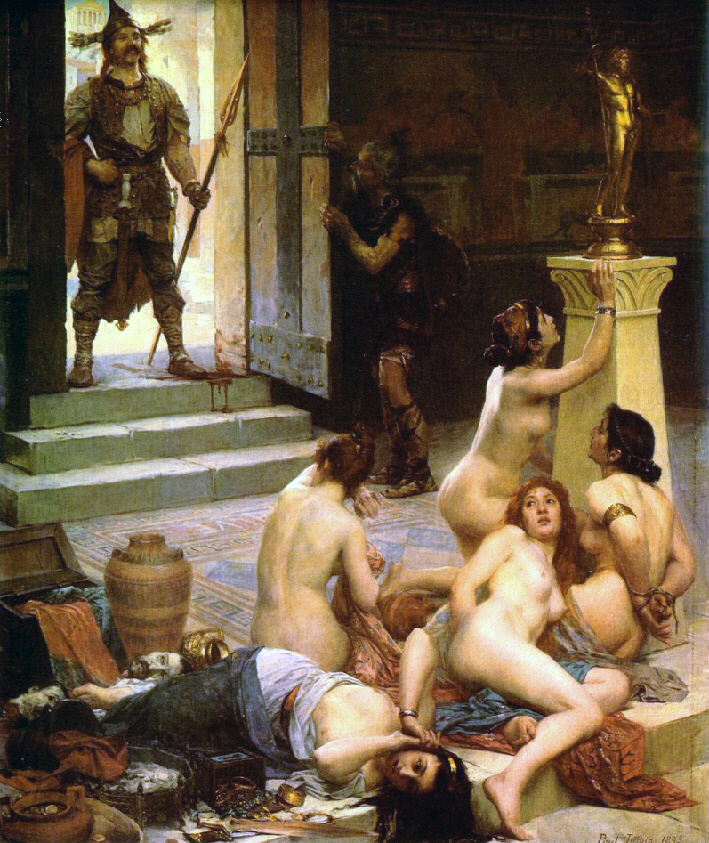
It's hard to say this is just "artistic nudity" when the whole subject matter is obviously just meant to be titillating. What kinds of people would have had these on their walls? Were they ever on public display?
Some examples:
"Slave Market" by Jean-Lean Gerome (1866)
"The Slave Market" by Jean-Lean Gerome (1884)
"The Slave Market Presentation" by Otto Pliny (1917)
"Inspecting the New Arrivals" by Giulio Rostati (1917)
"Brennus and His Share of the Spoils" by Paul Jamin (1893)
"Slave Girl" by Eduard Ansen-Hofman (1820-1904)
"Slave Market" by Eduard Ansen-Hofman (1820-1904)
3 Answers 2017-10-09
1 Answers 2017-10-09
Im taking a first year Ancient History class, in my last semester for an elective and I can't help thinking, did people actually believe this? Surely there must have been people who didn't believe all of this, and believed something else. Especially as the greeks started to span out and move around the world. I understand the origins of a lot of the myths and gods and the purpose for them (anthropology major), but surely someone, somewhere would have been like "ya know, I was at troy and I didn't see a god anywhere, all this is #fakenews" I did ask my University lecturer and she explained a little, but ultimately said it was a hard question and we don't know. Thoughts?
3 Answers 2017-10-09
I apologise if this is against the rules but I'm looking for a book that goes over the politics and history of Germany before, during,and after the two world wars. I find this period absolutely fascinating and want to learn more. This sub has some seriously knowledgeable people on it so any recs would be cool.
1 Answers 2017-10-09
Am Australia and lack little knowledge of American history
1 Answers 2017-10-09
1 Answers 2017-10-09
I was reading about the collapse if Cahokia, a large city built by Native Americans of the Mississippian culture.  One of the causes of the collapse is thought to be decreased agricultural yields due to soil depletion.  I've read similar theories about the collapse of the Maya.
There are many cities or areas in Eurasia, including in China, Europe, and the Middle East, that have sustained large agricultural populations for thousands of years.  How did these populations avoid the same soil depletion that the Native Americans suffered in many of their larger cities?
1 Answers 2017-10-09
The Macedonian people are largely Slavic and Albanian in origin and speak a South Slavic Language with deep ties to Bulgarian, despite having few ties to the historic Kingdom of Macedon or the ethnic Macedonians (who identified as Greeks or Hellenes often) of Greece and occupying a territory north of the Macedonia they identify deeply with that ancient kingdom and use the name. What caused the Macedonian people and government to adopt the Hellenic Macedonian identity as their own and try to link themselves to them historically? I understand this is a hot issue in some circles and apologize for any mistakes I've made or offense I've caused, but I am genuinely confused by this.
2 Answers 2017-10-09
Kaiser Wilhelm II doesn't seem to have gotten a good reputation among historians. He clearly made a lot of mistakes, but he was also clearly not the only person who made mistakes. Not to mention, there were a lot of other circumstances in Europe that made war more likely.
So the question is: how much was the decision-making of Wilhelm II responsible for the outbreak of WWI? And how responsible was he for Germany's defeat? And how much was out of his control?
1 Answers 2017-10-09
I was curious as to how the precident was set following WW2 and during the cold war that a nation could have its own military actively involved in a war zone without having to formally recognize itself as at war with either side.
1 Answers 2017-10-09
It seems like anytime I hear anything about the conflicts within the middle east, it seems that the Kurdish ethnic group is seemingly always given the short stick. especially when it comes to representation within the Iraqi government. I'm curious as to why the region is so historically hostile to the group, and what the Kurds might have done in the past to warrant such treatment?
Edit: I was unaware but apparently they are suppressed by the Turkish Government as well; what is the reason for the regional hatred for this particular ethnic group?
3 Answers 2017-10-09