1 Answers 2017-06-05
I've looked up pronunciations of her Greek name as well as english an I can only seem to find results for how the word "cleopatra" is pronounced when I am trying to figure out how someone in her time of life would have pronounced her name.
1 Answers 2017-06-05
I'm psyched about the 7th season of the show, and this question just occurred to me unbidden. I hope it's appropriate for r/AskHistorians. I will go peaceably if not.
2 Answers 2017-06-05
[deleted]
1 Answers 2017-06-05
1 Answers 2017-06-05
I've been reading a lot of Greek, Roman and Norse history recently and began to wonder why they had so many rowers. What made them obsolete and why?
1 Answers 2017-06-05
In the few hundred years after the Norman conquest, there's quite clearly a largely trilingual learned environment, and it's not until the Hundred Years War that the Norman line of kings loses its ground in France. But at what point do we see the Anglo-Norman ruling class shed its Continental heritage and become de facto English? I'm interested in questions of self-identified 'national' identity, if 'nation' is the correct term here, not just language or culture.
1 Answers 2017-06-05
To provide some context for where this question is coming from, I'm looking at the relationship between the Church and the Holocaust, and last night I started The Myth of Hitler's Pope by David Galin, and in the first chapter, he brings up Goldhagen's Hitler's Willing Executioners, pointing out that while it enjoyed popular success, it's not a serious historical analysis, and has been debunked by numerous professional historians.
What this has me wondering is how can I, a newcomer to this discussion, distinguish between good and bad historical writing/research? One obvious answer is simply read more, and while I intend to, I feel like good history should be about more than just reading everything available. I know relying more heavily on books by University presses as opposed to popular publishers is a decent rule of thumb, but that seems like an easy way to miss out on a lot of great resources. I've recently finished Tim Snyder's Black Earth and Laurence Rees' The Holocaust, and while both seemed good, I'm wondering if there's a way I can know that they're good and reliable. My degree is in philosophy, and there the quality of a text tends to rest on whether or not the arguments made are good, but with history, I don't see how I can factcheck a text, so when it comes to settling historical debate, I feel I'm currently at a point where all I can do is pit different sources against one another and pick one.
Apologies if this question is more meta-history than actual history, but this seemed like a good place to go. If there's another sub that might be helpful, feel free to point me to it, or crosspost yourself and link it back here. Any help will be appreciated, and thanks in advance.
4 Answers 2017-06-05
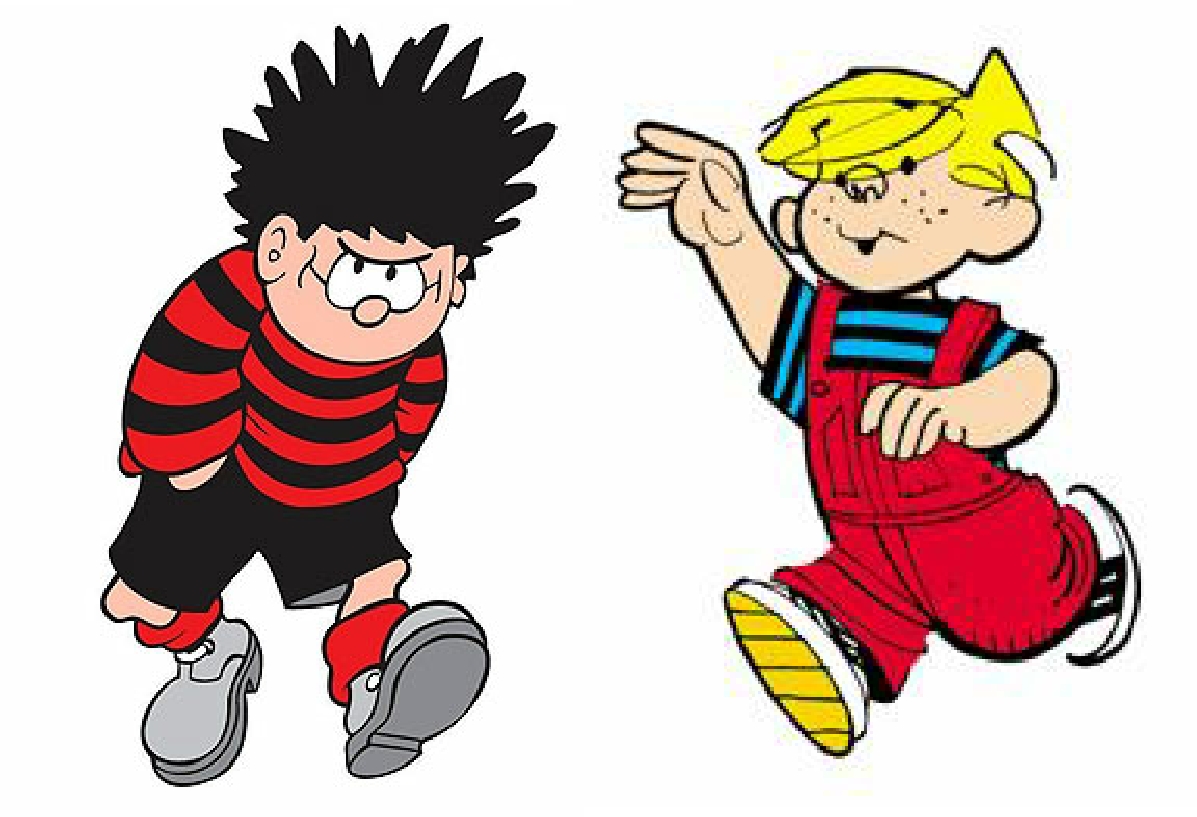
"Dennis the Menace" likely means something very different to you depending upon whether you were raised in the United States or in the United Kingdom. In the US, Dennis is an irrepressible young blond boy who's a bit of a scamp; in the UK he is a glowering bully who actively and willingly harms people, often with the help of his dog Gnasher.
These two characters are completely unrelated, but they first appeared in print during the same week in March of 1951 -- March 12 for the US version, March 17 for the UK version. It is an example of a seriously weird coincidence, and one that has since had consequences for how each property is marketed in the respective counter-territory.
Still... given the limitations of 1950s technology and the relative initial size of each market for these comics, how long did it take for news of this coincidence to make it across the Atlantic? Which side discovered it first? And what was the initial reaction?
1 Answers 2017-06-05
I'm working on a project about the communist leader of Albania, Enver Hoxha. There appears to be very little English-language information about him, other than Enver Hoxha: The Iron Fist of Albania by Blendi Fevziu, which, as you can tell by the review, is extremely biased against him. Other than that, I have found his own work, which is obviously probably biased in an entirely different direction.
Are there any historians whose specialty is studying communist Albania that I should use as resources?
2 Answers 2017-06-05
1 Answers 2017-06-05
2 Answers 2017-06-05
1 Answers 2017-06-05
6 days ago, /u/indiangamesthrowaway asked this question that was never answered. I think it is a great question which is why I'm reposting it.
Here's the text of the original post:
From my research I have found Chaupar and a few others. However, these games appear to be adult/gambling games. I am trying to have a child character in a stage musical play a historically accurate game. So the more visually appealing it is, the better. Thanks!
1 Answers 2017-06-05
I'm reading a textbook on communication and it says that Ancient Greece had a ban on professional lawyers for many years, meaning individuals would have to bring their own suits to court. What reason did the Greeks have for banning lawyers and what changed to make them legal?
1 Answers 2017-06-05
I came across this article in The Atlantic today and it seems to be a good summation of my understanding of Robert E. Lee (as well as adding some bits I was previously unfamiliar with, like the details of his time at Washington University). However, what I was not familiar with was the information about Longstreet; I've heard little about Longstreet outside of military assessments, and this came as a surprise to me:
There are former Confederates who sought [to] redeem themselves—one thinks of James Longstreet, wrongly blamed by Lost Causers for Lee’s disastrous defeat at Gettysburg, who went from fighting the Union army to leading New Orleans’ integrated police force in battle against white supremacist paramilitaries. But there are no statues of Longstreet in New Orleans; there are no statues of Longstreet anywhere in the American South. Lee was devoted to defending the principle of white supremacy; Longstreet was not. This, perhaps, is why Lee was placed atop the largest Confederate monument at Gettysburg in 1917, but the 6’2” Longstreet had to wait until 1998 to receive a smaller-scale statue hidden in the woods that makes him look like a hobbit riding a donkey. It’s why Lee is remembered as a hero, and Longstreet is remembered as a disgrace.
I'd like to know more about this subject and any in the former Confederacy who shared this apparent dedication to mending things. Thanks.
1 Answers 2017-06-05
As I understand it:
Sunday stems from the Latin, "dies solis."
Monday stems from the Anglo-Saxon, "monandaeg"
Tuesday, Wednesday, Thursday and Friday are named after the Norse gods Tyr, Odin, Thor and Frigg respectively.
Saturday is named after the Roman god Saturn.
I guess what I'm confused about is why are these various pagan religions all smashed together in our days of the week? The Romance languages seem to all utilize only the Roman gods in their names for the days of the week, but even they still named Sunday and Monday after the sun and moon (eg: Domingo and Lunes in Spanish)
Why didn't the Germanic languages only utilize their local Gods? Why the blending of various deities?
EDIT: /u/reinhold23 privately pointed me towards the work of Rudolf Simek, namely his work on Interpretatio Germanica, which was very helpful as well, just for all who are curious about the specific adaptation of German gods to the seven day work week.
8 Answers 2017-06-05
Why is such a small country neighbored by much more powerful ones for quite some time now still a country? Is it because of alliances or what. Has it ever contributed benefits to any other country?
1 Answers 2017-06-05
1 Answers 2017-06-05
I know the typical high-school history bits about slavery at the federal level--the Missouri Compromise, the Fugitive Slave Act. Setting those aside, did the Abolitionist cause, or reaction to it, have any effect on laws at the state level in slave states? For instance, were laws prohibiting slave literacy getting more or less common over the decades leading up to the war? Were state laws in general getting more protective of slaves, or more protective of slaveholders?
1 Answers 2017-06-05
During the Fall of 1918, first Austria-Hungary, then Germany suffered significant defeats, which served as a catalyst for the accedancy of various anti-war factions. In Austria-Hungary that meant mutiny, desertion, and mass surrender in the army and nationalist revolutions at home. Germany, fearing a similar crisis rushed to sign an Armistice with the Entente at any cost.
Yet, just a generation later, the belligerents of WW2 faced (at least in appearance) far worse military crises and defeats, but maintained their political solidarity. For example, Britain after the Fall of France, the Soviet Union during Barbarossa, and Germany after Bagration and Overlord.
Why was this the case? How was political solidarity maintained through WW2, and how did it differ from WW1 a generation earlier?
Edit: I should say that the premise of my question reflects only a layman's understanding of events, so please feel free to correct or complicate anything you feel is incorrect, or overly simplistic.
1 Answers 2017-06-05
I've seen several documentaries over the years on the History and Discovery channels before they turned into "reality tv" where we now hunt for aliens, ghosts, and big foot.
I just started watching the Nat Geo show "Genius" and there were some interesting things that I've seen that I'm not sure is reality, or just made for TV drama.
I was curious if there was a good book you knowledgeable folks could recommend that cuts through the fat and provides as authentic of a view of his life as possible.
Thanks in advance!
2 Answers 2017-06-05
The book takes a friendlier approach to the Mongol empire than you'd normally get from Western historians. Many of the reviews claim that it's "revisionist". It certainly depicts Genghis Khan as one of history's great men rather than a bloodthirsty tyrant and leader of pillaging hordes. On the other hand, it seems to tie together parts of Asian history that wouldn't make sense if the Mongols were just conquerers.
So, how big of a grain of salt do I need?
Edit: Link to book at Amazon
My desire for grains of salt increases looking at the "people also bought" section.
3 Answers 2017-06-05