I'm asking this in regards to both the revolutionary war itself and the proceeding governmental debates.
2 Answers 2017-02-09
In a French movie Ridicule (events of the movie happen shortly before the French Revolution) reknown soldier blatantly offends a protagonist who is praised by a king - indirectly undermining soldier's work. Protagonist asks a soldier to repeat what he said and after soldier clearly offends him again protagonist challenges soldier to a duel. It's an obvious provocation for everyone; soldier is sort of a high ranking officer and reknown marksman, protagonist is some provintial baron.
Was provoking nyone for a duel that easy? The movie made it look like a protagonist has no way out of fight and soldier could in theory kill anyone with minimal reprecussions. What woukd stop a trained marksman from offending people enough for them to not have a choice besides fighting a fight they'll lose?
1 Answers 2017-02-09
1 Answers 2017-02-09
What I'm looking for is armour were leather is the main protection, as there are evidences of brigandine were the metal plates are rivetted to leather.
As far as I know there's no evidence (both archaeological and written) of historical leather armour. I ask this because there's an obsession in fantasy with it and some modern historians say that it was the armour of the poor, something that I don't find any sense for the lack of evidence to support it and for the heavy ammount of evindence supporting the ussing of gambesons (padded armour) both under mail and plate armour and as the armour itself.
Any proof of leather use as armour during Middle Ages or, if there's none of it had a minimun use as armour, from were this misconception come from?
1 Answers 2017-02-09
I know a little bit about biblical criticism and a little bit about the Third Reich, but I'm curious as to how they related to each other. I've found very little information on this subject, which surprises me, considering the prominence of German scholars and theologians in the field of biblical criticism and the amount of writing on the Nazis' relationship to Christianity (and besides, I would have expected all "What did the Nazis think about X" questions to have been addressed already). Did the "Positive Christianity" movement draw on biblical criticism at all, and if so, how? Did any biblical scholars publicly support or oppose the regime? What position did German universities -- which in my understanding were pretty thoroughly Nazified -- take towards biblical studies?
1 Answers 2017-02-09
I'm assuming it's something like an interview of an American Civil War veteran or something like that. Hopefully it's something you can link to!
1 Answers 2017-02-09
2 Answers 2017-02-09
Gallup has a pretty cool interactive graph that follows presidential approval ratings.
It seems that while Truman's approval rating began pretty high at 87% at the end of World War II (which is understandable), it was completely in the shitter by 1952 when he was about to step down and hand over the keys to Eisenhower.
Why did more than 3/4 of the country hate Truman by the end of his term? I've only heard good things about him in history books.
1 Answers 2017-02-09
Both Apocalypse Now and (allegedly) Good Morning Vietnam feature this. I've heard the same before, but a cursory google search has revealed little, if anything, concrete. So while I figure that the US forces definitely used psychological warfare to some degree, I'm interested in finding out if those methods or songs were utilized or invented by fiction.
2 Answers 2017-02-09
1 Answers 2017-02-09
I was wondering because my teacher said that Jewish people scratched the walls and left marks, but I read that it is not possible and got in trouble for questioning her. Can someone actually tell me because I cannot find a reliable source to show my teacher. Can someone explain it to me and/or give a reliable source?
2 Answers 2017-02-09
I asked this questions about 2-3 days ago but didn't get any responses.
1 Answers 2017-02-09
If Plato and other "classics" authors and scientists had modern jobs where would they most likely be employed? Professors? Politicians? What would there actual role been in ancient society?
1 Answers 2017-02-09
Can anyone please recommend some college-level European history textbooks/books? Never got around to taking the general European history course in school.
1 Answers 2017-02-09
2 Answers 2017-02-09
3 Answers 2017-02-09
How far the Soviet Union stray from the original communist ideas? If the USSR had stayed closer to Marxism, what would be different? Would it still be a harsh authoritarian dictatorship were millions starved to death?
1 Answers 2017-02-09
I have seen a few posts here on r/AskHistorians about the Hundred Years War, such as this question on how the Hundred Years War affected French society or how the Hundred Years War was even able to last that long given population differences between England and France.
However, these questions seem to speak more to the effect of action/fighting.
What was the impact of the sheer amount of time spent on these long wars? Did "ordinary" people outside of combat zones just come to ignore that there really was anything happening, or did they just maybe take for granted that their leaders had "always been at war with the other side"?
(I would also appreciate answers about any "long" war, but my understanding is that there is dispute as to whether other really long "wars" can be considered to be continuous conflicts. As far as I know, even if the Hundred Years is a combination of several different "phases", there was fighting during most of the time period. That's why I included that in the title.)
1 Answers 2017-02-09
This week, ending in February 09 2017:
Today's thread is for open discussion of:
History in the academy
Historiographical disputes, debates and rivalries
Implications of historical theory both abstractly and in application
Philosophy of history
And so on
Regular participants in the Thursday threads should just keep doing what they've been doing; newcomers should take notice that this thread is meant for open discussion only of matters like those above, not just anything you like -- we'll have a thread on Friday for that, as usual.
1 Answers 2017-02-09
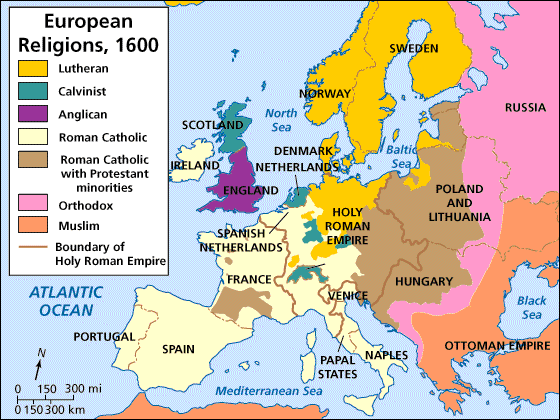
In this picture, the British Isles are shown to have 3 major religions. Why is Scotland Calvinist, and whereas Ireland remains Catholic and Britain is Anglican? I know that this map is just a rough approximation, but help would stil be appreciated! http://4.bp.blogspot.com/_zBTrwnUSmNc/TBqLUikJi5I/AAAAAAAAHms/Fy9hdW4UC74/s1600/European+religions+map.GIF
1 Answers 2017-02-09
Just wondering when the modern dispatch system we know from movies and TV began and what the police did before such systems existed.
2 Answers 2017-02-09
[deleted]
1 Answers 2017-02-09
Hello friends! I'm second year history student and my exams from this semester just started. I have a lot of theory to learn...and I mean it...A LOT. History of Ottoman Empire, World history in Early Modern Age and also Croatian history in Early Modern Age. I have just passed the exam from History of Bosnia and Herzegovina in Middle Ages, so that's kind of relief. Anyway, long drama rant short, does anyone have any good advice for studying history? Some tips maybe, or what helps you the most to remember and connect things? Also, can you suggest me some good history documentaries or tv shows? Books are welcome too, however, I'm too busy to start reading one right now.
2 Answers 2017-02-09