[deleted]
1 Answers 2017-02-09
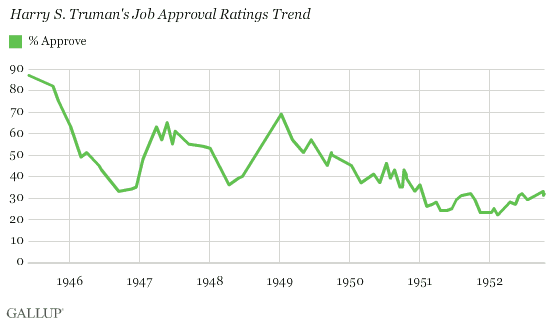
http://content.gallup.com/origin/gallupinc/GallupSpaces/Production/Cms/POLL/qx9sey_xme2a7hqsx6t6cq.gif As you can see in the image above, Harry S. Truman's approval rating almost 90 percent at the start of his presidency. Can anyone explain why it was this high?
1 Answers 2017-02-09
How would the House of Savoy fare in a post-war and defeated Italy had Victor Emmanuel III not allowed such a prominent rise to dictatorship throughout the 1920s? How would the House of Savoy have coped post-WWII had they taken a more anti-Fascist stance and not acquiesced and tolerated Mussolini?
Was their tacit support of Mussolini instrumental in their downfall?
2 Answers 2017-02-09
From what I have read in my history books the picture that was painted seemed to me that for the people that became workers the living standards declined, but I wanted to get a better understanding of this since the explanations were not detailed.
So how did they compare? Naturally the comparison can only be made with the workers and farmers of the same country (Britain, USA, Germany/Prussia, France, etc.).
1 Answers 2017-02-09
4 Answers 2017-02-09
1 Answers 2017-02-09
I have a midterm tomorrow morning. This is on the study guide and I'm having trouble finding a good answer in the textbook. Thanks for any help.
1 Answers 2017-02-09
1 Answers 2017-02-09
In the song "You're the Top," two characters praise the other and insult themselves using 1930's pop culture references -- "ovaltine" or "the nose of the Great Durante." To denigrate himself, Billy Crocker compares himself to the "nominee of the G.O.P. -- or Gawp!" What does this reference mean?
1 Answers 2017-02-09
1 Answers 2017-02-09
1 Answers 2017-02-09
I ask because we Americans, at least, tend to talk about the Germany of the first half of the twentieth century as if it were the world's greatest war-mongering state ever. I'm not questioning that judgment, but I am asking whether Germany of the first World War was - I guess I should say - ethically more of a piece with aggressive acts by other industrial and colonial era European nations than with Germany as led by the Nazis from 1933-1945.
(My apologies if this question is inappropriate to this subreddit or simply not well enough put. This is the question I'd like to have answered, and I can't figure out value-neutral language here. Maybe that's not a problem.)
1 Answers 2017-02-09
I'm currently reading about Nigeria, and their civil war. And I remember hearing about other conflicts on the continent that have their roots in different cultures being forced together into one country. What has caused these arbitrary borders to last and why haven't these countries divided naturally into countries that are more homogenous culturally?
1 Answers 2017-02-09
1 Answers 2017-02-09
1 Answers 2017-02-09
1 Answers 2017-02-09
I'm very interested in analysis of why, contextually, particular pseudoscientific theories become popular, and what that then says about that context. I'm especially interested in environmentalist and health focussed theories (chemtrails, anti-vaxxer theories), and alternative histories (like Ancient Aliens) rather than religious-influenced theories like Intelligent Design.
My searching has turned up a few things, mostly when I search about a specific topic, but any online inquiry into pseudoscience more generally tends to only turn up either pseudoscientific theories themselves, or writing debunking them. I haven't found much writing about the whys and wherefores and historical influences.
I would deeply appreciate any sources, and any analysis from a historian who knows something about this. Thanks!
1 Answers 2017-02-09
The Wikipedia page on the Taiping Rebellion lists the death toll at one hundred million people, but doesn't give an answer as to how this is possible. How did it happen? And have there been more deaths ever before?
3 Answers 2017-02-09
John Bell Hood and Braxton Bragg were enemies of federal forces. Why does the federal government honor them in this manner?
1 Answers 2017-02-09
USSR was eventually dissolved, people (including communists) don't consider China to be communist, the same goes for NK, and Venezuela. The only place where it seems to work is Cuba.
1 Answers 2017-02-09
I've been looking into my family history for several years now but have not been able to get any further than my great-grandfather on one line. I'm not looking for family history help (although that would be appreciated) just possible reasons why the majority of a family could have been killed and the remaining survivors flee Belarus in the early 1900s.
1 Answers 2017-02-09
Even limiting context to Americas, a lot the historical accounts, from colonial days to early 1900s, seem to suggest that clean drinking water was not a reliability. Instead, I've heard about all manners of substitutions - beer, grain based liquors, etc. From my vantage point, I can't imagine subsisting on fermented beverages and not feeling constantly drunk, hungover, and dehydrated. Am I missing something or was this the nature of the game?
1 Answers 2017-02-09
I can't seem to find an answer to this, and it's really been bugging me. It seems like every time Parliament would ask her, she would just say no without providing a convincing excuse.
Why wouldn't she just name a successor? Have I missed an obvious answer to this somewhere?
Thanks in advance!
Edit: Thanks to everyone for their informed and helpful responses!
3 Answers 2017-02-09
I understand the qualifier that the Medieval Era represents a large swathe of time, but I implore all of your various expertise to chime in with your more specific knowledge on this.
When I think of a medieval town I am imagining in essence a group of buildings that were erected to support a market. Unevenly distributed around the town for miles were farms, and the farmers would go into town in order to barter for goods not immediately available to them and to sell their produce, participate in festivals, hear news, and if they were lucky, relax at some point.
Is this model correct?
And if that is correct what was the typical make up of who resided more full time in the town? I assume the clergy and the skilled laborers (carpenters, smiths) and any semblance of local authority (the mayor/baron/lord), but would anyone else live in the houses there? What would daily life be like?
Again I know the general nature of the Middle Ages, but for each flairs give me your expertise both in the British Isles and Continental Europe from the 1000s to 1500s, because I would adore a good overview from as many areas as possible to help me paint a better picture.
1 Answers 2017-02-09
Hello!
I know Gibbon's "Decline and Fall of the Roman Empire" is a topic all on its own in the FAQ, but I didn't quite see an answer to this and I was hoping to get informed opinions from experts in the field:
I understand that Gibbon's analysis is considered flawed for many reasons, and I know that a lot of new information has come to light since his work. Still, suppose that I want to learn about the history of Rome post 2nd Century, and am aware of Gibbon's biases. Would it be worth it to read his work in this sense?
Or is it only worth it from a literature standpoint ("it's well written and has influenced the thinking of people at the time and beyond") / meta-history standpoint ("this is what people in Gibbon's time thought of that period in Rome's history") / history of ideas standpoint?
Many thanks!
2 Answers 2017-02-09