If the pledge was politically popular, why was it?
1 Answers 2016-09-15
^ Title
1 Answers 2016-09-15
Thanks
1 Answers 2016-09-15
I don't know much about Sikh's.
I know they are monotheists, was curious if this idea has roots in neighboring faiths. It doesn't seem like it evolved from Abrahamic faiths.
What's the history of ideas behind Sikhism?
1 Answers 2016-09-15
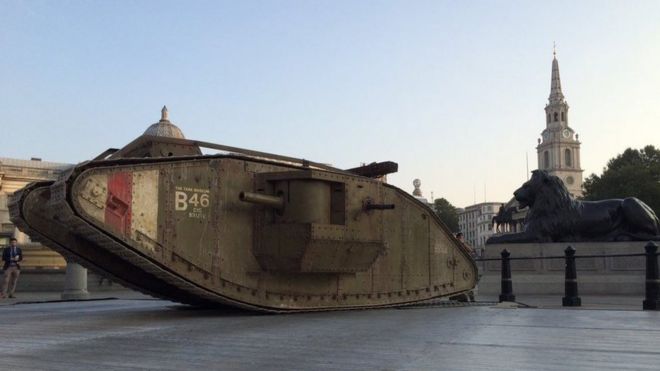
If you look at a picture of early tanks they look quite imposing, but I know they also had severe problems with mechanical failure. What did German soldiers under attack by tanks in WW1 (and German commanders receiving reports of them) think of them, especially when they were unknown weapons?
1 Answers 2016-09-15
Was Jesus a real person? If so where is the proof the he was?
Is there bloodline of Jesus or any person in the bible? is there proof of anyone in the bible?
My husband says that Jesus and the people of the bible was stolen from ancient Egypt?
2 Answers 2016-09-15
In different fields like math, physics, metallurgy, agriculture, engineering, philosophy, chemistry, biology, medicine, warfare, etc.
Exactly what knowledge did Western Europe lose after the fall of the Roman Empire, and what did they regain in the Renaissance? Geometry and algebra? Crop rotation? Steelworking? Hippocrates and Galen?
1 Answers 2016-09-15
There were larger battles in the Civil War which lasted for longer periods of time than 3 days (Chancellorsville comes to mind). What made Gettysburg unique enough to be the bloodiest battle of the war?
1 Answers 2016-09-15
As the title states, I am about to begin studying History at the University of Huddersfield, England. I'm excited, terrified, but very homesick, and I haven't even left yet.
Is there any tips you guys could give to a budding Historian in the works?
7 Answers 2016-09-15
Plain question, I wonder if Neanderthals could speak. In case that yes, how complex their speaking skills were? Could they speak just like us? It is even possible that some of our languages were started by them?
This question applies for the man of Flores and other hominids.
1 Answers 2016-09-15
as people came to oppose slavery, you would think they would also want to see justice done to the rapists, torturers, murderers, and maybe just slavers in general in their country. While this would be impossible constitutionally since it would be retroactive, was there ever discussion of this?
1 Answers 2016-09-15
Why did the ransom of King John happen? In modern war, when an army captures the head of state of the opposing country, the war ends.
Wikipedia says, "Now in English captivity, King John began the challenging task of negotiating a peace treaty, which would likely require the payment of a large ransom and territorial concessions." Saddam Hussein or Napoleon don't get to negotiate the peace treaty from captivity.
Why didn't the English kill the French king or hold him prisoner, instead giving him a comfortable life and then releasing him. Additionally, why did John choose to return to captivity later?
1 Answers 2016-09-15
1 Answers 2016-09-15
My US History teacher told me that while physical beatings did happen, it was very rare. He stated that doing so was very ineffecient for the slave owner, considering they're property, and that this would decrease their profit margin.
Furthermore, he said that because of historical documents and caloric calculations, we know that slaves were generally fed fairly well(otherwise they'd die from exhaustion in the fields, again decreasing profit and becoming inefficient).
Lastly, he stated that slaves generally finished picking cotton(as an example) around mid-day and tended to food and provisions for themselves because they were expected to grow agriculture and raise chickens in a coop for themselves and the plantation.
How much of this is true, because it definitely goes against the narrative that I'm sure most everyone was taught in early US History and most of life?
1 Answers 2016-09-15
2 Answers 2016-09-15
Hi all, I was interested in learning more about early Britain (Pictland, the Heptarchy, Kings Drest and so on) but I don't know exactly where to start. I'm wary of more modern documentary's and it doesn't seem like a hot topic. Any suggestions would be greatly welcomed! Thank you
1 Answers 2016-09-15
Although the geography is obviously vast, a suitable generic answer may also be appropriate: when would the average person living in the former lands of Western Rome realize that the [Western] Roman Empire no longer existed?
2 Answers 2016-09-15
This is something that I've been wondering about today. I've only seen Habsburg but my phone is trying to tell me Hapsburg. How did the English language change this name and why is the autocorrect incorrect?
I've found only one question that asked this but he answer was poor and used Wikipedia as a source.
2 Answers 2016-09-15
tl:dr royal people used to get in on out of wedlock quite a bit. How likely could someone be a descendant of an illegimate child originating from them?
Let's just stick with European royalty since most people tend to be at least somewhat more familiar with them.
My mom claims that my she is descended for an English royal bastard child. She says the child was smuggled over seas to Canada for safety reasons. She even claims that money used to be sent to my family from over seas from an anonymous source.
I'm pretty skeptical of this since the majority of my mom's family came over during the Irish potato famine and she only has a small number of English ancestors.
However it's not like illegitimate children didn't exists, many nobles had extra-marital affairs. How common were these children and how likely is it that their descendants would still be kicking around today?
1 Answers 2016-09-15
[deleted]
2 Answers 2016-09-15
Examples of this being the Asiatic countries, such as Korea, China, Thailand etc.
1 Answers 2016-09-15
So, for instance, would Athenians paint an owl on their shields similar to the Spartans? What about the other city states? Did they have symbols?
1 Answers 2016-09-15
Even today mortality rates in rural areas are higher then urban ones which made me wonder how much more profound was that difference in the past. I'm mainly wondering about the late 1800s and early 1900s in either Canada or the USA but any information you have on this topic outside of that would still be nice.
1 Answers 2016-09-15