The CIA has supported a host of repressive regimes and been party to torture, kidnapping, murder, human experimentation etc. Have the people of a country ever benefited from the CIA getting involved?
4 Answers 2016-05-17
Was just reading about some of the Egyptian obelisks in Rome and how several were restored in the late 1500s by a pope after being found broken/toppled over. When I was in Rome several years ago I also remember the tour guide mentioning that the statues we saw of the Gemini Twins and their horses had been made during the Roman Empire era, but had broken apart and been restored/put back together during the Renaissance.
So..what is the deal? The statues/obelisks just toppled over and sat there in place for a thousand years? Was Rome totally abandoned? Was an earthquake involved? Did people steal smaller statues and take them home but these were too big to move? (Don't remember the Gemini twins being THAT big)
1 Answers 2016-05-17
A paper on the history of plant taxonomy notes that a famous botanist of the 17th century (Joseph Pitton de Tournefort) died in a 'serious traffic accident' in Paris in 1708. This struck me as...unexpected?
Does anyone know how common traffic accidents were in the pre-automobile era?
1 Answers 2016-05-17
When did the question start? Is it a disease that causes people to question every artist, or is this question specific to Shakespeare? This is a History Question only. Please don't throw in any theories of authorship, mainstream or alternative. Added: When did the Literature Department become a part of the British Higher Education System?
3 Answers 2016-05-17
The only explanation I can think of would be, maybe it would be considered such a high offence to impersonate the emperor, that most people wouldn't even consider it possible?
1 Answers 2016-05-17
In the extant religions, we mostly find that they contain a "center of morality" that is congruent with the "center of power" - the deity, or deities - of the religion in question.
I am wondering to what extent this can be expanded upon the religion of ancient Greece. That morality, unlike in Abrahamic religions, in ancient Greek religion was not derived from divinity, but rather coterminous with the morals of the surrounding culture, seems a given, but to what extent did the deities of ancient Greece conform to the morals of that surrounding culture? Or, in simpler terms, did the Greeks think of their deities as "good"?
I think this question can be cast in different angles:
Did the Greek deities themselves commit acts that were immoral? Was this immorality "canceled" because of the standing of the deities as deities, but would have been maintained if committed by a non-divine entity?
Did the deities intervene to ensure the maintenance of cultural morals? Was it expected that wrongdoers - thieves, cowards, murderers, perhaps others - would be punished by them, regularly or on occasion? Did they do so in myth, or was the tale of Lycaon unique?
Were there any other entities that would ensure the maintenance of moral standards, or some of the moral standards, through supernatural intervention, but which could not be considered part of the pantheon, because they could not be appealed to in a functional way? Who determined that the "wicked dead" would go to Tartarus? Hades? Or was it a "law of nature" that did not depend on the personal judgement by any deity (although deities could intervene to place certain individuals there in person)?
Did the deities demand any acts that were considered immoral? For comparison, the Aztec deities demanded human sacrifice - I assume that murder and manslaughter were considered immoral in Aztec society. Did the Greek deities similarly demand acts that would be inconsistent with the morals of Greek society?
Why were the Greek deities worshipped? Because it was hoped that they would intervene in the natural world to bring rewards for those who worshipped them? Or because it was hoped that worshipping them would prevent them from intervening in the natural world to bring about punishment intended for those who did not worship them?
Did the Greeks think of the natural world being in every instance a reflection of the deity to whose portfolio that instance belonged? Did every thunderbolt strike because of Zeus' personal decision? Or did Zeus merely have the power to control thunder and lightning if he so desired, but thunder and lightning would also act on their own, as inanimate phenomena of nature?
A few examples:
Zeus - I'm assuming that rape was considered an immoral act in ancient Greece (and probably a crime?). Yet, a vast portion of the corpus of myths that involves Zeus deal with his sexual exploits with non-consenting women. Was being a rapist, even if the act was considered immoral, a "signal" that was understood as representing masculinity, sexual prowess and power, and hence Zeus was confabulated to engage in it so frequently? (Or perhaps I am wrong, and the rapist was considered entirely without blame and instead the woman who had let herself be raped was considered the immoral seductress?) Zeus also desired to have the edible parts of cows to be given to him in sacrifice and when that did not happen, ventured to sabotage the creation of human civilization. When that did not work either, he caused the creation of all forms of human suffering. A somewhat... mixed record... in my estimation, but what did the Greeks think about it? Did they consider Zeus' punishment justified?
Athena - One of the few deities whose domain includes things that are by definition positives, and such as are commonly considered beneficial for the lives of humans - wisdom, courage, strength, justice and so forth. Did the Greeks recognize her as a "good" goddess, morally superior to other deities?
The Gigantes - Featuring as the opposition of the deities in the Gigantomachy, one could speak of them as the "villains" of the Greek corpus of myths. As descendants of Gaia, they are often described as representatives of "untamed nature" at odds with human civilization, supposedly represented by the Greek deities. Is that accurate? It does not seem to me that the Greek deities - apart from a scant few, such as Athena - had any greater affinity to civilization, nor any lesser to untamed nature. Zeus is the deity of thunder and lightning, Poseidon the deity of the sea - both are natural forces. I grant that Poseidon, Athene and even Artemis may act in favour of human civilization (by bestowing pescatorial boons, knowledge or a successful hunt), but how would Zeus be conductive to civilization? Were the Gigantes really villains beyond their opposition to the deities? Were they considered "evil"? Was their defeat considered as having been beneficial to anyone but the deities themselves? Was Gaia, as their mother, considered "evil"? Or was this merely a tall tale, told for entertainment, of various ancient supernatural entities fighting each other, with no "right" or "wrong" side?
Ares - Creates war and bestows success in war. While surely useful when there is a war already, and you want to win it, was his role as creator of wars ever bemoaned? Or were wars considered "good" by virtue of being the will of a deity?
2 Answers 2016-05-17
[deleted]
4 Answers 2016-05-17
The Eurovision Song Contest has been running in Europe since the 1950s, however none of the Eastern Bloc/Warsaw Pact countries took part until the fall of the USSR/end of the cold war. Why not?
1 Answers 2016-05-17
2 Answers 2016-05-17
Or was his goal "just" to free his comrades? Were there slave revoltes that tried to abolish slavery in general in ancient Rome?
1 Answers 2016-05-17
4 Answers 2016-05-17
Looking at old maps I came across what they say is the oldest known map, that being the Babylonian map of the world.
They said it lists seven island, but only have information on three of them. Has there been any effort in identifying them?
island-"place of the rising sun"
island-"the sun is hidden and nothing can be seen"
island-"beyond the flight of birds"
Also is there any corolation between seven islands and seven continents?
1 Answers 2016-05-17
Hi,
Currently I'm doing research on the influence of the British Empire on Scottish identity in the late 19th century. I'm doing this by using two case studies: Glasgow and Edinburgh.
And I was wondering if you could think of some interesting articles or insights?
Thanks in advance!
1 Answers 2016-05-17
Rwanda seems to stick out as a case of 'world should have done something' or a case of 'world could not have done anything.' I want to know what actions were considered, and what were possible options the int'l community had to intervene or not.
1 Answers 2016-05-17
Given that Korea did have a partially recognized government in exile?
1 Answers 2016-05-17
1 Answers 2016-05-17
Friends, I did check the Master List as well as the other questions, but I did not find what I am looking for and hence raising this query. The book should contain - a)foundations of the apartheid state (govt. policies for non whites, why did the national party win in 1948 etc) b)How did the opposition to apartheid develop, who were the main people) and a bit about the economy during this time c)Change in South Africa (Pol. / econ. factors) in 1966 - 1980 d) Why/how did the white minority rule come to an end e)The role and motives of: – President de Klerk – ANC leaders – Desmond Tutu – Chief Buthelezi • School boycotts and township unrest • White extremism • Economic and international factors • Power-sharing aims and responses • 1994 general election. f)Development and effects in South Africa of: – ANC aims and campaigns – women’s resistance – ANC and PAC split – Umkhonto we Sizwe and Rivonia Trial – Sharpeville and Langa • International effects; 1961 South African Republic Thanks a lot
1 Answers 2016-05-17
[deleted]
1 Answers 2016-05-17
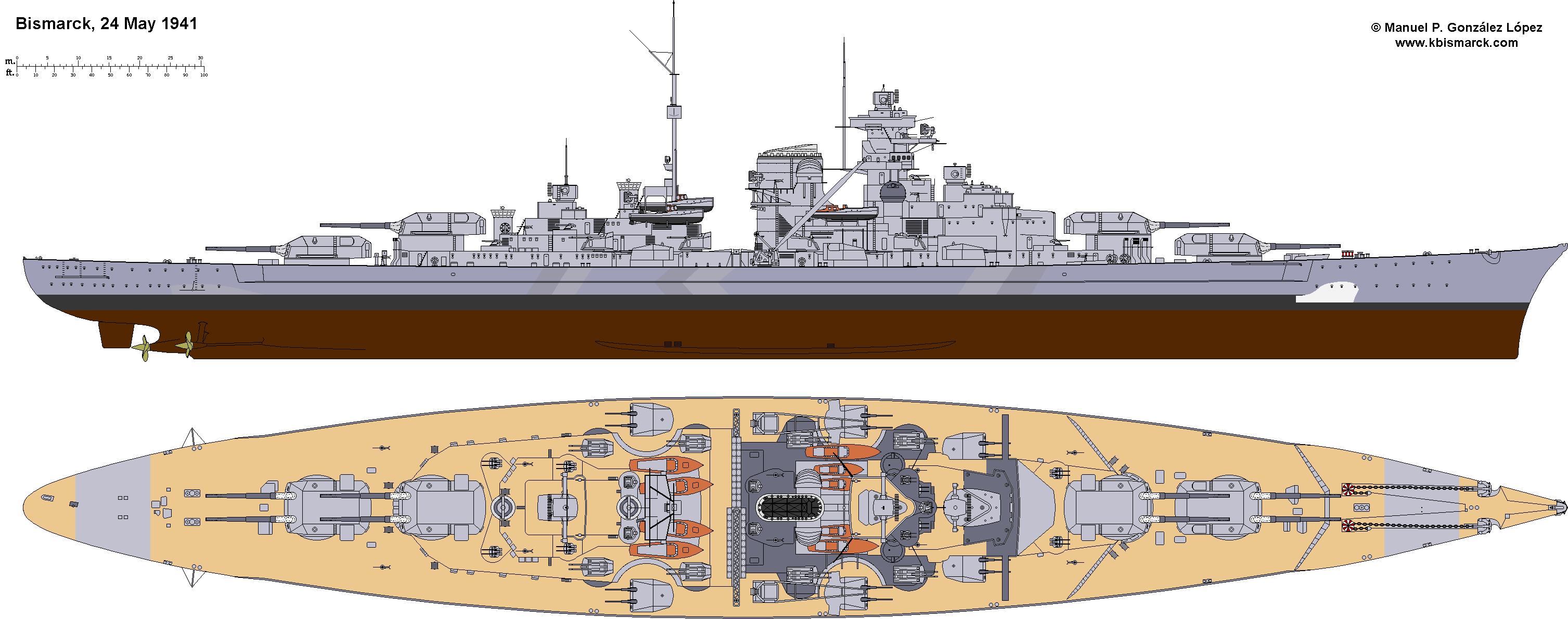
I've recently become fascinated with warships, and I noted a very striking similarity between the Admiral Hipper-class heavy cruiser and the Bismarck-class battleship. Both have very similar superstructure configurations, two fore and two aft turrets, and a single smokestack.
For reference, here is a profile image of the Bismarck, and here is a profile image of the Admiral Hipper.
Both have tall superstructures, the same low bridge behind the B turret, a large, relatively flat area behind the smokestack, and even that giant walkway that Bismarck has just behind the bridge.
So, I guess my question is this: Who designed each of these ships? If they weren't designed by the same person, then why are they so similar?
Also, is there a better place to ask this question?
1 Answers 2016-05-17
Recently, I have gained an interest in pre-colonial India, but I only just realized how complex it all was. I was wondering if there were any worthwhile books/texts for an incomer to the area, especially since I haven't been able to find any. This is purely for self-interest, and I apologize if this isn't an appropriate post for this subreddit.
1 Answers 2016-05-17
Were people just covered in pimples throughout history? Was is fashionable to cover up or get rid of one's pimples? Is there any evidence of people popping their pimples throughout history for aesthetic reasons?
1 Answers 2016-05-17
I have begun writing a story about the superstitions of the Catskill Mountains as inspired by Washington Irving, and I'd like to use some real villages of colonial days as my backdrop. The events taking place within will be completely fictional, and so do I intend to make any mention of surrounding geography. However, I did want to use a real name. Here is an old Dutch(?) map of the region. Thanks for your help!
1 Answers 2016-05-17
Algeria, India, etc. all had profound independence movements manifest after WW2 that made them their own countries, but why specifically after WW2? Why not during the depression or other times? How did colonialism end so rapidly?
1 Answers 2016-05-17
If a ship was put at sea it would be months away from any kind of communication with back home. Now, all major decisions can made directly with the chain of command back home but it seems like back then a captain could run in to a situation with huge diplomatic consequences and have th choice rest on him.
Also how did the command back home communicate with deployed ship?
Has wireless communications reduced the responsibility of that role?
1 Answers 2016-05-17
I'm asking specifically about British ground crew during the battle of Britain. But any answer about ground crew/maintainers in general is very welcome.
Would they be involved in defence? Did they have adequate protection during bombings? What was the rate of mortality? Were they in fear?
Thanks!
1 Answers 2016-05-17