I am comparing the 1946 FA Cup final highlights with that from just 30 years later, in 1976.
They have completely different atmospheres. Some of these differences are technical advances which were available by 1976: colour, slow motion, and being able to have multiple cameras cover the action.
But there's a lot more.
In 1946, the commentator was calm, collected, and almost an objective observer. By 1976, the commentator sounds like a fan himself: excited by the action.
The way the footage was cut and commented on may explain a lot of the differences. But there is still yet more.
The crowd celebrate goals in 1946 by, it seems, mainly waving their hats. I see the odd rattle. And lots of people saying "jolly good show" (or words to that effect). By 1976, however (as seen around 3:07 in the video), the Southampton bench are running onto the pitch, the crowd are jumping around wildly, and the players themselves celebrate with hugs and jumping on each other, rather than the rather formal handshakes in 1946.
Compare the footage at around 02:00 in the 1946 video: that is an extra-time goal which puts his team into the lead! But judging the reactions of his fellow players by the standards of 1976, you'd think that the scorer had just returned from a short holiday and was being met by his family at the airport: "hello, old chap - good trip? Good. Your mother is bringing the car around."
This is the same sport. Actually, the very same sporting event in the calendar. It's the same venue. Just 30 years separate these events: so why are they so very different in atmosphere?
3 Answers 2016-04-19
Reading wikipedia apparently the name of the rank of a general, as in 'general Patton', comes from the medieval or early modern 'captain general', as in a captain (Not in the modern sense, I guess? Like not 'someone above a Lt. but below a Colonel' but 'a high military rank'?) with more stuff to do.
I'm curious, how did we drop the captain bit?
And how does it tie in with other [something] generals? Like Lt./Maj. or even Col. general?
1 Answers 2016-04-19
Despite being older than the Catholic Church and having been endorsed by eastern empires, I hadn't seen any Orthodox knightly orders. I know that this may be due to the fact that the Catholic Church was more centralised than it's eastern counterpart, and that in the East most religious matters that required military intervention were handled by the state. Even so, there have been catholic orders that operated in this area, with the support of the locals, so it would be hard to say that the climate wasn't the right one for them, especially with the proximity. Even the Order of the Holy Sepulchre was catholic, despite operating on the lands of the former Eastern Roman Empire.
1 Answers 2016-04-19
Obviously there was a big difference between the amounts of food. But what else was different between the two? I'm talking like ceremonies before dining, or the amount of people dining at the same time in the same room, the reason of dining, etc.
1 Answers 2016-04-19
Given the level of decentralization, it seems unlikely that there were true seminaries, so what was the system?
1 Answers 2016-04-19
I don't know the exact years when it happened but it is probably around 1920, when he came to the Taurus Mountains.
Here is what I do know:
He said he was originally from near Van, Turkey. He was a devout Sunni Muslim who spoke in a peasant dialect of Turkish common among the Yoruks (Nomads) of Turkey. He was tall, had light brown hair, and green eyes. He was very kind and had a sharp mind, even though not being able to read or write.
He came to the Taurus mountains with only clothes on his back, his siblings, and first wife. His sister died along the trek, and his first wife and child died during childbirth. His other sibling, his brother, had survived but I heard nothing about him. Eventually, my Great-Grandfather was able to get a job in a small village. After the death of his first wife he remarried to the mayor's daughter, (my Great-Grandmother) and he took over as mayor of that village before his death. He married my great-grandmother when he was around 16 years old, and she was only 13.
Whenever asked about why he left Van, he spoke very little about it. My Great-Aunt always asked him about it, but even after many years of being prodded about it, he still wouldn't tell why. He would tell my aunt: "I cannot. If you truly knew what happened, you would become very bitter and you will harbor hate for what happened forever, and it is best if you don't know." That is all that we (the family) know from his account.
This is what the family speculates: they think there was a blood feud between my Great-Grandfather's family and another. They think he ran across the Asia Minor with his sister, brother, and wife, because the blood feud loomed over their heads. They ran far and fast as they could, and tried to create a new life away from worrying about dying.
During the time period, there was the Armenian Genocide. Van was overtaken by both Turks and Armenians, and it was a mess according to some reading on the internet. It is more likely he saw the carnage of the conflict, but as for why he would run all the way to the southwest of Turkey instead of being elsewhere, leaves much to be desired.
1 Answers 2016-04-19
When looking into the Reformation for a fictional work that I am currently creating with some other people I found it rather difficult to not make reforming sound like the obvious right choice.
We want to tell the story of the Reformation in this fictional setting and show both sides of the debate, but when researching this I personally thought that the 95 Theses by Luther and the 12 Articles from the German Peasants' War sounded quite reasonable as far as religion goes and have trouble finding reasons for people to stay Catholic.
We don't want to paint Catholicism as a corrupt and horrible religion but rather in such a way as people would have looked at it at the time.
Trying to look up things like "arguments against the protestant reformation" on google resulted in "Protestant Errors" which is a website describing everything wrong with Protestantism in a modern light (and a very confusing way of wording things combined with an unhelpful layout)
I would like to know arguments against reforming, was it faith and trust in their Catholic priest? Was it the fact that Catholic Churches ran most social services like Orphanages, alms for the poor and what little education was available? A combination of these things? or are there more reasons I have missed/overlooked?
I don't mean to start a religious debate between different Christians I am just trying to figure out why people would choose to reform or stay Catholic during the reformation, which arguments did they weigh to make their decision.
1 Answers 2016-04-19
Talking about blacksmiths, tailors, stuff like that.
Were there often old "apprentices" that were just never good enough to move forward?
When someone become a "master" (not sure how that happens), is it assumed that they go and buy a new shop somewhere or were they likely to stay on and work for their old boss. Were there often large firms with many masters working under a single employer?
If there was a person who was born with amazing natural skills in a career that they were able to secure an apprenticeship in, would it be likely that they would end up successful and renown for their craft?
1 Answers 2016-04-19
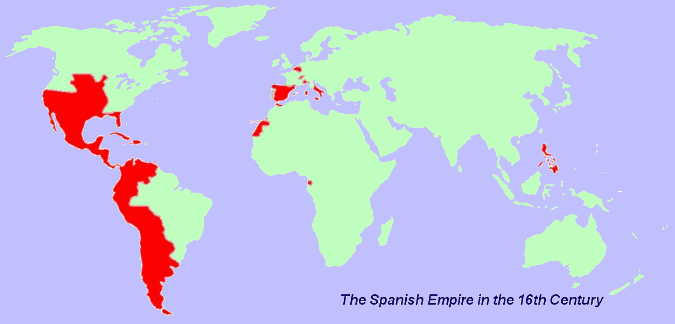
One thing I've noticed when looking at maps of the Spanish Empire is that the highlighted areas strike me as...somewhat exaggerated. They quite obviously didn't control the whole Pacific American coast in the same way that they controlled areas like say, Cuba or Mexico, even at their height.
I haven't encountered a map that's actually made any type of distinction between what they simply labelled as theirs and what they had actual, enforceable authority over however. Is there any scholarship or archeological study on the matter?
1 Answers 2016-04-19
Had a discussion with a lecturer in my university and he claimed that the Incan empire was the largest in the world in 1491. I told him I disagreed, he promised to check his sources and asked me to do the same. The only source I could get my hands on through the internet was by Turchin, Adams & Hall, 2006: http://peterturchin.com/PDF/Turchin_Adams_Hall_2006.pdf I was thinking of sources for the size of the Ming empire, or the Timurid empire. I tried to look for East Asia: The Great Tradition by Fairbanks but came up empty. So what were the largest states in the world around that time, with sources if possible.
1 Answers 2016-04-19
I am doing some research on the establishment of "Kimilsungism" and its links to the Soviet Union. Finding the connections has been very easy but a question that I can not seem to find the answer to is why Stalin removed his troops. This action is completely contrary to what the Soviets did in Eastern Europe when developing communist countries. Any insight would be appreciated, at this point it is more for my own curiosity than the paper.
1 Answers 2016-04-19
David Simon was on the WTF podcast and claimed that the decommissioning of military bands after the Spanish American War was a factor in the creation of Jazz, because surplus military instruments were dumped in New Orleans. The man did create The Wire, but is this true or too good to be true? If it's too good to be true, just anecdotally it seems like instruments were more accessible than they are to day. Is there any explanation for that?
1 Answers 2016-04-19
Middle Ages is a broad term, so let's say I have my existential crisis after Charlemagne but before Agincourt. Still broad, but a bit less so.
1 Answers 2016-04-19
So, I searched for few subreddits for this topic to avoid repetition and haven't found anything. Question: out of all of these theories involving variety of different hypothetically contacting civilizations, which theories are the most scientifically plausible? Can somebody write a personal rank or 'Top 5, 10, whatever' theories that may most certainly survive after the most possibly accurate analysis of their data? Also, I would really appreciate if any of the theories can get some commentary as well, not only the rigid list.
1 Answers 2016-04-19
1 Answers 2016-04-19
Never really got to learn about the old west, always thought it was intriguing though so I thought it would be about time to learn.
2 Answers 2016-04-19
Fire pots seem effective against both formations of infantry and during sieges but they dont seem to be widely mentioned in most battles, What gives? Was oil and pitch rare or difficult to produce?
2 Answers 2016-04-19
Or any other language that was lost for a period of time for that matter?
1 Answers 2016-04-19
Considering how much Pagan elements found themselves in western Christianity like Christmas and Halloween symbolism.
1 Answers 2016-04-19
1 Answers 2016-04-19
I've come into possession of some pictures from WWI.
There are a ton more. If these are legitimate are they rare enough for a museum to want to preserve them?
Or are they common enough to remain a family curiosity?
I am concerned that as a household, we do not have the wherewithal to properly keep them. But there is no question that we would like to maintain ownership. We would be most grateful for any assistance or direction in making sure they are properly preserved.
Thank You for your time!
1 Answers 2016-04-19
Don't get me wrong here, I love history but personally I don't know how it'll be used in life.
1 Answers 2016-04-19