I've been reading about peasant life in 18th and 19th Century Europe. From my understanding peasant life differed greatly between the east and west. My main source is an AP European history textbook "The Western Heritage Since 1300" by Kagan. I've also read selections of "Economic and Social Conditions in France During the Eighteenth Century" by Henri Sée.
From what I've read:
Families: Families in Western Europe tended to be nuclear. Due to marriage later in life, Grandparents were often dead by the time the grandkids were born or old enough to remember them. Where as families in Eastern Europe tended to be generational, and could number in the 20s for one household.
Manorial Oversight:
In eastern Europe it seems that the nobility had very strict control over the peasants lives. From what I've read their situation seems akin to slavery. Forced marriages, legally bound to the land, and their overall condition seems pretty destitute. In Western Europe, however, peasants didn't have such strict controls, and some could move to a new area if the nobility offered better pay/living conditions. Their life seemed pretty tough, but better than their counterparts in the east.
Is this information correct?
Am I generalizing too much with a huge population?
If what I've said is correct, why did these differences develop? I'm especially interested in the different family dynamic.
1 Answers 2015-12-21
Mainly I'm curious how people, both former soldiers and civilians saw the 'other side', after the war was over and the confederate states lost. Was there a desire to 'forgive and forget'? Were the losing states and their inhabitants seen as less than the people on the winning side? What were the attitudes of people on either side towards people on the other side, both shortly after the war as well as say, 15-20 years later?
3 Answers 2015-12-21
1 Answers 2015-12-21
2 Answers 2015-12-21
Did the NAACP support eugenic programs? How was this in contrast to whites who supported eugenics?
1 Answers 2015-12-21
2 Answers 2015-12-21
[deleted]
1 Answers 2015-12-21
WW2?
1 Answers 2015-12-21
Did, say, the people of Spain view him as a great liberator, freeing them of the shackles of their ruling party? Or did they view him as just another war-warmongering, power mad dictator?
1 Answers 2015-12-21
When JFK was killed the entire military of the US was put on high alert, i was wondering what was the reaction of the Soviet Federation following the news? do we have any knowledge of the KGB reaction? how did they see this and what fears could have triggered in them.
1 Answers 2015-12-21
2 Answers 2015-12-21
Hello, just made an account on Reddit. I am currently writing a story based on medieval combat and it would really help me if I can learn the average size of armies back then.
Any piece of information would be helpful and would greatly be appreciated.
2 Answers 2015-12-21
Also if true, what kind of situation did this create for the kingdom? Why was there never a coup attempt? What did her subjects/other countries think of her? Also why did she want to submit to the pope when it apparently (according to the movie) went against her very nature?
Thank you in advance for any responses and if someone could enlighten me on her reign in general, if it was significant in any way.
1 Answers 2015-12-21
I am a third year student at university. I am doing my dissertation on the effect that the change in tactics - from bombing airfields to cities - had on the outcome on the battle of Britain, discussing if that was the biggest factor in countering the odds into the RAF's favour. I am currently struggling to find many insightful primary sources around this subject. Would anybody be able to give me a point in the right direction? I am beginning to look at diary entries and the national archives, but would really appreciate some help. Apologies if this is the wrong sub. Thank you.
1 Answers 2015-12-21
[deleted]
1 Answers 2015-12-21
I can see why heavy armour wasn't used in line infantry formations on European battlefields but against less well armed enemies surely it would have proven an unstoppable combination?
1 Answers 2015-12-21
1 Answers 2015-12-21
Welcome to our sixth and final installment of our Finding and Understanding Sources series. Today the discussion will be about specific types of primary sources, and how they may be studied differently than a more "standard" primary source. Happily, we have quite a few contributors for today's post.
/u/rakony will write about using archives which hold particular collections.
/u/astrogator will write about Epigraphy, which is the study of inscriptions on buildings or monuments.
/u/WARitter will talk about art as a historical source.
/u/kookingpot will write about how archaeologists get information from a site without texts.
/u/CommodoreCoCo will write about artifact analysis and Archaeology.
/u/Dubstripsquads will write about incorporating Oral history.
Edit- I want to take this opportunity to acknowledge the work /u/sunagainstgold did to plan and organize this series of 6 posts. Her work made the Finding and Understanding Sources series possible.
5 Answers 2015-12-21
Perhaps this is a question more for /r/etymology, but surely there must be a historical explanation for this common expression?
1 Answers 2015-12-21
Names they adopted to hide their true origin/identity. I'm imagining a Roman version of "Trixxxie"
1 Answers 2015-12-21
Searched the FAQ and didn't find anything pertaining to this question in particular. My understanding is that the notion of a "Byzantine Empire" is a largely western affectation, and the Byzantines themselves would have just seen themselves as Romans. To what extent, however? Would they still have talked about things like "the glory of Rome," only referring to the empire rather than the city? What sort of emphasis did they place on figures like Julius and Augustus? To what extent was reconquering former Roman territories prioritized (I mean I know Justinian I was into that but I'm not sure how reflective that is of the ERE as a whole)?
1 Answers 2015-12-21
Was it clearly defined? Did any Africans buy into it?
1 Answers 2015-12-21
I'm finishing up reading Gulag: A history, and I'm very interested in reading more about Stalin and to a lesser extent Lenin and Trotsky. Are there any books and/or biographies that are a must read? Or just any highly recommended, comprehensive books?
Any and all suggestions are greatly appreciated!!
2 Answers 2015-12-21
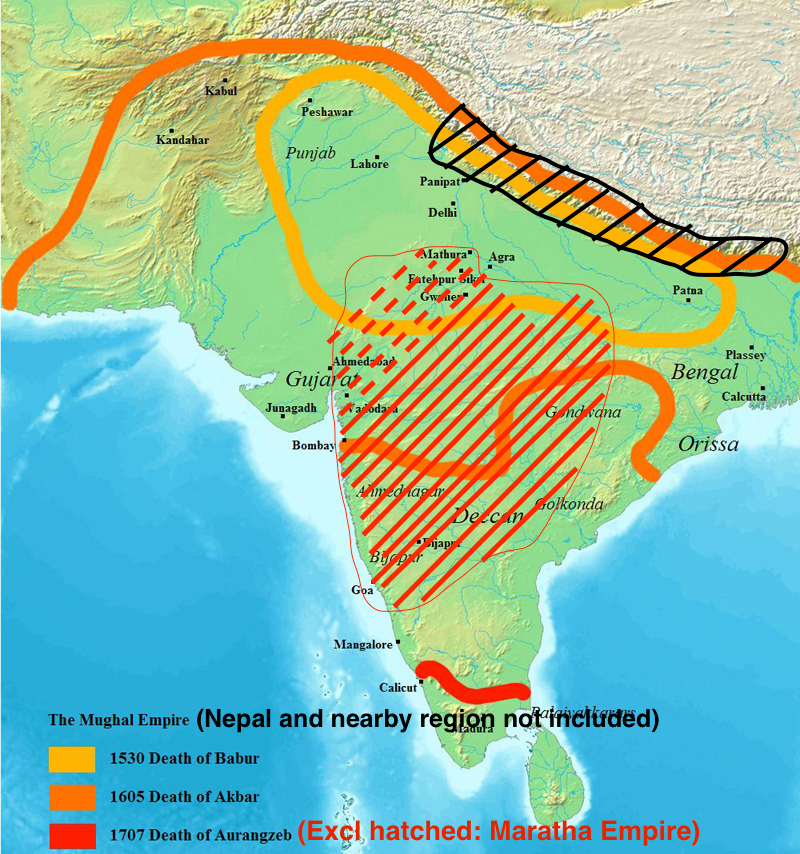
Maurya Empire
Gupta Empire
Delhi Sultanate
[Mughal Empire] (https://upload.wikimedia.org/wikipedia/commons/f/ff/Mughal_Historical_Map.png)
All the empires I listed were quite clearly expansionist, but they never included South Indian territory, and never Sri Lankan land either. Why is this? Is it fair to say that South India was united with the rest of the subcontinent only under the British? And if so, why did the people there decide to join the Republic of India and not form their own country since ruling themselves independently for centuries must have created a separate culture
3 Answers 2015-12-21