I recently wrote an article about the erasure of disabled people from the Holocaust narrative, after a disability activist was vilified for citing the gas chambers in her speech at a political conference. She was called anti-Semitic and lots of publications interviewed Jewish people rather than disabled people regarding her statement.
The article was mainly about the parallels between the pre-T4 propaganda and the UK media propaganda, but it covered T4 itself. It got a fair bit of exposure, which was great because over here almost no-one knows about the events, but I've also had questions about how the Allies dealt with it given how popular eugenics was until much later in Allied countries (eta: eugenics with regard to disabled people specifically).
I'm not a historian, just a writer with a vested interest, and with how little has been written about T4, there's even less about the aftermath. I love reading your answers and am always impressed with the breadth of knowledge in here, so was hoping that someone might have some insight I can point questioners towards. Thanks!
2 Answers 2015-11-03
I'm curious if there has ever been a documented case where a general used knowledge of chess tactics to affect the outcome of a battle or at least help form a strategy. Thanks.
1 Answers 2015-11-03
The book in question is The Greenwood Histories of the Modern Nations: The History of China, by David Curtis Wright The book linked is the second edition, but I'm reading the first.
I've already been reading it for a little bit now, but I'm slightly worried about its historical accuracy since I read about the book in the series on Japan portraying a myth concerning Nobunaga's death as fact. I know that that book and this one were written by different authors so it's kind of silly for me to even be asking this, but this is my first book on this subject and I don't want to get some falsehood implanted in my head as fact, however unlikely and easy-to-correct that may be. Thanks in advance.
1 Answers 2015-11-03
The full quote: "And anti-communism was genuinely and viscerally popular in a country built on individualism and private enterprise where the nation itself was defined in exclusively ideological terms ('Americanism') which could be virtually defined as the polar opposite of communism."
Hobsbawm: The Age of Extremes, Abacus, 1995, Page 235.
1 Answers 2015-11-03
The more I read about the Habsburg family the more is obvious Geopolitics was a big influence on their realm, the one thing I cannot identify is what theory would mostly represent their stay in power. Does anyone here in Ask Historians can guide me a bit more on this? What made the Habsburg family stay so long in power?
1 Answers 2015-11-03
I'm not talking about knights, but men-at-arms and other proffesional soldiers. I'm aware
Who were they in the social strata of that time, depending on the country? How were they trained and financed? Were they sons of rich merchants and non noble land holders?
1 Answers 2015-11-03
While listening to Blueprint For Armageddon VI, Dan Carlin mentions that during the 1918 Spring Offensive, the German army accidentally stumbles upon the old Somme battlefield with all the 'shell holes' and 'corpses'. I'm aware that the Western Front was fairly static for most of the war and the trench lines moved minimally, but what exactly happened on those parts of the front once these months long battles were over? Did these battles just fizzle out to where both sides just sat in their trenches from exhaustion? And by the sounds of this description, the battlefield seems empty. Why not have one side, such as the Germans in this offensive case, just punch through this spot that was so highly contested by the Allies only two years previous and now appears empty?
1 Answers 2015-11-03
in reference to the Soviet Invasion of Xinjiang (1934) and the Xinjiang War (1937).
I can't find a satisfactory explanation. The white russians were anti-communist, and I thought they would've been outlawed by this time. why would they assist the soviets, why would the soviets allow it, and why for the defense of a pro-soviet, quasi-communist regime in Sinkiang?
1 Answers 2015-11-03
2 Answers 2015-11-03
And why? Warmth? Or just ease?
2 Answers 2015-11-03
6 Answers 2015-11-03
The image of modern or recent historians knelt in the dirt, gently brushing age-old dust from a fragment of skull or a shard of pottery is a familiar one. What I want to know is whether or not this was something that an ancient people like the Romans did. What did they do when they found - if they found - the ruins of an ancient Sumerian city, or other cultures that had risen and then perished before them?
1 Answers 2015-11-03
1 Answers 2015-11-03
As far as my understanding goes the Europeans and the Japanese had very similar Feudal systems around the same time, with having very little, if any interaction. Why is this?
1 Answers 2015-11-03
Since WW2, the members of the White Rose, and Hans and Sophie Scholl in particular, have been held up as heroes, and one member of the group was even sainted by the Orthodox church. Do we know what came of Jakub Schmied, the university maintenance man who turned in the students after he saw them throwing some pamphlets? It seems like he might have been pretty unpopular in post-war Germany.
2 Answers 2015-11-03
Reuter concession was a contract signed in 1872 between Baron Julius de Reuter (born Israel Beer Josaphat), a British–Jewish banker and businessman, and Nasir al-Din Shah, Qajar king of Persia. The concession gave him control over Persian roads, telegraphs, mills, factories, extraction of resources, and other public works in exchange for a stipulated sum for 5 years and 60% of all the net revenue for 20 years. The concession was so immense that even imperialists like Lord Curzon characterized it as the most complete grant ever made of control of resources by any country to a foreigner.
Why? Source.
1 Answers 2015-11-03
I imagine the devastation to cities and civilians would have been devastating, but my understanding is that a significant portion of the population, especially outside Europe and America, wouldn't actually perish in the blasts, as would a large amount of military troops (I imagine). But there is the challenge of the nuclear winter and remaining enemy forces.
Was the plan to just try and rebuild/survive? Were there plans for forces in Europe to make moves? Naval forces?
Were there plans to survive the winter? Wait it out in bunkers?
I've seen a lot of text regarding what happens leading up to and during the war, but very little discussion of what comes after.
1 Answers 2015-11-03
So I have been getting to grips with Early English Books Online (EEBO) recently and although I was aware of this before, I have really noticed just how long the titles were. For example...
Walsh, Peter, The history & vindication of the loyal formulary, or Irish remonstrance, so graciously received by his majesty anno 1661. Against all calumnies and censures. In several treatises. With a true account and full discussion of the delusory Irish remonstrance, and other papers, framed and insisted on by the national congregation at Dublin, anno 1666
Which is even shortened from the original one.
Then of course popular books like Gullivers Travels or A Modest Proposal had much longer titles. So I was just curious when the preference towards short titles started to happen and why this was the case?
I'm thinking maybe to save space and paper, but then paper was so expensive in the 17th century so it's somewhat surprising that they had such long titles back then! Was there a particular reason why the convention was to have these long titles?
1 Answers 2015-11-03
Background
So, I'm currently writing the biography of my father who was born in March 1948 but before, and after, this my grandfather, George Wells, spent long stints away from the home, travelling the world, apparently repairing and/or dismantling planes that it seems were left over from the WWII.
My father obviously only remembers so much about this but grandad was, for most of his life, a fitter and turner for Rolls-Royce in Glasgow, Scotland. Dad thinks he was in the airforce and I don't know if he saw active service but certainly that, after the war, he was apparently seconded multiple times - with this job at Rolls-Royce secure and waiting for him each time - to the British Air Force as part of this apparent cleanup. According to my dad, "he was part of the force that was going around the world, mainly Asia, and repairing warplanes to come back."
The Question
So my questions are:
Bonus Info
The multiple times away are rather crucial to the story as during one, before my Dad was born, my grandmother had another kid with a different man - who my grandfather chased off upon his return - and during a later tour she ran away with this man, his kid and her then four children with my grandfather, travelling the UK in a horse drawn caravan as essentially tinkers (think gypsy stereotypes) stealing from one town and selling to the next until... well, you'll have to read the book when I finish ;)
Any help any of you would be able to give would be amazing! I searched through past answers but couldn't fidn anything that lined up. Oh, and thank you in advance!
1 Answers 2015-11-03
Hi there! I'm writing an essay on child sacrifice in Phoenicia. I've found plenty of papers on the archaeological evidence (the Tophet at Carthage for instance) but not so much about references to the practice in contemporary accounts. Could anyone point me to some good papers/books on the subject? I have access to jstor and a good university library.
Thanks in advance.
2 Answers 2015-11-03
Umayyad Caliphate is plain white
Abbasid Caliphate is plain black
Fatimid Caliphate is plain green
Ayyubid dynasty is plain yellow
Why didn't they employ any symbols like crescent or seal of Solomon, or even Islamic inscriptions like shahada, or seal of Muhammad?
2 Answers 2015-11-03
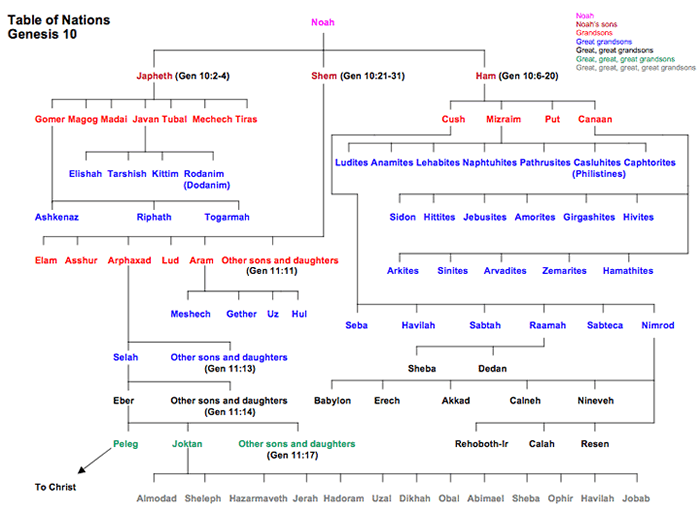
For exmaple, is Titus Flavius Josephus' Table of Nations indicative of ancient tribes settling in the Middle East? How much does our modern belief of how Babylon, Assyria, Canaan, Cush, etc. originated differ from his works and writings? http://www.swcs.com.au/jtable2.gif
And in general, how often do historians rely on Greek/Roman/Jewish historical accounts regarding antiquity (1000 BC and prior)? Or are those writings mostly discounted due to having 1000+ years between the writings and the events? I wonder how much of what was in the Great Library of Alexandria we would deemed/considered non-sense and how much of it was accurate?
1 Answers 2015-11-03