1 Answers 2015-11-01
It's been over 70 years since the end of the Holocaust, and the world's population has swelled since then. What about the Jewish population? Has it reached the level it was at before the Holocaust? And how spread out are they compared to before? More, or perhaps less because of Israel?
1 Answers 2015-11-01
So I understand the Austro-hungarian empire being broken up to punish Austria. But wasn't Hungary forced into the war on account of being the 'lesser member' in the union?
Why wasn't Hungary just free'd from Austria and allowed to keep the majority of its territory?
2 Answers 2015-11-01
I know that they didn't celebrate Christmas, Easter, Pentecost, All Saints, Saints' Days etc.
What exactly was their rationale for not celebrating (for example) Easter or Whitsun? Fundamentalist Protestants today who refuse to celebrate those holidays tend to do so because of their alleged 'connection' to ancient Babylonian fertility/solar religion. Did the 17th century Puritans really buy into all that Easter = Ishtar stuff? If so, then surely the more educated among them must have realised that it wasn't true?
Did they have any other festivities to celebrate? Surely they must have brought up Christ's death and resurrection on Easter, when they were preaching in church? Or did they deliberately avoid mentioning it on that specific day?
1 Answers 2015-11-01
4 Answers 2015-11-01
Both in Spain and other countries of the time, how did the people, specially Catholics (and non persecuted groups), perceived the inquisition? Were they in favor? were they against?
I'm interested especially in the first reaction at first, and at what point did it radically changed (if it did) the perception of it, and why.
Thanks!
1 Answers 2015-11-01
Today:
Welcome to this week's instalment of /r/AskHistorians' Sunday Digest (formerly the Day of Reflection). Nobody can read all the questions and answers that are posted here, so in this thread we invite you to share anything you'd like to highlight from the last week - an interesting discussion, an informative answer, an insightful question that was overlooked, or anything else.
4 Answers 2015-11-01
The battle of the bulge is superficially similar to the tet offensive in that both were major surprise attacks launched by an enemy that was supposedly on the brink of defeat.
The tet offensive is often described as a propaganda victory for north Vietnam and caused a great deal of political fallout in the United States. But I have never heard any similar discussion of the battle of the bulge's political consequences.
Did The battle of the bulge shake the confidence of US or UK government and civilians? Did opposition parties use it to put pressure on the party in power? Did civilian leaders put more pressure on their commanders or replace them? What was the reaction in Germany and the ussr?
1 Answers 2015-11-01
It is often documented how, at the end of WW1, there was mass celebrations in places such as England. However, what was it like in places like Germany, and Austria?
Also, what happened in France after the war? The northern region basically got torn to pieces, was there also celebrations there?
1 Answers 2015-11-01
It had blue stripes as well as red stripes, but the blue stripes were only on the bottom half of the flag, and it had only a few stars (either nine or sixteen).
The car parked in front of the house that was flying it had some Civil War stickers on it, so I assume it has something to do with the Civil War, but when I looked online I could not find any references to an American flag with blue stripes.
4 Answers 2015-11-01
Its my understanding that the Coalition forces had huge advantage over the Iraqi army, surely Saddam must have had at least an idea of what he was up against?
2 Answers 2015-11-01
I know the ruling elite was Arab (at least in the pre-Almoravid/Almohad period) and arabized Berber, but the greater part of the population was Iberian-Roman. Considering the openness of Andalusian government towards native religions and cultures, how Arab-like was life and culture then?
1 Answers 2015-11-01
Is it due to agenda of opposing the West, thus allying with Soviet pact?
If you downvote, please explain why.
1 Answers 2015-11-01
The north-south axis is defined as the rotational axis of the Earth, but the fact that the Earth spins was discovered only a few centuries ago, and it was probably a long time before geographers pinpointed the exact location of the north pole. How then did ancient peoples decide where north was?
2 Answers 2015-11-01
The question popped into my head with this post where the woman in the pic has her hand one way and the rest of the folks had their hands the other way. Is there a rule for how it's done? I asked the same question there but no replies, so I was wondering if any history gurus can shed some light.
1 Answers 2015-11-01
Assuming that it is at its height of popularity currently.
2 Answers 2015-11-01
From the Aztec with Quetzalcoatl to Freud ans Jung, passing by Hermes and Adam & Eve, the snake is used a lot as a symbol. I was wondering why it got so much attention through ages.
1 Answers 2015-11-01
Almost everything I know about this era of history comes from the bible and the latest episode of Hardcore History. When the Babylonians took the Jews captive, was that a big deal or was it just business as usual for them? When Cyrus set returned them to Jerusalem, were they getting special treatment because they were especially important in some way, or did he do the same with dozens of other displaced peoples who didn't cover half the globe with offshoots of their religion? When the big empires of the era made decisions, was Israel's reaction a factor?
2 Answers 2015-11-01
The Germanic peoples were originally from Scandinavia, and during the Classical Antiquity period - although not quite the Roman empire - their tribes were numerous and formidable all across Europe. You have the Goths who went as far as Anatolia (and then I believe they went even further - conquering Rome and Iberia, but I think that has more to do with the fall of the Roman Empire more than my question), the Franks in Gaul, the Angles and the Saxons in Britannia, and of course the Germans (Suebi? Marcomanni?) in Germania. Most striking to me is the fact that Germania is named after peoples that did not even originate from western-central Europe, but after Scandinavian migrants.
More puzzling to me is the fact that (to my knowledge) Scandinavia has a relatively harsh climate and poor soil, at least in comparison to continental Europe. My understanding is that soil fertility/agricultural strength would be a pretty good indicator of a civilization's population density, development, and perhaps war prowess. Powerful ancient civilizations that arose out of the Indus Valley, Yellow River, and the Nile Valley went on to subjugate other peoples and conquer lands.
However, in the case of the Germanic peoples the pattern seems to be reversed. How and why were the presumably less prosperous Scandinavian Germans able to triumph over the indigenous population of Germania? What happened to the indigenous populations? Why was the migration pattern not the other way around - it seems counter-intuitive that the Germanic peoples migrated through Finland, Sweden/Norway, and Denmark only to come back down to continental Europe. Why did they migrate so often?
2 Answers 2015-11-01
The show, Vikings, take place around the year 800 CE. There are Roman ruins in the show and the King of Wessex mocks how everyone thinks the ruins were built by "giants" and how the other must not know the truth about the Roman Empire.
This seems imply that no one (at least in England) knows what the Roman Empire was, even the Nobles don't seem to know.
Did people really forget about the Roman Empire and if so when did we "rediscover" it?
2 Answers 2015-11-01
I've googled questions like, "What did Abraham Lincoln sound like?" And I've found nothing. Is there a way that people can surmise how people sounded? Not just dialect but intonation and unique pronunciation... Is it possible for people to know?
1 Answers 2015-11-01
1 Answers 2015-11-01
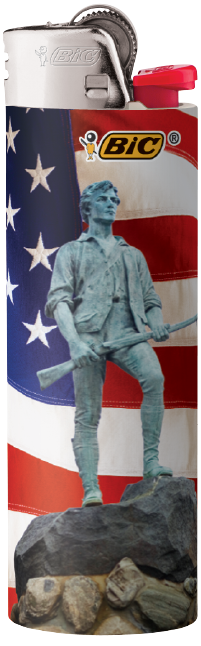
I picked up a bic lighter the other day with this statue on it. Who is this man and where is this statue?
http://flickyourbic.com-prod.s3.amazonaws.com/Product/special-edition_americana_604.png
1 Answers 2015-11-01
In particular, I'm interested in the kinds of political powers he held during the Edo Period, and what led to so many different factions (like the Choshu and Satsuma factions) fighting against each other and against the Tokugawa shogunate for support from the Emperor. I understand that near the end of the Edo Period, Japan had opened its ports for the first time, and the sudden accessibility to Western materials and ideas is what fueled the turmoil of the Meiji Restoration. But why were so many factions vying for support from the Emperor? What significant political roles did he hold that a sudden change in his political views would signal the end of the Edo Period and the beginning of the Meiji Restoration? And also, what kinds of reformations took place during the Meiji Restoration in terms of political and social structures in Japan?
1 Answers 2015-11-01