This is a weird question, I looked everywhere but didn't find anything. I don't know a lot about guns, what I do know is the many ways they are used: for fun,defending yourself,robberies etc. My question is ( an I know it's kinda of a broad question) was archery used the same way? Did people use a bow to steal from people at night? Did you have the same "standoffs" with 2 drawn bows? Did peasants go shooting trees for fun ?etc I know archery was used for different purposes, but the idea behind is is basically the same: you damage your opponent from afar, I hope this bypasses the "vague era" rule because archery has basically remained the same.
Hope the question makes sense, thank you!
1 Answers 2015-10-13
[deleted]
1 Answers 2015-10-13
[deleted]
2 Answers 2015-10-13
From what I understand, most people on both sides were keen to get back to normal after peace was made, but there were certainly people on the American side who wanted to conquer/liberate Canada, and there were tensions throughout the 19th century.
Did anyone from Britain seriously propose reconquest or reunification?
2 Answers 2015-10-13
There is well documented affects of agent orange on the people living in Vietnam, but what is the affect on people who were deploying it or were exposed to it on the U.S. side? The people flying the planes/helicopters? Are there more casualties/birth defects affecting people who participated in these missions? This may be a very touchy subject, but I want to know how many/if we poisoned our own troops (USA)
1 Answers 2015-10-13
I've read that the reason America's mega-fauna went extinct was over hunting because they were easy prey because they hadn't evolved alongside humans and so didn't know to fear them (or some such). I figure that if this is true, we should find scads of butchered carcasses of American mega fauna lying around, but AFAIK we haven't. Is this theory bunk?
3 Answers 2015-10-13
1 Answers 2015-10-13
4 Answers 2015-10-13
Was it a repressed view similar to some European eras or a more relaxed opinion?
Were acts against the norm considered impolite or improper?
2 Answers 2015-10-13
I'm trying to put together a plot of the number of human slaves, worldwide, as far back as I can go. The number 30M for 2010- is easy to find, and I can find plenty of numbers for the US pre-civil war, but is there a reference that might have cumulative global numbers dating back any significant length of time?
1 Answers 2015-10-13
Does the historical method dismiss supernatural events on the account of them being scientifically impossible? I'm talking about events like the Great Flood, resurrection of Jesus, etc.
2 Answers 2015-10-13
1 Answers 2015-10-13
A friend and I are watching a documentary right now and got to thinking. One, is it possible people escaped? Two, If they did, did they survive? We are really interested in learning more about this.
2 Answers 2015-10-13
1 Answers 2015-10-13
I know that prizes for literature and mathematics are as old as the fields themselves, but I am aware of no prior precedents for chemistry, physiology/medicine, and peace. Were there any which might've been a source of inspiration for Nobel? If not, how did he explain picking those fields as worthy of recognition?
3 Answers 2015-10-13
Thanks to everyone in advance :)
1 Answers 2015-10-13
In discussions on gender roles, the "fact" that gender roles have been pretty constant across cultures and throughout time is inevitably brought up. The opposite "fact" is also often cited: that gender roles are diverse and varied. However, I have rarely if ever seen this claim linked to evidence and usually the evidence that is cited is flawed either by being too exclusive (Only western societies or only societies that are widely known an talked about) or based on too few cultures. So I'm interested in whether or not this has been explored broadly and in depth and quantified over many cultures.
2 Answers 2015-10-13
In modern times it seems that when a government is overthrown, even if that government was a brutal dictatorship, what results is often far worse. Iraq, Libya, Egypt, etc. have all pretty much been disasters, Syria is shaping up to be one as well, and I'm sure there's plenty of other examples in Africa, Asia, and Latin America that I don't know too much about. Taking out the current regime seems to always create massive destabilization, and a power vacuum that is usually filled by someone much worse.
Why then did the American Revolution seem to work out so well? It was definitely a somewhat bumpy road getting the constitution written and the government established, but it was by no means chaos. With the British gone there was plenty of opportunity for some rogue group with the less than noble intentions to take over and send everything to shit. Why did everyone then seem to pretty much just follow the Founding Fathers?
Is it that these modern examples of revolution are usually perpetrated by a small group that's not representative of the general public? Is it that they're usually strongly influenced by outside forces (cough the united states cough) that rarely have the good of the actual country where the government is being overthrown as a top priority? Is it something else entirely, or a combination of a bunch of factors?
1 Answers 2015-10-13
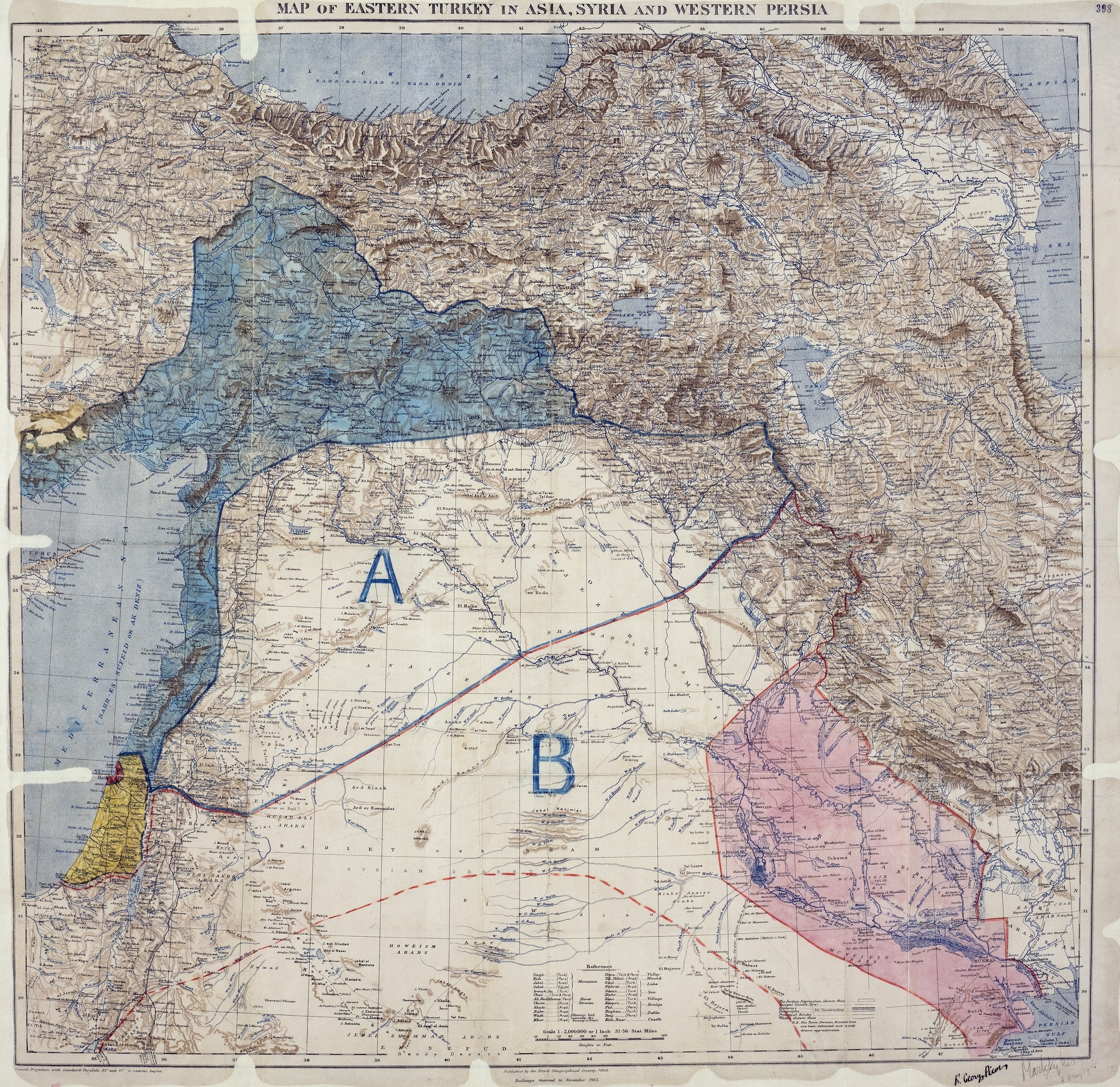
The sykes picot, i assume this is the original?
has 3 colors, i can guess blue is France and red is Brittan(i play eu4 after all)
the wiki mentions zionist involvement, but does not seem to spell things out, it also mentions the idea of a dutch mandate?
the map seems to be legit so what did the yellow part originally mean,
1 Answers 2015-10-13
When Christopher Columbus returned from his first voyage from the New World, he spread wild exaggerations of exotic riches and wealth that were ripe for the picking. Believing his wild boasts, King Ferdinand and Queen Isabella of Spain granted Columbus a second voyage, one that was to be a mission of colonization rather than exploration. Unlike Columbus’ first voyage, the second voyage would be massive, comprising of 17 ships and over 1,200 men. During his second voyage in 1493, Columbus explored Hispaniola and Cuba. As per agreement with the Spanish crown, Columbus became viceroy of the lands he discovered, and was granted a healthy share of any riches that were found.
Columbus planted his flag on the island of Hispaniola (Haiti and the Dominican Republic), making it the center of his small Caribbean empire. Once situated in the New World, the expedition began their search for the gold that Columbus had boasted off. The only problem was that there really was no gold on Hispaniola, or the rest of the Caribbean. All of the gold jewelry worn by the native Caribbean people was made from rare nuggets and bits of gold dust occasionally found in small rivers and streams, gathered over a period of years. This was quite the problem for Columbus, whose mandate was to find enough wealth to turn a profit of the expedition, not to mention he wanted his own share of the riches as well.
At first, Columbus attempted to make money through the slave trade. Slaving parties would capture local natives and ship them 500 at a time to slave merchants in Spain. However Columbus’ slaving program proved fruitless as over half the slaves would typically die before reaching Europe. Then Columbus set upon a new plan, an even crueler plan to squeeze Hispaniola of all wealth that could be had.
Columbus made a decree that all of the Taino people 14 years and older in Hispaniola had to provide a tax of 1 hawksbell (thimble) of gold every three months. Those who paid the tax were given a copper token to wear around their necks. Those found without a copper token after three months time had their hands cut off. The greed and cruelty of Columbus put the Taino in a no win situation, as in a very short amount of time the islands supply of gold was exhausted. Faced with the prospect of mutilation, many Taino committed suicide. Others fled to the inland mountains where they were hunted down by Spanish soldiers with dogs.
After two years with Columbus as governor of Hispaniola, almost half of Hispanoila’s 250,000 Taino natives had died, either being murdered by the Spanish, or dying of disease, starvation, and exhaustion. As for the Spanish themselves, Columbus spared little of his cruelty. Minor infractions were brutally punished with floggings, mutilation, or even death. Due to mismanagement on Columbus’ part, the Spanish were constantly short of food and supplies. Any talk of mutiny or rebellion against Columbus was met with immediate punishment as Columbus took the role of an all powerful dictator who was beyond reproach.
When Columbus returned to Hispaniola from his third voyage, he found that many of the colonists were in open rebellion against him. He quickly quashed the rebellion and hanged the conspirators, but word of his tyranny reached the Spanish court. After an investigation of Columbus’ governorship, the Spanish king ordered Columbus stripped of his titles and brought back to Europe in chains.
Columbus would spend six weeks in prison before friends in King Ferdinand’s court convinced him to order Columbus’ release. Columbus would conduct one more voyage to the New World, one that would end in disaster. After his exploring days Columbus grew wealthy writing books in which he prophesied the future. In fact, he made more money as a seer than as the ruthless tyrant of the Caribbean. He died in 1506 at the age of 54.
2 Answers 2015-10-13
Were they unified on racial policies? Were they culturally integrated at all? As the white minority did the English-speaking South Africans have any real power once South Africa became independent?
I mean these are just some questions that someone could answer but the truth is is that I have close to no knowledge about this at all.
1 Answers 2015-10-13
"It cost 70,000 for a new transmission, tigers where also known for braking down half the time from being rushed in production, its engine was a little weak for its weight and the transmission often fail from being over stressed, at least 40% of tigers died because of mechanical problems."
Is there any truth to the points described in the above quote?
1 Answers 2015-10-13
1 Answers 2015-10-13