I'm an English creative writing major and for me the choice to focus on writing was easy, but I'm wanting to take up a second major, history. I love history and always have, but my love of history is broad. I don't even know where to begin when deciding to narrow it down into a focus.
How did you guys decide?
6 Answers 2015-08-28
[deleted]
1 Answers 2015-08-28
Hey guys,
I often hear Britain of the 1850s referred to as Imperialist. 1940s Germany was Fascist.
What was 1900 Germany? They had a monarchy, they had what they deemed a German Empire (though it was hardly global). Under Kaiser Wilhelm II they were assertive and recalcitrant.
How would you describe them at this stage? Monarchist, Imperialist, Nationalist, Chauvinist etc?
Any help much appreciated.
1 Answers 2015-08-28
I've come across mentions in other books of a shortish piece by Francis Bacon called "The Masculine Birth of Time," AKA Tempus Partus Maximus. Thing is, the thing is nowhere to be found as far as I can tell. I've tried gutenberg, archive.org, amazon, my university library catalog, etc. Nada. Has it not been translated? If so, by whom, and where can I find it?
Thanks in advance for the help.
2 Answers 2015-08-28
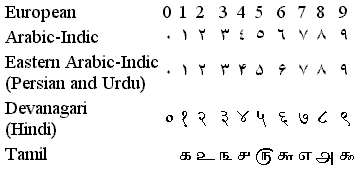
So even this image gets it wrong, it describes what i've always been told were Arabic numerals as European. Even a teacher here in the mideast where i am now called them European numbers, or English, I forgot what she said.
On every license plate they have the numbers we know and these Indic ones in column 2.
Why would middle eastern countries have used these indic numbers, which interestingly like ours are read left to right (whereas Arabic words are read right to left) instead of their own numerals?
1 Answers 2015-08-28
I'm very interested in learning about the dispute between India and Pakistan over Kashmir. However, as I know very little about History in general, I don't even know where to start... Could you please fill me in?
Thank you!
3 Answers 2015-08-28
I've done a lot of research about the Christ Myth theory and I have to say, most of the evidence for Jesus is pretty dubious. Like the Josephus quote, for example, which even conservative scholars are willing to admit is partially fake. The Tacitus quote seems a lot more legit and solid.
Even as a skeptic of Jesus's historicity, I find it difficult to explain away Tacitus's reference, since he says "our" prefect Pontius Pilate. Being a Roman senator and a dedicated historian I highly doubt he would reference an event one of his government's politicians did if they didn't actually do it, even if Jesus' execution was about 80 years before he wrote Annals. Though then again, many people believe Al Gore invented the Internet, so you never know I guess if he was just accepting the Christian legend as fact.
The fact we've found the Pilate Stone (even if to my knowledge it hasn't been carbon dated, it seems like historians accept it as genuine and coming from the era it's claimed to be from) and the fact Philo talks about his deeds as early as 40 AD (without mentioning Jesus, which to my knowledge is the only written reference to Pilate we know of that's separate from a mention of Jesus) gives more credence to Tacitus' quote on the crucifixion.
If we accept that Jesus was executed under Pontius Pilate and baptised by John the Baptist, does that also mean that history supports his divinity to some extent? If it vindicates the Gospels as historical documents, it seems like we ought to take seriously the miracles Christ was claimed to perform. Either that or he was just extremely good at making people believe what he wanted them to believe, or the Jesus of the Gospels is essentially a fan-fictional version (ala Chuck Norris facts) of the actual Jesus aside from his baptism and the way he was killed.
4 Answers 2015-08-28
1 Answers 2015-08-28
2 Answers 2015-08-28
I get that it was a complete non-title, considering the conquest of the Empire by the Turks, but that didn't stop them from taking 'King of Jerusalem' into their styles, and it seems to me like there would be a ton of prestige to be had in using a title they paid good money for.
2 Answers 2015-08-28
I remember hearing somewhere that when trains were invented, many passengers would bring books on them to avoid having to talk to the other people in their carriage. I've tried to find a source for this, but have been unsuccessful. Is this actually true?
1 Answers 2015-08-28
I would like to read more then just wikipedia and I have been connecting kings and rulers and wars thanks to wikipedia links withing wikipedia links but I would like to read more in depth rather then this. I would like to read something detailed that started from Romulus to 1453 or 1461 or holy roman empire for that matter , or even today whatever is left since then , I am not putting any end date but it should start from the beginning and should be very boring to uninterested with the amount of details given . Could be book , could be website , could be podcast but I rather not listen podcast because I drift off when I listen something but I would rather read about it
1 Answers 2015-08-28
1 Answers 2015-08-28
There's a popular probably myth that sagging originated as a way for prisoners to signal that they were "homosexualy available". Others say that while it did start in prison it was due to ill-fitting clothes. Can't find any good sources online for either theory or any other. Anyone have any clue how this fad got started?
1 Answers 2015-08-28
I can somewhat get an idea about Italy but I don't understand what either side saw in North Africa at all.
2 Answers 2015-08-28
I'll be honest, I've never read Mein Kampf all the way through. In all honesty I get about 7-8 pages in and then just get bored out of my mind because Hitler was such a horrible writer. However, I do know that a lot of what he did was proposed in Mein Kampf. So I guess my question is, why were the allies so surprised by what Hitler did, when he pretty much stated what his goals were in his book?
4 Answers 2015-08-28
1 Answers 2015-08-28
My friend was saying that Charlemagne was the first Holy Roman Emperor while I was taught Otto I was. Wikipedia supports his claim but it seems wrong. Charlemagne was French and ruled a centralized French Empire, the Carolingian Empire, not a German decentralized empire. I understand they were both crowned emperor by the pope but they ruled distinctly different empires so can it really be said that Charlemagne was a Holy Roman Emperor?
2 Answers 2015-08-28