So back when I was in college I wrote an essay on Lincoln. I have this memory ingrained but cannot find a source online to back it up but something won't let this thought leave my head. I remember reading that Lincoln had the Emancipation Proclamation written pretty much the day he took office but he kept it in his desk drawer because he knew that freeing the slaves would cause some northern-leaning states (whose economies relied on slavery) to immediately join the Confederacy. So he prudently allowed slavery to continue until a more strategically opportune time.
The above is simply my memory of what I read. I can't find anything to substantiate this online, but at the same time I find it weird that I remember so many vivid details about this (my) version of history.
Has anybody heard the same thing?
1 Answers 2015-08-11
Particularly, were they as fiercesome as warriors, as effective in combat and as cruel to their captives?
Was his portrayal of historical Comanches such as Buffalo Hump accurate and/or fair?
2 Answers 2015-08-11
I've read a bunch of different explanations for why the English longbowmen defeated the Genoese crossbows at Crécy. Most mention the rain, and the Genoese being unable to keep their weapons dry. I'm confused about this, because I know Genoa was a major port, and I've heard elsewhere that crossbows were often used in naval combat. Given that the ocean is known for its large quantity of water, how could they not have a means of protecting their weapons?
The rain also apparently made the ground soft, which is a problem for crossbows because they need to place their weapon on the ground to pull the string back. How important a factor was that, really?
Most baffling of all, the Genoese seem to have forgotten their shields when they formed for battle that day. How is that possible? I thought these were professional soldiers.
Finally, did the French knights actually turn on their own archers when the Genoese withdrew, because they interpreted it as cowardice? Killing your own allies seems a poor choice on both tactical and strategic levels.
1 Answers 2015-08-11
I am thinking, of course, of the common media portrayal of pirates using crude tools like hooks to replace lost limbs. Was this an accurate portrayal of prosthetic use in an age before modern medicine or is it a hollywood fabrication?
1 Answers 2015-08-11
2 Answers 2015-08-11
Agriculture played a large role in many parts of the world, but did it play a role in the far north as well, where the weather was very cold and much of the land was tundra? Or did people rely solely on herding and hunting/gathering? If it existed, how would this agriculture differ from what existed in more temperate regions?
1 Answers 2015-08-11
2 Answers 2015-08-11
There are many motives behind Vietnam but it appears that the main US interest was to not lose another country to communism. If this was the case then why did they oppose the Geneva Accords of 1954?
"We shall seek to achieve unity through free elections supervised by the United Nations to insure that they are conducted fairly."
-Beddel Smith US delegate
They knew that the majority of the country favored communism and the installed French state was incredibly unpopular.
How is it that the US was so successful in subverting the media in believing that they were defending Vietnam when they were playing both sides of it? They called for free elections and then they oppose the majority rule in Vietnam.
1 Answers 2015-08-11
I'm currently studying in Vienna and have discovered that the Hapsburgs were "buried 3 times." Most of the dynasty's bodies are in the Imperial crypt, yet their hearts are in the Church of the Augustinian Friars and their other organs are in the catacombs underneath the Stephansdom.
I can't seem to find anything online related to why the Hapsburgs did this, so I was wondering if there are any theories. Furthermore, I'm wondering if this practice is related to the ancient Egyptians, similar to the adoption of historicistic Greco-roman architecture.
1 Answers 2015-08-11
Previous weeks' Tuesday Trivias and the complete upcoming schedule.
A simple theme today: color, or colour, if that’s your game. Tell us anything you’d like about color, meanings of colors in different cultures, how colors were made and enjoyed through dyes and tints, rules and laws about using color (you may have noticed only mods here can Wear the Purple, for instance, perhaps it is inspired by a historical practice...) Or anything else you can dream up!
Next week on Tuesday Trivia: Historical poetry, oh noetry! The 18th of August happens to be Bad Poetry Day, which inspired my theme, but we’ll just be sharing any historical poetry, no judgement calls.
9 Answers 2015-08-11
1 Answers 2015-08-11
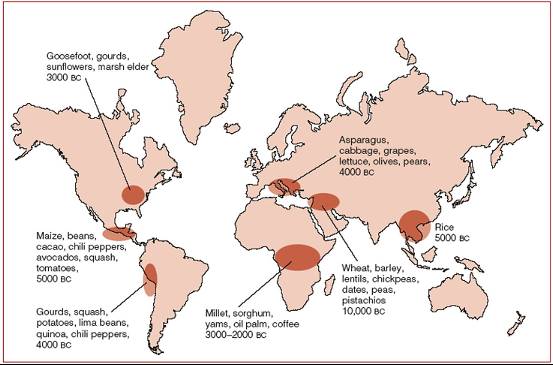
I'm basing it on this map. There are a lot of maps with various differences like this and this, but they're all roughly the same.
According to Wikipedia, "...gave rise to anatomically modern Homo sapiens in Africa about 200,000 years ago". So why, after all that time, was there such a rush of agriculture around the world, from 10,000BC to 3,000BC?
I suppose I can understand some cultures learning of it from others, and then having their own revolutions. (eg. fertile cresent to Sahel, or mesoamerica to the Mississippi), but I can't imagine this for more far apart revolutions (eg. fertile cresent and China, or a Eurasian revolution and an American one.
4 Answers 2015-08-11
Did they still respect the old "legendary" viking kings?
1 Answers 2015-08-11
1 Answers 2015-08-11
So I read this book and now I want more. I'm also in the midst of listening to Dan Carlin's Podcast on the History of the Khans. In particular, I am very interested in the tactics and strategy employed by the nomads, and the way of life instituted by the Mongols on the lands they captured. I would give more specific details but I still feel like I don't know much yet and am very interested in these people in general. Any good books? While I would probably prefer less textbook-formats I don't mind them.
1 Answers 2015-08-11
Irrespective of whether Stalin would have gone for such a proposal.
1 Answers 2015-08-11
So there were lots of wars involving Ottoman Empire's rivals in Europe but why did the Ottomans not seize the opportunity to increase their European holdings? For example, why didn't they attack Austria during the Thirty Years' War? Why didn't they attack Austria and Russia during Napoleonic Wars? There are probably more examples of this but I can't remember right now.
When Russian troops retreated further into Russia when Napoleon invaded, couldn't Ottomans easily reclaim their lost Black Sea provinces? When Austria was weakened during Thirty Years' War, why didn't they invade Vienna? There wouldn't be a resistence as fierce as 1683 or why they didn't attack Austria to reclaim their lost Hungarian provinces during Napoleonic Wars?
2 Answers 2015-08-11
Hello there! My name is Conevery Valencius, and I'll be taking questions today about my recent book, The Lost History of the New Madrid Earthquakes, which just came out in paperback. If this discussion gets you interested to learn more, the University of Chicago Press is offering a discount of 20% on the paperback for this AMA, good through Nov 11 (use code PR20VALEN).
The Lost History of the New Madrid Earthquakes is my attempt to figure out why, as a person who grew up in the Mississippi Valley and now makes my living as a historian, I knew almost nothing about big quakes that had hit that region in 1811-12 (the epicenters are in the Missouri bootheel, along the Mississippi River, in the part of the U.S. where the states of Arkansas, Missouri, Tennessee, and Illinois draw close together). When I moved out to California to go to school, people said I was moving to "earthquake country" -- but the thing was, I was already there!
To figure out why I never knew that, I had to figure out a few topics:
what earthquakes do: turns out that not only do they shake the ground, but they also cause huge commotion on rivers, especially rivers as big as the Mississippi. In areas of loose, unconsolidated, fertile soil, they also create huge sand blows: areas of liquefaction in which hot liquid sand shoots up into the air and makes a conical, volcano-looking mound. Yikes!
news in the nineteenth century: in 1811-12, news of the quakes spread through excited gossip and through newspaper stories, which were cut-and-pasted into the many quarrelsome little local papers all around the U.S. That's how knowledge got made back then.
Native American history: the quakes were big news for indigenous peoples throughout the North American southeast, as well as for the pan-Indian confederacy led by Tecumseh and Tenskwatawa.
Cherokees and swamps: I found out the areas right where the quakes hit were a main area of settlement for Native people tired of losing land and culture to invading Americans in the Southeast. The New Madrid quakes made good hunting and fishing land into barely-passable swamp and pushed those settlers further west. This is a whole area of American Indian history -- as well as Arkansas history -- that hadn't been known before!
religion: when the earth heaves and cracks and people see glowing lights and smell sulphur, people of many faith traditions seek to get right with God - and quick!
bodily experience: I wrote one book about bodies and land in the nineteenth century (The Health of the Country, in 2002). I figured I was done with that topic --- but then I started reading accounts by people in earthquakes, who used their bodies as barometers of environmental upheaval, and who interpreted the earth's behavior according to how it made them feel.
early American science: wow, were these quakes a puzzle! Lots of people -- not just academics, but ordinary folks -- tried to figure them out. The earthquakes show us a truly lively world of scientific thinking in the early U.S.
change and forgetting: why could quakes so big and powerful be forgotten? partly because of environmental history: timbering, railroading, swamp drainage. partly because of social history: newly-freed African-Americans moved into the quakes' epicenters and had other pressing problems. partly because of the Civil War: a major battle, Island No. 10, was fought on earthquake terrain, but afterwards was only remembered for the battle, not for the earthquake-shaped landscape.
revolutions in the earth sciences: the introduction of instruments into the study of the earth's movement was REVOLUTIONARY! so exciting! so much became clear! ….but old newspapers with excited stories about people feeling seasick when the earth shook were no longer scientific evidence once researchers had clean, clear, quantified seismograms to work from. Similarly: plate tectonics did a great deal to explain why earthquakes happen in much of the world, but very little to focus attention on seismic movement within tectonic plates.
changes in sciences: only in the last 15 years or so have the New Madrid quakes gone from the preoccupation of a few people to a major area of study. This is in part because of new recognition of a the phenomenon of so-called 'stable continental region' quakes, that is, quakes that are similarly far from a plate tectonic boundary, and partly because of new interdisciplinary methods in paleoseismology that bring together people from soil science, archeology, tree study, and all kinds of other disciplines to research very old quakes.
public policy: this new research shows that the 1811-12 events are only the most recent to have struck that region: mid-America needs to be prepared for future similar events. This has important consequences for planning, and those challenges are not easy.
…I'd be glad to talk more about any of these topics!
Also, if you, like me, need to picture how to say words in order to think them through, my name is pronounced CON-a-very val-LEN-chus (you're on your own with Bolton), and yes, they're all family last names! seismically yours, Conevery
12 Answers 2015-08-11
A poison dart shooting pen cant be that hard to make.
3 Answers 2015-08-11
I was listening to the Revolutions podcast and in an episode about the English revolution it was mentioned that London was head and shoulders the most important city in England. I am just looking for an explanation as to why it was so far ahead of all other English cities thoughtout history.
1 Answers 2015-08-11