1 Answers 2021-09-07
1 Answers 2021-09-07
Im quite fond of ww2 and play alot of hoi (ww2 map game) but when i play another country then germany, they get so strong, and have so much troops and impossible to invade after 43, and in ww2 like d-day and that invasion on a island of italy with the 3 leg flag, that gets me wondering how powerful the germans really was, beacuse i learnt that they were super powerful, with like the blitz trough france, and operation barbarossa, most powerful conutry on earth but when russians pushed back they were weak,
1 Answers 2021-09-07
Perhaps “die out” isn’t the best word choice, but it’s what I’ll stick with. No one considers themselves Frankish today, with their descendants being a mix of French, German, and everything in between, so when did the last Franks cease to be? Did they speak Frankish, or did Frankish die out long before people stopped identifying as Franks? Did they have any political power or prestige, or were they pushed to the outskirts of society?
1 Answers 2021-09-07
I live in Albuquerque, New Mexico and I saw an interesting photo essay in a local newspaper about segregation in Albuquerque that included photos of "whites only/ coloreds only" signs but even to this day New Mexico doesn't have an especially large Black population so what was the point? What did segregation look like in a place where the majority of the population is Hispanic and or Native American?
1 Answers 2021-09-07
http://imgur.com/gallery/RN98sFM here is an Imgur link with all the pictures I was able to take, I'll try to post more if I can.
2 Answers 2021-09-07
Also, what are the main conflicting points of the "orthodox" works?
2 Answers 2021-09-07
When the nazis took power in 1933, did the German people as a majority or a large group support the nazis? Or where they seen just as a very successful extremist party?
Is there any genuine and unbiased reports about the popularity of the nazis either under the Weimar Republic or “Nazi Germany”?
Any sources will help, thanks.
1 Answers 2021-09-07
I am hoping to research on Justinian II as I think he's one of the most interesting Roman Emperors that most people have never heard of. What sources are the best on him? I know this time period is a bit sparse.
1 Answers 2021-09-07
My grandma was a kid at the time and living on a farm in Poland. She mentioned seeing the Northern Lights in passing to me and that she was too tired to get out of bed to see. Her reaction (or lack thereof) made me curious about the reactions of other people around the world.
1 Answers 2021-09-07
When, where, and why did people start saying words like "half-ass," "bad-ass," "dumb-ass," and so on?
The Online Etymology Dictionary says "jackass" is from 1727 and "raggedy-ass" is from 1930, but it doesn't give much of a through line.
1 Answers 2021-09-07
There's many interesting lists of so called 'native American names for Bigfoot' that include things such as ghosts, gods, dwarves, and what most would describe as the 'living dead' or things of that nature, alongside well-intentioned generous translations of words in many now-rare languages that have been perpetuated for years ('hairy man' where 'ogre' might have been better used ect). To be specific, I do mean just things that could be described as 'wild men who live in the wilds, generally larger than a human' instead of any number of innumerous creatures that exist within many Native American belief systems, such as dwarves.
To use a example, the Thunderbird appears among the mythologies of dozens of Native belief systems as widespread as what is now the Southwestern United States to above the Great Lakes; there's many names for it, and outside the realm of speculation regarding possible oral histories of extinct megafauna there's no serious debate that the Thunderbird is 'real'. Meanwhile, stories of 'hairy men/night people/bush indians/wood people' (to use common English translations of a few different creatures, such as the Nuhu'anh and the Ba'wis) generally appear in most large ethnographies of tribes in the Pacific Northwest and elsewhere, but there doesn't seem to be any good research or texts available regarding considering the 'hairy man' as a /universal/ figure in these respective mythologies and belief systems akin to, say, a flood myth.
1 Answers 2021-09-07
To my knowledge the Pilgrims settled here to get away from Britiains (arguable and ironically) more lax religious laws regarding Catholics. But by the time of the Revolution, Britain is more or less fully "in control" of the colonies. When did this happen? When were the "Pilgrims" fleeing England replaced with just "The British" in general? Was there a brief war or invasion, or was it just a gradual thing?
1 Answers 2021-09-07
Of the people in the Manhattan project, was Einstein one of the ones who leaked info to the soviet union? I have heard that he was, but I can't find a source.
3 Answers 2021-09-07
I took a college class 15 years ago and I’m interested in fact checking a few points I learned about Christopher Columbus and his treatment of the natives he discovered in now USA. 1) he has a journal available somewhere detailing his treatment of the natives, 2) he/his men rode pregnant women like horses for amusement, 3) he/his men cut off the breasts of women and made them into balls for games.
Please note these represent a few incredibly awful stories from a credible professor and I’m interested in learning more and fact checking. Are these accurate and what’s the best/easy resource to learn more?
Thanks in advance for your time!
1 Answers 2021-09-07
How would a Roman layperson refer to -30 BC? Did they have another metric they measured from?
1 Answers 2021-09-07
A combination of high tariffs, subsidies, and a focus on import substitutions seems to have been the basis for fantastically successful industrialization for the U.K. and US in the 19th century, but when countries such as Argentina tried it in the 20th century, the results seem to have been pretty lackluster.
1 Answers 2021-09-07
1 Answers 2021-09-07
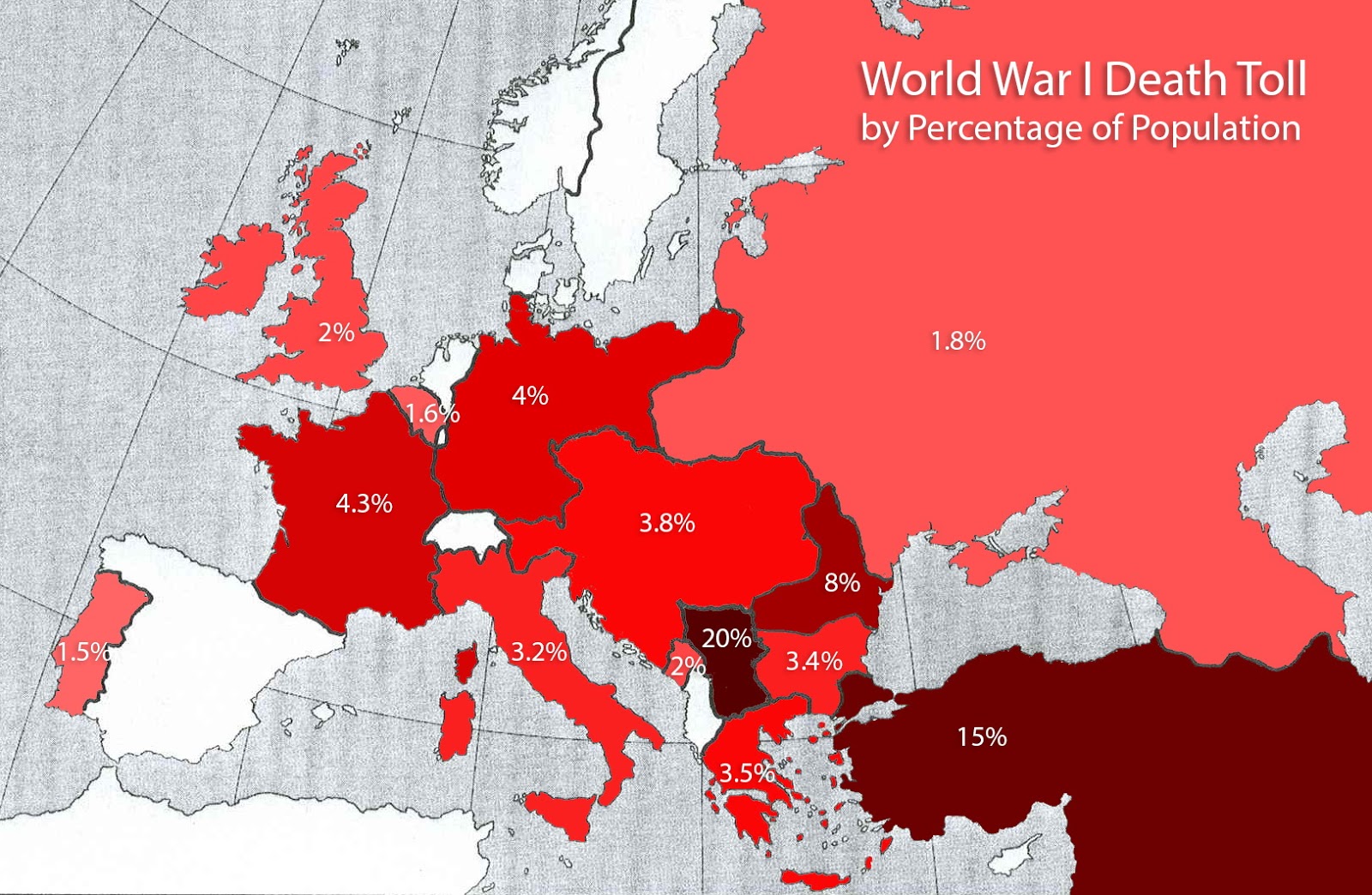
Not sure if this image is correct, but it's the one I'm sourcing my casualty figures from.
3 Answers 2021-09-07
I am doing a final project on the history of anti-semitism and I mainly want to focus on the early 20th century. I know that it had large influence on anti semetism at the time but I'd like to get to know a bit more in depth. Additionally, if there are any historians out there that are able to help guide me through this project and help me with questions id love it if we could talk so I can get some more guidence (this is going to be a long project that I need to submit next May) so if I could have someone I can talk to that would be great!
Thank you to everyone that answers.
1 Answers 2021-09-07
These days, many people are saying and writing, "It's impossible to take Afghanistan. Look at the Soviets, the British, and even Alexander the Great." It was my understanding that Alexander defeated the Achaemenids in three battles: the Granicus, Issus and Gaugamala. These battles took place in modern-day Turkey, Syria, and Iraq, respectively. They were all decisive victories for the Macedonians. And it was also my understanding that the diverse provinces of the Persian Empire acquiesced to Alexander rather quickly. By defeating Darius, Alexander was accepted as the inheritor of the empire. Of course, Alexander went beyond the borders of the Persian Empire and invaded India, but even there, he was only limited by his soldiers' willingness to go further, and not material defeat. So did the ancient province of Bactria, which mostly corresponds to modern-day Afghanistan, actually give Alexander any defeats or troubles?
1 Answers 2021-09-07
1 Answers 2021-09-07
There are, in 2021, many conspiracy theories involving the State. Sometimes it is about the State covering up something, sometimes it involves secret societies or space aliens, etc. They are popular enough that they even appear in pop culture.
But when did that trend start? Would a Roman have told me that maybe the Emperor was actually a secret Nubian agent, or that Caesar was actually killed by Augustus playing the long con?
I'm specifically interested in the birth of conspiracy theories involving the State itself, or something linked extremely closely to the State (like for example the various Illuminati conspiracies), rather than conspiracy theories in general.
Also just in case, I didn't ask this question to give credence to any conspiracy theory, I'm purely interested in the history of the conspiracy theory phenomenon itself.
1 Answers 2021-09-07
I've been reading "The Crusades: The Authoritative History of the War For the Holy Land" by Thomas Asbridge and it's got me thinking.
Raynald of Châtillon's violent raids are often cited as the reason Near-Eastern Islam would invade the Kingdom of Jerusalem. But from what I've read about Saladin, it seems to me like invasion would be the logical end goal of his ambitions.
Saladin derived a lot of his legitimacy to rule his vast realm by taking up the mantle as "mujahideen" from his ex-liege (and the person to unite the realm previous) Nur Al-din. Jerusalem is considered a holy site for Islam that was invaded by infidels. So the justification for his rule would be the reconquest of the city.
And anyway, the lands of the Kingdom of Jerusalem were valuable for trade with the Med, and would strengthen the connection between Ayyubid Egypt and Syria.
Wouldn't it be in Saladin's best interests to eventually conquer the Kingdom of Jerusalem, even without a figure like Raynald?
1 Answers 2021-09-07
“Never alone, never again,” is a mantra for the German military today. The Japanese actions post ww2 seem “regretful” to me. The Italians seem very “meh” about the 1940s. Is this just my lens? Or is there more too this?
1 Answers 2021-09-07