Did what happened to the Romani during the Holocaust/Porajmos contribute in any way to their current, marginal status?
1 Answers 2015-03-24
The "Underground Railroad" from the South to the North is well documented, was there a similar system for moving slaves to the Western states?
It just seems like it makes more sense for a Texas Runaway to go towards California rather than North.
1 Answers 2015-03-24
2 Answers 2015-03-24
When knowledge of Islam reached the Byzantine Empire, do we know what they thought about it? Did they just see it as another heresy? Did they expect it to be a threat at some point?
1 Answers 2015-03-24
I am trying to get a comprehensive understanding of American history. I would like your recommendations on what you consider to be the best history of the United States.
Some things I value in a history are objectivity, balance, comprehensiveness, academic style, accurate and verifiable sources.
Thank you all for your help!
1 Answers 2015-03-24
Previous weeks' Tuesday Trivias and the complete upcoming schedule.
Today’s trivia theme was suggested by /u/fuck_your_theory2 who asked "In the history of international diplomacy have there been any notable cases of interpreters screwing up and causing an international incident?"
We'll have "diplomacy" include any official dealings between peoples or nations.
Next Week on Tuesday Trivia: Fad Diets!
6 Answers 2015-03-24
If this question is already asked I am sorry.
2 Answers 2015-03-24
I'm wondering, I know that the American South was largely racist against African Americans but i'm just wondering, did the American South have just as bad anti-semitism as they were with racism against African Americans?
2 Answers 2015-03-24
If you aren't up to date with the everpresent race-relations drama, recently there was there was a large storm around the (lack of) representation of "persons of color" in a game by Daniel Vavra called "Kingdom Come: Deliverance", starting in 1403. Vavra responded to complaints about lack of racial diversity by claiming that there wasn't a significant amount of black people in Bohemia during the time period.
The argument has been heated, so i think that this subreddit is the best place for me to get an accurate answer to my question:
Just how many "people of color" (whatever AskHistorians judges that to mean) would be in the kingdom during the time period (just before Hussite wars, it seems), and how likely would a person be to encounter one while wandering about the cities? How about the countryside?
3 Answers 2015-03-24
Alan Turing's acceptance of chemical castration by "organo-therapy" as an alternative to prison time after his conviction for gross indecency with another man always seemed a bit odd to me.
What were the ideas about masculinity, homosexuality, and the punishment or treatment thereof that were held by British people at the time and made this seem like a reasonable way to handle men who performed homosexual acts? How would the doctors and lawmakers who designed this response have explained why they thought it was appropriate? What was their desired outcome?
Was the idea to simply curb all sexual desire? Did they think it would turn people heterosexual? Why use a biologically feminizing procedure to address what I (perhaps incorrectly) assume was viewed as a problem with masculinity? Was it in part an attempt to feminize the men further and thereby shame them publicly (the medical equivalent of calling them "Nancy boys")? Were there similar "treatments" for homosexual women?
Edit: I have no idea what happened with my capitalization in the title. Stupid itchy shift-finger.
1 Answers 2015-03-24
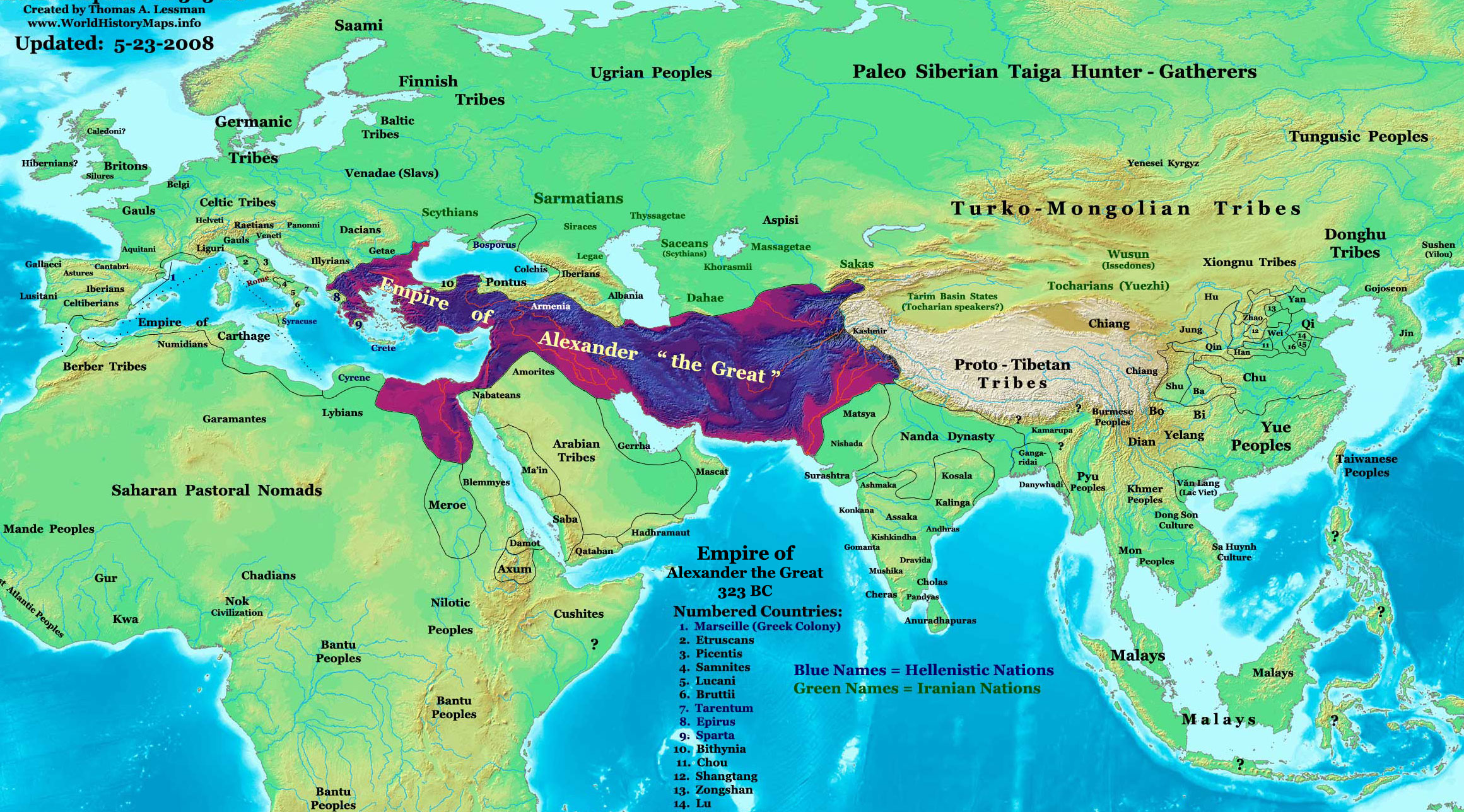
According to this image Epirus and Sparta weren't a part of Alexanders Empire at its greatest extent. Why not?
http://upload.wikimedia.org/wikipedia/commons/6/6a/Alexander-Empire_323bc.jpg
2 Answers 2015-03-24
I've been listening to some Podcasts about ancient battles, but for the most part they would say things like "...they crossed the (Alps, steppes, river, etc..) and there they encountered the (Romans, Mongols, Huns, etc...) waiting for them". Mountain ranges and steppes are vast areas covering hundreds or thousands of miles. So how did those armies ever find each other, or better yet, not simply avoid each other?
Edit: Thank you everyone for the great answers!
8 Answers 2015-03-24
Moorish Spain lasted for 800 years, and the Ottomans/Turks have had a presence in Europe since they took Constantinople in 1453. Looking at these two civilizations I'm increasingly struck by the fact that they don't seem to be included in Europe's vision of its history, its identity or its collective cultural memory (excluding the Christendom/marauding invaders dichotomy).
Did substantial exchange actually take place, or was it limited to the areas of Europe included within those societies' spheres of influence (the Iberian peninsula and the Balkans)?
1 Answers 2015-03-24
I found this map of North America, which I assume depicts national borders before 1867 because it shows the Alaska area as still possessed by Russia.
The map depicts the United States as extending all the way up the Pacific Northwest to the area of Russian control. I thought that the area that is now British Columbia was effectively always claimed by the United Kingdom. Perhaps by the Hudson's Bay Company...? Did the US ever lay claim to that area? Did they ever try to exert control over it?
Was this map actually made in the time it depicts or a later time? What years would those be? Does it accurately reflect what they knew about geography and political boundaries at the time it depicts?
3 Answers 2015-03-24
1 Answers 2015-03-24
Why did the Romans attempt to Invade Germania from Gaul? Why didn't they just try to go in from another direction via Modern Austria, Czech Republic?
I'm an American, so forgive my ignorance if that direction is harder than just crossing the Rhine, but if I understand it correctly, the two ways into Germany is through france or the great plains to the east, is a south-eastern approach not possible?
I understand a southern approach straight from Italy into Germany is difficult with the Alps, but surely they had to have thought about going another direction?
1 Answers 2015-03-24
Hi. I write and draw a comic about bards in ancient Ireland set in a town on the coast near the Giant's Causeway. It is set around 250-300 AD. I try to be historically accurate, but also take some creative liberties.
I wish to have a traveling group of north African or Mediterranean musicians arrive in the Irish town, so that I can introduce griots in to the story.
I know that it might be unlikely in real life that people from the Mediterranean ever went to North Ireland circa 250-300 AD but were any cultures physically capable of making the journey by sea if they choose? Would the Phoenicians or Egyptians been strong and capable, in theory, of sea travel to the British isles at this time period?
Like I say, I don't try to pretend that my story is real history. It is historical fantasy. At the same time though, the world is grounded, and I don't want to write something that physically wasn't possible.
For another question, were the Northern Europeans c. 250-300 AD capable of sea travel from Scandinavia to Ireland, and is there any evidence of trade or interaction between the two cultures?
1 Answers 2015-03-24
A few come to mind - Another Brick in the Wall by Pink Floyd, The Headmaster Ritual by the Smiths. All portray an environment of terror and physical torment for boys in British schools. What were schools typically like, and were they generally similar to how they were portrayed?
1 Answers 2015-03-24
Here is the scene: https://www.youtube.com/watch?v=CHsoPPynIIc
2 Answers 2015-03-24
Australia has an abundance of iron and other metals, is a vast area, and it's inhabitants were no stranger to fighting and clashes of culture. Why, when this mixture in Europe, the Middle East and Asia prompted their civilisations to develop new and increasingly complex technologies and understandings of physics and mathematics, did the Australian Aborigines never do so?
Is it because of their nomadic lifestyles? I'm often told it's because the land was too harsh, but that doesn't describe all of Australia - much of the South and East is lush and full of life. I know it's terribly incorrect of me to suggest, so I'm not quite sure how to word it, but why didn't the Aboriginal peoples see upward development in the same way as much of the rest of the world?
3 Answers 2015-03-24
A song praising the USSR during the height of the Cold War had to make a ton of people mad. I'm aware it was a parody of "Back in the USA" but still.
1 Answers 2015-03-24
Hello historians of Reddit!
I ask this because we had a discussion in my french class and all the information I find on the Internet says it was founded in 1642 while two other girls in my class say it was founded in 1534, but wouldn't that be also very early?
1 Answers 2015-03-24