Why and how are always appreciated!
edit; as pointed out below
I would hasten to add a stipulation here. The richest person ever to be executed under the rule of law and not during a revolution. I think that's a more interesting exercise, as many regimes have been overturned throughout history.
6 Answers 2015-02-09
I currently study modern Austrian and German history in the UK at MA level. In no way am I unsatisfied with my current subject, it's just there are so many interesting things to write about! For example, starting with Nazi Germany, I have since moved towards pre-WWI Austria(-Hungary). It seems the course for professional historians is to become more and more specialised as they go on, is this universal? Or is this merely part of the doctorate student/researcher to lecturer process? (this may be an oversimplification). Many thanks!
9 Answers 2015-02-09
From the Tsars to the CPSU to Putin, Russia has had liberal government only in short, sharp bursts (Provisional Government 1917, Yeltsin). Are there any reasons for this?
3 Answers 2015-02-09
Was there a push for a two state solution? Or was it just "here are the reservations enjoy!"?
2 Answers 2015-02-09
How common where they?
How did the public react to them?
What methods where used?
What types of characters were executed?
1 Answers 2015-02-09
While reading the comments here (http://www.reddit.com/r/todayilearned/comments/2v85tz/til_the_pink_cherry_blossoms_in_washington_dc/) I came across this quote:
The US government reciprocated with a gift of flowering dogwood trees to the people of Japan in 1915. In 1981, the cycle of giving came full circle. Japanese horticulturists were given cuttings from the trees to replace some cherry trees in Japan which had been destroyed in a flood.
But I could not find a picture of those dogwood trees. I would love to know what happened to them.
2 Answers 2015-02-09
Imagining the world's most ruthless police state pursuing the world's most nonexistent cabal amuses me. I am less amused by the thought of Himmler shooting a man who happens to be named Rothschild and then telling an elated Hitler that he executed an Elder of Zion. Did anything similar to these hypothetical situations actually happen?
Edit: I'm asking if the Nazis believed any of the Jews they killed were members of the sinister cabal of large-nosed financiers that supposedly ruled the world from the shadows. I suppose that by extension I'm wondering if the Nazis' paranoid delusions affected their diplomatic and military policies i.e. did they think negotiating with the American government was pointless because Jewish bankers were actually pulling the strings. Sorry that the question was unclear.
2 Answers 2015-02-09
So I came across a section in a book printed in 1885 (Parisian life in the 80s) and purporting to describe society life in Paris in then-modern times. In this book, in the chapter on »Parisian dinners», a sort of regular dinner exlusively for women is described. The book calls it le dîner des rieuses.
The book describes the so-called Parisian dinner as being almost ritualistic, reserved mostly for close friends, and almost exclusively male. It describes different »companies», such as Dîner Bixio (Alexandre Dumas, Sardou, Legouvé, Labiche, Meissonier, Turgenev, and others), Les gaudes (Pasteur), le dîner celtique (Rénan) ... as I understand it, these were simply groups of men regularly meeting for dinners. Le dîner des rieuses would be a similar company but for women, started because women were excluded from the already existing companies.
The book describes this coterie of theatre-ladies as being a monthly occurrence with ceremonies such as the performing of a self-composed song by every new »presidentess», the recording of each inaugural address, and so on. It also describes how the dinners are paid for: it is forbidden, under penalty of a fine, to speak of a man or even to mention his name. Once a year, so the author says, they suspend this ban of the other gender and host a very popular ball.
Now, for the questions:
Does this picture of the Parisian society dinner seem correct? Did le dîner des rieuses exist? Is it mentioned anywhere other than in this book? If so, were any »famous» women members of it? Are there similar female-only dinner companies in other places or eras?
Sorry if this got a little lengthy. I realise that this might be a long-shot, as it's rather specific ...
1 Answers 2015-02-09
2 Answers 2015-02-09
Hey everybody and thanks for your time. So this was more something of a showerthought and i thought somebody here might have an idea about it. I checked with the rules and it seems to fit.
For anybody checking in out of interest/boredness i'll provide some context/explanation at first: that we have a "decimal" counting system means that it is on the basis of ten. Basically if you coun upwards you get ten single digit numbers (0-9) before you add another digit. So if you coun in Binary you'd have two: (0,1 then 10 and 11, then 100, 101..and so on) if you'd count one the basis of 6 it'd go 0-6;10,11..16;20..26 a.s.o.
Now some context for my question: I sadly couldn't find the source right now but i read it a bunch of times that we are pretty unfortunate that we have historically developed to use the decimal system. A basis of six would be far preferred, just look at how our time is divided into sixties or how the number with the most dividents is 6,12,24, etc. I'd reckon the reason is that we have ten fingers? The answer seems intuitive but i feel like there is more to it. Further, how did these kind of numbers actually devlop? After all i know the basis of mathematics are found in old greece but how did other "high-cultures" of that time cope with numbers and counting. And (again) did they all work with a decimal system from the start?
1 Answers 2015-02-09
Does anyone know of any historical/mythological/ literary incidents of insincerity/deception? In particular incidents of “strategic” or “tactical” insincerity, where it is consciously made use of in order to realize long-term goals.
I am particularly interested in the classical antiquity (Ancient Rome and Greece).
3 Answers 2015-02-09
4 Answers 2015-02-09
My own searches only yielded pictures of Norwegian Stave Churches. While they look awesome, I get the impression that this answer isn't quite right.
1 Answers 2015-02-09
Similar to history of philosophy podcast here: http://historyofphilosophy.net/avicenna-metaphysics
1 Answers 2015-02-09
Most ancient Indian texts describe wars fought on chariots, so I am guessing that they must have been a popular war machine once upon a time. What events/developments replaced warriors on chariots to archers on horseback? How it actually happened?
I am an absolute beginner in history so I don't really know if it is a silly question, but this really made me curious and I didn't find a convincing explanation online.
1 Answers 2015-02-09
1 Answers 2015-02-09
Specifically I'm asking about this scene
1 Answers 2015-02-09
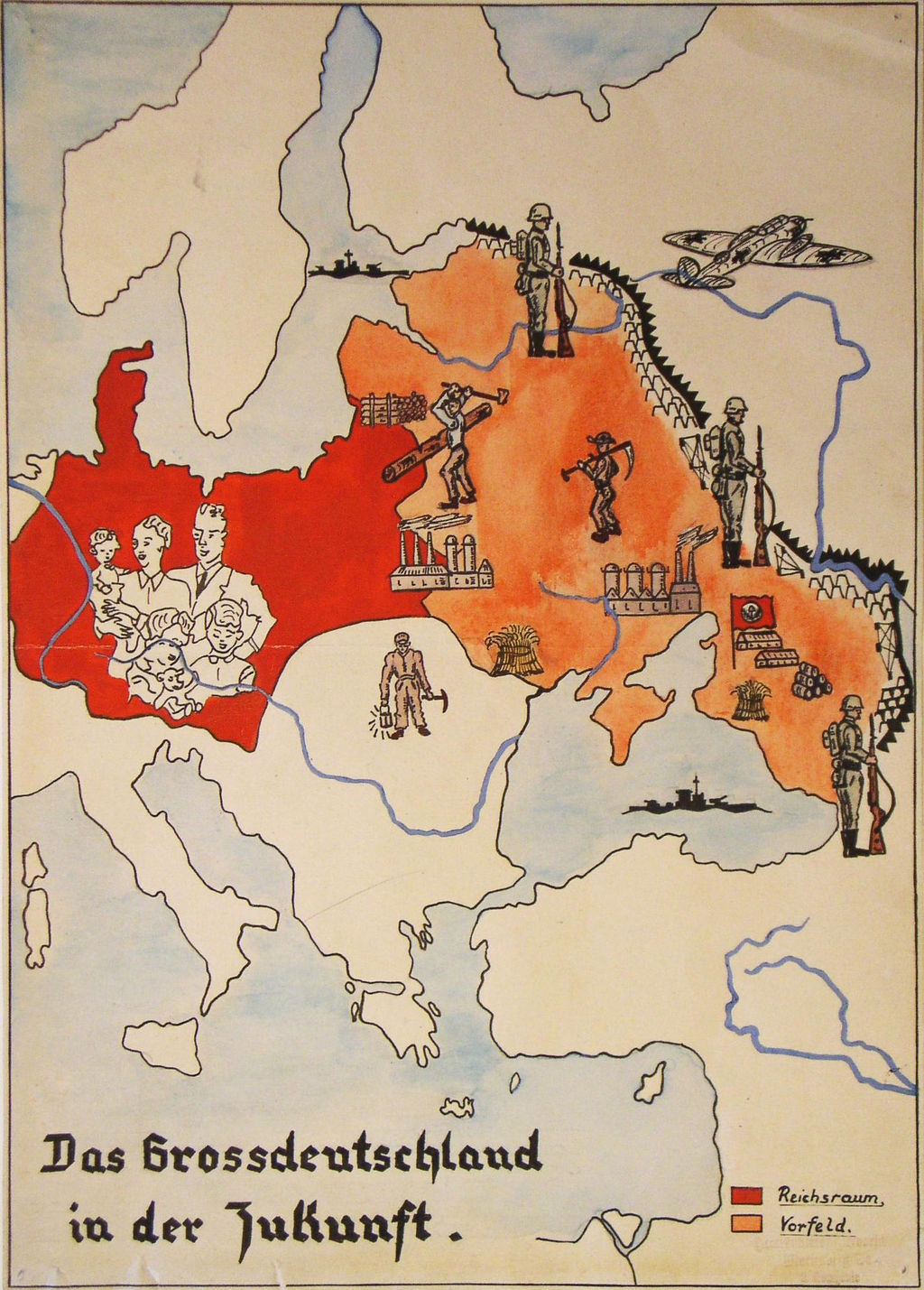
In this poster from 1943 there is a "Reichsraum",where the Germans lives, and a "Vorraum", where there are the industries. Apart from the border control, what was the role of the "Vorraum" and was it a popular opinion during the "Third Reich" I never saw something like this before.
2 Answers 2015-02-09
Saw the TIL, very skeptical. And yes i've played Rome: TW
1 Answers 2015-02-09
1 Answers 2015-02-09
I was recalling my University days the other week and I seem to remember my Professor talking about a certain book in a Historiography lecture and now I can't rest until I figure out what it was exactly.
The context was tackling History from a more macro point of view, in contrast to microhistory which we had studied previously. The particular study in question concerned a particular region of Europe, Southern or South-Western I think, and examined the region from it's Geography up. Beginning with how the climate and geography of the region would affect it's subsequent history.
To be honest that's all I remember of the book (I mustn't have been concentrating that day) and I'm not even sure if this is the right place for this question, nevertheless any help would be much appreciated.
1 Answers 2015-02-09
I love the History Channel's "Ancient Aliens" series as a way of teaching skepticism regarding sources to the ESL history classes I teach on occasion. However, while there is much the TV series exaggerates, misleads, and downright lies about, is there any information that corroborates this theory?
1 Answers 2015-02-09