Hello,
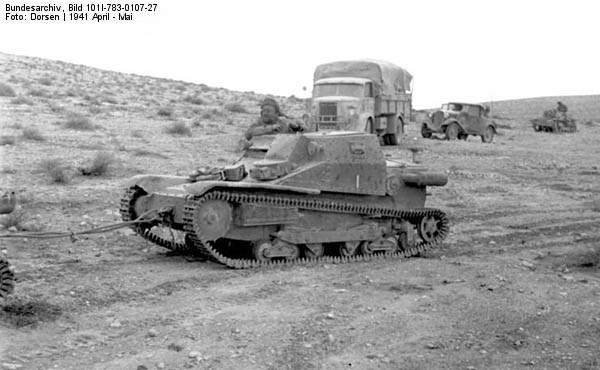
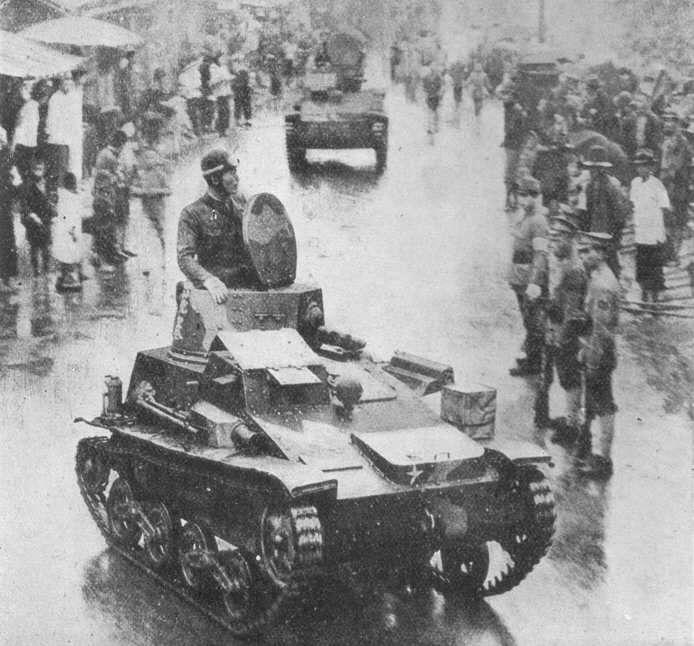
Lately I've been rekindling my interest in WWI-WWII armoured combat, and reading up on a lot of various models of tanks and other armoured vehicles. One class of tracked vehicle that I keep on stumbling upon references to the "tankette" - small, tracked vehicles with around 2 crew members, generally armed with a simple machine gun.
Lots of nations came up with tankette designs - the Carro Veloce (Italy), Carden Loyd (UK), Type 94 (Japan), TKS (Poland), et cetera - but the concept seems to have faded during the war, like so many of the pre-war eccentric ideas that designers came up with (like sticking multiple little turrets on tanks).
As a result, I've always mentally dismissed tankettes as being death traps for the unfortunate soldiers assigned to drive them about. But I've never really studied them, so I could be being quite unfair to the tankette!
Basically, did tankettes ever successfully carry out what they were designed to do in any campaign during the various wars they were involved in?
3 Answers 2014-12-11
I have been reading Nellie Bly's Around the World in Seventy-Two Days of 1890, in which she describes a visit to the Great Buddha of Kamakura. I was rather surprised by the following comment:
Years ago at the feast of the god sacrifices were made to Diabutsu. Quite frequently the hollow interior would be heated to a white heat, and hundreds of victims were cast into the seething furnace in honor of the god. It is different now, sacrifices being not the custom, and the hollow interior is harmlessly fitted up with tiny altars and a ladder stairway by which visitors can climb up into Diabutsu's eye, and from that height view the surrounding lovely country.
Can anyone confirm whether description of the statue being used for burnt sacrifices is accurate, and if so whether they were animal or human (as implied by referring to them as victims)?
Either seem contrary to what I know of Buddhism, but so far I have been unable to find any source which refutes the claim - in fact I haven't found any which mention it at all.
For reference the entire text of Around the World in Seventy-Two Days can be found here.
1 Answers 2014-12-11
I'm currently working on a project for school in which it's my responsibility to take care of the economic aspect of the Edo Period and the Meiji Restoration. Now, I'm interested to hear about what the experts at /r/askhistorians have to say.
If any of you guys would be able to help me out, that'd be so awesome!
Thanks in advance!
1 Answers 2014-12-11
The title is pretty self explanatory. If this isn't the right place to post it please let me know! Here are the medals/patches.
2 Answers 2014-12-11
Wouldn't it be smarter to be more mobile, try and come in from behind/flank, hide behind trees, lie down, etc.
3 Answers 2014-12-11
How and When did people decide "This will be year 0"?
Surely the pre-Hellenic Greeks couldn't have known 'I live in 200 BCE, going downwards to 0', so what time period did they think they lived in?
Have there been any other serious attempts at making a new year 0?
3 Answers 2014-12-11
1 Answers 2014-12-11
If they are literal layers, how do these layers form? Do the cities get buried in time then built on top of or is each layer not really a complete "layer" (like buildings on top of buildings)?
1 Answers 2014-12-11
1 Answers 2014-12-11
Okay, hey guys :)
So, for years now I've been doing research and trying to place my family tree together, however it's been rather difficult due to the fact that my Oma - Elfriede, was German, was adopted when she was 2 years old and placed into a christian orphanage.
So! What i'm trying to find out is a number of things:
Is the last name "Otto", a common German last name?
Children who were adopted out/ had an illegal birth/ unrecognized birth - were documentation destroyed/ non existent?
How is one to find out any information regarding "gypsy" German's? (As she grew up with them and yes i know the term "gypsy" is offensive now and i know they're either Roma or Sinti.
Facts:
If anyone can help me, I'd honestly, be so appreciative!
1 Answers 2014-12-11
What are the main counter-arguments to this seemingly Protestant-driven portrayal of Mary I of England?
I've read articles proclaiming her brutality in dealing with Protestants, but I've also read other material saying that she wasn't that horrible compared to many other monarchs, and her image is largely the result of Protestant propaganda following her death along with the fact that her reign was short and unable to implement the policies she wanted, and was therefore a failure in that regard.
I have no history background besides a couple of university courses, so I'd be very interested to get an informed perspective on the matter. Thanks very much!
1 Answers 2014-12-11
1 Answers 2014-12-11
1 Answers 2014-12-11
Earlier this year, I remember there was some hubbub about some texts suggesting that Jesus Christ was a political construct created by Roman scholars to exert some sort of socio-political control over Jewish subjects of Rome, and related cults.
I've always assumed that there was a historical Jesus, and that this person influenced much of western culture for the last... Well, all that Europe and the Americas identify as western culture.
Obviously, my thoughts are very fallible, but I'm curious as to what some good books would be to read up on if I was curious about the idea of the Historical Jesus, either arguing for his existence, or against?
(I'm glancing through the sub's history on this subject, but not seeing anything specifically focusing on good reading materials)
2 Answers 2014-12-11
My mom doesn't even know what branch he served in. She is the last decendant on that side of the family. From what I know, he was a forward observer for an artillery group. I've heard a story about a North Korean finding him at point blank range and pointing a gun at him and not shooting.
As a youth, I visited yearly, often for a month at a time till he died when I was 14 and remember my grandma well from that perioid, but little about him. However, my grandpa was a serious alcaholic and very removed from life, as I remember, even at 72 when he died. He obviously still suffered severe PTSD at that age and I remember him waking up in the middle of the night yelling...
Anyway, he never talked about it, none of the family members did either. He had a brother who had kids who I could ask but they are pretty distant.
How can I find information on his service. The government keeps records on military, could probably find something there but how. Any advice, pointing in right direction appriceated.
1 Answers 2014-12-11
1 Answers 2014-12-11
I mean, in my opinion it doesn't seem to be any more special than a lot of the other ancient structures around the Mediterranean. What makes it stand out so much that people around the world know about it??
I think the Castel Sant'Angelo, for one example, is a lot more impressive of a structure. Why isn't it talked about more?
Sorry if it's not a very good question, I don't know much about this stuff, just wondering.
1 Answers 2014-12-11
Please help me with a sentence I came across in Aldous Huxley's essay "Justifications", published in the book The Olive Tree.
Huxley quotes Lorenzo Da Ponte on his work process (how Da Ponte liked to have a bottle of wine on the right hand, a box of tobacco on the left and an inkstand in the middle when writing librettos). Da Ponte also frequently employs the services of a 16-year old girl ("Whenever I rang the bell", which cracked me up).
Huxley's description of the scene:
"It is a scene from a settecento Earthly Paradise - before the Fall of 1789."
Settecento refers to the period from 1700 to 1799, but what exactly happened in 1789 that Huxley refers to as the Fall?
1 Answers 2014-12-11
1 Answers 2014-12-11
I dug through and didn't find a thread. I am ignorant on the subject, but from what I've seen about their armor and blades, I've imagined they would last awhile. Did they avoid each other?
Apologies beforehand if I broke forum rules, I read them and don't think I have.
3 Answers 2014-12-11
Brief synopsis:
This novel spans a few years of a girl's life during the Revolutionary War Era (maybe 15-18, 1776-1779). She goes about her daily life, marries her husband, and at some point falls in love with a woman. I see her as middle class, maybe upper middle class (if that existed?) Her father is in a skilled trade or maybe owns a small business; her husband does the same.
The problem is that all of the resources I've found center on the roles on women in the actual war. This girl will not be involved at all in the war; her father is anti-politics (which is realistic, as I understand it, because some people didn't choose a side?) Obviously, the war is still going on and effecting their lives in some way, but most of it is about daily life and relationships. At some point, her husband may decide to fight in the war and leave her to manage the family business. I haven't decided yet, or even what side her husband would be fighting for.
Location: I'm not sure. A smaller city or town in the North, not rural. Maybe somewhere where loyalties and the war don't affect daily life so much.
Okay, so, questions:
Lesbian Relationships: What was the general opinion of lesbian relationships? Was it criminalized? Or brushed off, since women weren't taken seriously? Did people know about it? What would be the reaction to two women spending a lot of time together and seeming intimate? What if they were caught kissing or making love?
Puberty: Would a middle class teenage girl know about puberty before it happened? Would she learn it from her mother? Would she know about menstruation before it happened to her? Would she know why she was menstruating and what it meant? What would she use for menstruation, since there were no pads or tampons? Was menstruation shameful? Would she hide away during that week, go about her normal activities, or some combination? What would she use for menstrual pain?
Education: Would an average middle class teenage girl be able to read and/or write? What kind of education would she receive, and for how long?
Relationships: In this era, did a woman generally marry a man older than her, or about her same age? At what age did women typically marry? How common was it for husbands to abuse, beat, or rape their wives? If a man never hit his wife, was that considered uncommon?
Sex: How much would my character know about sex before it happened? Where would she learn it from? How common was premarital sex, and was it criminalized? What were the general opinions about sex from a women's point of view?
Relocating: I think my main character falls in love with a newcomer, not a woman she's known all her life. How common was relocating? If this new girl moved in to town, where might she have come from, and why?
If anyone takes the liberty on themselves to try to answer some of these, I would be awed and grateful. :)
1 Answers 2014-12-11