Hello,
Can anyone help to interpret a political cartoon from 1779?
I'm particularly interested in why the Scotsman (second from left) is shown seemingly defending Great Britain (third from left) from France (far left). The Scotsman is gripping Great Britain's staff with his left hand. On top of the staff is a liberty cap, which America is attempting to remove. Meanwhile, the Dutchman is on his knees stealing Great Britain's coin purse.
Here's the cartoon: The Present State of Great Britain
1 Answers 2021-07-09
Also, what do academic historians think about the competence of the CIA (leaving aside the morality of their actions)?
1 Answers 2021-07-09
This book series is often used cited when Roman history is discussed and Gibbon is often seen as a great historian. However, the book series is quite old, and perspectives have changed since the Enlightenment. Is is still useful to read it if you want to learn about Roman history, and is it difficult to read for people who do not have a degree in history?
1 Answers 2021-07-09
I looked around old posts about this topic, including that really long meta-review by a user here, and the main consensus seems to be that the documentary committed "sins of omission." Specifically, it (1) neglected the role of white supremacy in the casus belli, (2) it didn't reflect women experiences, and (3) it didn't focus enough on Reconstruction. I've also read some of Burn's responses to his critics.
I guess my question is, how could it have been improved? It's a 12 hour documentary, so I'm not sure "sins of omission" makes sense. It seems unreasonable to expect the documentary to include more info that extended its watch time. And while I get the criticism, I do feel like the purpose of pop history is to engage in a form of myth-making. That is, it's impossible and unreasonable to expect the general public to understand topics to the nuance of academic historians, and that necessarily means that a certain narrative agenda must be advanced to incorporate into the national myth, which further necessitates tough decisions on which voices to sideline.
So, what should have Burn's Civil War documentary done differently? Is the issue that it wasn't long enough to incorporate the full story, or is the criticism that the documentary included things it shouldn't have instead of things it should? And if so, what are some examples of things you think should have been removed to make time for the omitted components?
1 Answers 2021-07-09
IIRC, before the German Empire, the definition of a German changed quite a bit, though it retained the ideas of them speaking German and being from Central Europe. However, the German word for Germany, Deutschland, means "Land of the Germans", so I would assume that, before the German Empire, where exactly Germany was changed often.
1 Answers 2021-07-09
At the Battle of Hattin, the army sent by the kingdom of Jerusalem was between 18,000 and 20,000 men strong, as a share of the population of the Kingdom this represent something between 2,7% and 4,1%.
I used the population numbers of the Wikipedia page of the Kingdom of Jerusalem and those of the size of the army on the page of the battle
If we use the highest population number and the lowest army size this make : 18,000/650,000*100=2,7%
On the contrary with the lowest population and the highest army size we have : 20,000/480,000*100 = 4,7%
I compared to size of the army to the population to show that it would have been a burden on the administration of the kingdom to organize and supply such an army without disrupting the livelihood of the inhabitants, but the kingdom was seemingly able to manage it without any issue since an army of similar size was dispatched 4 years earlier at the Battle of al-Fule.
Contemporary battles in Western Europe such as the Battle of Fornham, the Battle of Legnano or the Battle of Bouvines featured smaller armies mainly made of mercenaries or retainers when the states raising them were many times bigger.
Was the Kingdom of Jerusalem just more hard-pressed by its neighbors that it was forced to raise relatively bigger armies, or was it administered differently from its European counterparts so it had better organizational capabilities?
1 Answers 2021-07-09
Looking for some good bibliography on the Persian empire and it's history, do you have eny recomendations?
2 Answers 2021-07-09
I understand the Henry VIII’s brand of Protestantism was very ‘Catholic Lite’ and that at the end of his reign he was pretty catholic again even leaving funds for mass to be read for his soul for a number of years (I forget how many), being very proud I don’t think he would have ever gone back to the church in his lifetime but my question is do you think he wrote the act of succession with returning to the catholic faith in mind?
He knew his son Edward was sickly, otherwise he wouldn’t have rewritten his succession and then he puts Mary after him. He could have chosen Elizabeth or any of his sisters’ Protestant children if he really wanted a Protestant line. But no he chose Mary, who I can’t believe he didn’t know was still catholic at heart.
2 Answers 2021-07-09
So, as one probably has observed, there is a lot of nudity in the statues and the paintings of the renaissance-era. However, the church was still strong. So, my question is what they thought of it.
1 Answers 2021-07-09
Niall Ferguson in The Pity of War seems to make a strong argument that this was feasible, that,
Ludendorff' mental collapse and willing to surrender caused troops dissatisfaction and surrender, but regaining and regrouping loyalist would have been easy w/the well trained German Army.
I don't have a copy w/me so, I'm going from memory. Troop loyalty with the goal defending along with strong defensive positioning, and an unwillingness from say France or Britain to force the issue;
Also, Ferguson suggests there was no sudden collapse but, rather an orderly convincing retreat causing severe causalities to the attacking forces by well placed machine gun pits and just the total destructive path left to the landscape
1 Answers 2021-07-09
Sorry if the answer is obvious / there’s a FAQ for this, but I’ve always found it curious that Great Britain, a nation (so far as I know) without a particularly large or historically significant Jewish population would support the idea of a Jewish Homeland in the Middle East. Why did the British authorities support this? Even if they didn’t predict the century of turmoil that would surround Israel and Palestine, what did Britain expect to gain from supporting Jewish settlement in the Levant after the fall of the Ottoman Empire?
1 Answers 2021-07-09
Einstein was one of the most brilliant minds who redefined physics, but scientific achievement doesn't always correlate to popular culture awareness. Euler made a ton of contributions in math and science, but few people outside of those fields would know who he was or have posters of him hanging on their walls. Meanwhile, even small children know of Einstein and his name has become the byword for intelligence. Additionally, a lot of tall tales have been attributed to him as if he were a figure from folklore.
How did Albert Einstein's image transition from scientist to celebrity to mythic folk hero?
1 Answers 2021-07-09
1 Answers 2021-07-09
In THE AENEID there is much made of Rome being founded by descendants of Aeneas (and Teucer and Dardanus and Ascanius) and there are many mentions of Rome as a "second Troy" and descriptions of reprisals against Greek city-states (like Lucius Mummius' sack of Corinth in 146 BC), for the destruction of Troy.
Forgetting for a second the historical veracity of the Trojan War and Teucer/Dardanus/Aeneas/Ascanius, can someone explain how seriously Romans thought of themselves, even spiritually or figuratively, as descendants of Troy?
Did they feel like hardy wounded survivors who had had a second chance or rebirth? Did their "nostros" feel like a kind of Trojan manifest destiny?
Or was this story about a supposed Trojan heritage just a nifty part of an epic poem written to please Augustus? Was it not really taken seriously by the Roman people?
1 Answers 2021-07-09
While playing total war I have noticed how skirmishers form themselves like a tightly packed square or rectangle. Then they proceed to fire their weapons while in that formation. Did ancient armies really used such formations?
1 Answers 2021-07-09
I was discussing with someone how many religions base themselves off the practices and mythology of older religions, and it came to me that the pre-Olympian primal gods (Gaea, Uranus, Oceanus, Hyperion, Typhon, etc) that were later supplanted by the Olympians could have represented that same process in action, especially as many of the Titans represented natural aspects that would later be represented by a Olympian. Is there any evidence of that?
1 Answers 2021-07-09
I just started getting into French Revolution and Napoleonic history and I’ve been searching for an engaging history book about these periods that reads like a novel. I was thinking of picking up one of the newest most marketed books out there A New World Begins by Jeremy Popkin but some of the reviews mention that it’s pretty dry and textbooky so I’m hesitating. Citizens by Schama is a book that’s gotten recommended a lot I’ve seen but going by the goodreads reviews it sounds really dizzying with how it jumps around so much and requires a lot of prior knowledge about the French Revolution
1 Answers 2021-07-09
I don’t get the sense that the Franks really create a sense of shared heritage in the countries of Germany, France, the Netherlands and so on. Of course, more important things have happened since so it isn’t surprising but there much have been a point where this shared identity was there and so at some point it started to fade.
1 Answers 2021-07-09
Today:
You know the drill: this is the thread for all your history-related outpourings that are not necessarily questions. Minor questions that you feel don't need or merit their own threads are welcome too. Discovered a great new book, documentary, article or blog? Has your Ph.D. application been successful? Have you made an archaeological discovery in your back yard? Did you find an anecdote about the Doge of Venice telling a joke to Michel Foucault? Tell us all about it.
As usual, moderation in this thread will be relatively non-existent -- jokes, anecdotes and light-hearted banter are welcome.
15 Answers 2021-07-09
1 Answers 2021-07-09
In 1574 Oda Nobunaga deposed the last shogun of the Ashikaga line ending the Muromachi Shogunate. On wikipedia the successor of Ahikaga Yoshiaki is shown to be Tokugawa Ieyasu who wont be ruling as shogun till 1603. Who ruled the shogunate in these 30 years ?
1 Answers 2021-07-09
I recently learned that efforts were made aboard the USS Missouri to essentially pour salt in the wounds of the Japanese delegation to make the surrender a humiliating experience. The example that was told to me involved height restrictions of all sailors on the main deck. I was told that sailors on the main deck had to be at least six feet tall so that the Japanese delegation would somehow feel small and inferior. How much of an effort did the Allied powers make to intimidate their recently defeated guests? Were the efforts approved by higher ups in the military? Did any such efforts actually increase tensions between the representatives of the Allied forces and the delegation from the Empire of Japan? Does the US have a history of similar behaviors at the conclusions of conflicts?
The source I learned about the height expectation was a relative of a sailor that was on the USS Missouri during the surrender ceremony.
1 Answers 2021-07-09
Hello
I'm a German History Lover and it has been a year since I have some problems answering to this question .
We Iranians are very good in Translation , so I have read many books about ww1 ,But none of these ever pointed out a logical reason for Germany's defeat in 1918 .
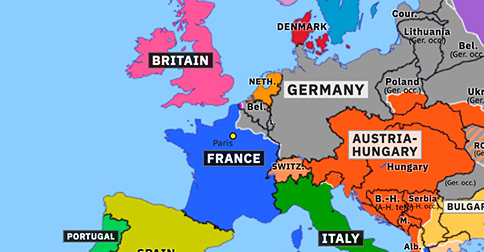
I mean Look at this picture : Germany map 1918
You see that everything goes fine with German empire , Eastern front is out of sight and Paris is near to fall and Britain being bombed heavily with Zeplins , in short Germany was winning !
So why people just Rebelled against the Regime when the victory was near ?
Please give me a detailed answer , I'm tired of nonsense stereotypes .
Thank you
1 Answers 2021-07-09
1 Answers 2021-07-09
The demography data I was able to come by stems from the Wikipedia page on Medieval Demography and the corresponding estimates. I understand that at this time, far from being nationalistic, military matters were somewhat feudal and relied on small professional armies, and that the House of Plantagenet relied on some allies on the continent. Nonetheless, this population difference seems massive. How was the House of Valois not able to absolutely dominate the war?
3 Answers 2021-07-09