I mean wouldn't the people have been a little but incredulous of what their Minister for Propaganda of all things was telling them.
2 Answers 2014-03-30
Were the Japanese well-defended? I can't seem to find a definite answer.
2 Answers 2014-03-30
If let's say there was an one-legged bank robber with a bounty on his head, and someone brought the dead body of an one-legged man to the authorities claiming that the man was the criminal, how would it have been confirmed?
1 Answers 2014-03-30
4 Answers 2014-03-30
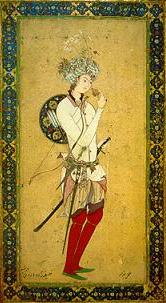
I stared at this in awe and admiration at the Natural Art History Museum in LA last week and I cannot find any information about who drew it, when it was drawn, or even whether it's Harun Al Rashid. Also, does anyone have sources to a higher resolution picture?
2 Answers 2014-03-30
Wondering if the USSR ever attempted to create a similar computer network?
2 Answers 2014-03-30
I'm curious about how we will deal with teaching history in the distant future since there will be so much information by then about things that happened in the past.
Will history just keep getting dumbed down, or will we only focus on certain parts of history that are most important? Also, will teaching/analyzing historic people and events be different in the future because of technology?
I realize that humans already have such a large history and that a lot we teach is summed up, but wont there eventually be so much of our past that it would be very hard to touch on all of it?
2 Answers 2014-03-30
1 Answers 2014-03-30
Had Flavius become the new Caesar? If so, was it due to it's usage as a praenomen (or nomen? did it change since the Flavian dynasty?) by the Constantinian dynasty?
The first post-Constantinian Emperor, Jovinus, has Flavius and Augustus as parts of his name, but is the first (I think) to not use Caesar- is this evidence for the shift in usage?
Also interesting to note that Constantine III, son of Heraclius, and first Emperor to not have his reign officially recorded in Latin (since Heraclius changed the language of government to Greek in 620), doesn't have Flavius as part of his name.
My source for all of this is wikipedia
1 Answers 2014-03-30
Is my understanding that in the late 1800s and early 1900s, the aftermath of major busts (following periods of economic prosperity during booms) were more propitious in the formation of federations/unions for Canada and Australia (and also South Africa after the Boer War) than the periods of prosperity, because the appetite for changes like customs unions, large-scale transport infrastructure projects, and the like was there more during periods of bust than during periods of boom?
For example, was one of the reasons why Australia federated only in 1901 (despite several attempts in earlier decades to do so) because the 1890s bust was such a downer for the Australian colonies (more than earlier busts) that they wanted to help out each other by joining each other as one?
1 Answers 2014-03-30
I know that in our time it is considered to be one of the many things that made WW2 possible, and even in the thirties people like Winston Churchill criticized Chamberlain for it. But in the years prior to the war, was it ever popular with UK (or any other country's) citizens?
1 Answers 2014-03-30
I am the stickler that will glance at you warningly if you whisper during a classical music performance. So I was surprised to notice that in 19th-century novels such as Anna Karenina by Tolstoy and Persuasion by Austen, concerts seemed to be an opportunity for talking and socialization, even moving around during the performance. For example, a long conversation ensues after the following excerpt from Anna Karenina:
A famous diva was singing for the second time, and all the high society of Petersburg was at the theater. Vronsky, from his seat in the first row saw his cousin there, and without waiting for the entr'acte, left to visit her box. "Why didn't you come to dinner?" she asked; and then with a smile she added, so as to be heard only by him, "I admire this clairvoyance of lovers; she was not there."
This phrase "she added, so as to be heard only by him," implies that the rest of the time they wouldn't have been whispering, but talking so that others could hear. Today, a conversation in the middle of a concert would definitely attract some disapproving stares, and maybe even a verbal reprimand from another concert-goer.
So, I am curious: In general, what was concert etiquette like from the beginning of classical music concerts until now, and specifically, when did it become rude to make noise in concerts?
2 Answers 2014-03-30
I'm sorry if this has been answered, but I searched. I couldn't get a clear answer.
2 Answers 2014-03-30
5 Answers 2014-03-30
While at the National Museum of Scotland today, I saw a brief exhibit about how Vikings converted to Christianity after raiding in Scotland. Generally, though, I know that it's usually the other way around, that conquered peoples convert to the conquerors' religion. Why did the Vikings and Mongols convert?
2 Answers 2014-03-30
I've gotten the impression (from tv, US history in high school) that many women found new opportunities to work during WWII, and the culture (seen in Rosie the Riveteer ads) promoted this.
But as soon as the war was over, the culture went back to portraying them as housewives.
Why did this happen? I'm specifically interested in the role of women in aviation -- why did the Soviets have female astronauts but we didn't?
Are there any books/papers that I can read that would help answer my question?
1 Answers 2014-03-30
Does anyone know how to get my deceased grandfathers world war 2 records from the air force? I have his social security number and some of his belongings and effects from then. Has anyone done this with any luck?
2 Answers 2014-03-30
I'm mostly talking about the start of Operation Barbarossa and around that time period. How was the life for the pilots and how did it go?
2 Answers 2014-03-30
My understanding was that daily milkmen went out at about the same time that refrigeration became popular, in the first half of the century. After all, why have the extra cost if milk will now last until you go to the store in a couple days.
In popular culture, though, milkmen stuck around through the sixties at least (this question was prompted by my seeing one on the Dick Van Dyke show.) Was this a holdover just of popular culture, or did milkmen actually survive refrigeration for a while, and if so, why?
2 Answers 2014-03-30
It seemed like they did not want to join Britain and of course they came to regret it, so why exactly did they join or who signed?
1 Answers 2014-03-30
I was talking with a friend earlier about how people jumped on Obama's high speed rail proposal as an expensive, tax-wasting, federal "boondoggle." A lot of states turned down the funds to build it. I was just wondering if the interstate highway system faced any of the same criticisms at the time. Was the plan controversial at all? If so, who were the prominent opponents of the system and what were their arguments?
1 Answers 2014-03-30
My grandfather was a flight lieutenant in a glider squadron (669) that spent most of its time training near the end of WWII and almost all of his flight logs were in the de Havilland Tiger Moth for the time he was there. I assume they may have been the rig that towed the gliders, but I can't find a reference saying as much. I'd love to know more.
Thanks in advance.
1 Answers 2014-03-30
3 Answers 2014-03-30
I just finished reading Ghosts of Empire by Kwasi Kwarteng and it was great and interesting book, one which I learned a lot from. I am incredibly interested in imperialism across the globe and the time period in general. What other great books or even documentaries are out there for me?
2 Answers 2014-03-30