1 Answers 2014-03-13
The population of China and India combined comprise of almost 1/3 of the world's population.
As a comparison, the entire population of Europe is only 739 Million and the whole of Africa is 1.033 Billion.
EDIT: changed to 1/3 from 2/3 and oops, should read the FAQ
1 Answers 2014-03-13
2 Answers 2014-03-13
So today in my physics class we learned about Tycho's passion for astronomy despite being a member of Danish nobility, and how Kepler stole his data from Tycho's family after his death and used it to come up with his own theories, one of which was elliptical planetary orbits. How exactly did he pull this off? I'd imagine it would be quite hard to steal something from a noble's property. I asked my teacher, and he jokingly responded with "Ocean's 11 style" and moved on. Hoping someone here can enlighten me!
1 Answers 2014-03-13
The obvious is that they both suggest the populace can change the ruling system if the ruler does not rule well
1 Answers 2014-03-13
When were uniforms first used? What could be seen as a uniform, was a coat of arms good enough or only a scarf of the same colour? How did it evolve and where did it come from?
1 Answers 2014-03-13
I'm not sure if this is the right place to ask this since this mostly deals with pre-historic civilisations, but I figured some of you guys might know something about it.
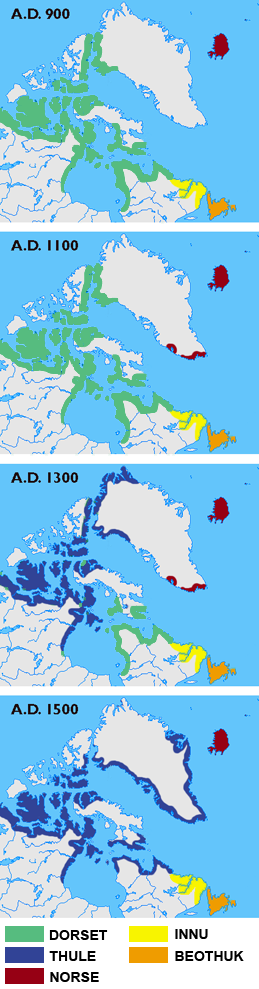
I'm talking about things like the celtic cultural groups you hear dominating central Europe before the start of classical Antiquity, or for example this picture regarding pre-European artic tribes in North America. It interests me greatly because in the corresponding, it mentions that the "Thule were a strong people with a history of warfare, and they had better weapons than the Dorset. The process of "driving off" the Dorset, which is recounted in their legends, would likely have involved direct conflict". Which then, to my analytic mind, creates some questions.
How could a very wide, loose organisation of tribes create a distinctive divide between themselves and another, very loose organisation of tribes? How would an isolated Thule village in say 1250 AD, know that their neighbours 10 miles across the lake were filthy weak Dorset, whereas their Thule brethren 500 miles down the coast were somehow "more similar" to themselves? Would a pre-agricultural society have very limited knowledge of the world beyond their immediate surroundings, and hence would only know how to compare themselves with those whose existence they were immediately aware of? How can something as conceptual as a "tribal group" come about, given the diverse, scattered and isolated nature of pre-agricultural civilisations?
As usual, thanks for all the responses? Knowledge is power!
1 Answers 2014-03-13
I know this is a bit of a strange question but the thought just popped into my head.
1 Answers 2014-03-13
Particularly why are there almost no stone structures? Is there less stone available, is it lower quality?
2 Answers 2014-03-13
I've been discussing the merits and faults of Socialism with a friend of mine, who is very politically active in the Socialist groups. Mainly, they get a lot of their views from this site: http://www.wsws.org/en/articles/2005/09/le4-all.html
From your perspective, as Historians, do you believe History to be a "hard" science? Why or why not?
4 Answers 2014-03-13
if yes, what was their status?
Thanks.
1 Answers 2014-03-13
In the times of slavery, how/why was Africa at such a great disadvantage to be so easily taken captive and controlled?
2 Answers 2014-03-13
The Romans had the strongest military of the Mediterranean world and were quite capable of dominating the Gauls so what made the Germanic tribes so difficult to pacify? Did the Romans simply not care about expanding east of the Rhine? Or did the tribes have a style of warfare that was particularly effective against the Romans?
1 Answers 2014-03-13
As inhumane as they were, was any valuable information that sped up medicine collected from Nazi research?
Perhaps experiments deemed too dangerous to be performed on humans, even in the 21st century.
1 Answers 2014-03-13
1 Answers 2014-03-13
I am, have been and always was absolutely engrossed by Roman history but this is the one part that I have never been able to wrap my head around.
This battle ended the Final War of the Roman Republic and created the Roman Empire as a result, making it one of the most important events in all of western history to say the least. However, It was always my understanding that Marc Anthony had the advantage over Octavian Caesar. Anthony had more men and certainly more experience than the self proclaimed boy emperor, so why was it that he lost so splendidly?
1 Answers 2014-03-13
Could someone inform me as to why most fascists in the inter-war period were so virulently opposed to Communism? I know that, to an extent, they was some opposition in Germany in particular due to the high proportion of Communist thinkers who were Jewish, but other than that, I can't fathom why they would be so opposed to it.
2 Answers 2014-03-13
1 Answers 2014-03-13
I'm aiming this more at the Medieval and renaissance era's, but would be interested in knowing the answer in broader senses. I enjoy reading a lot of Phillipa Gregory novels and they make it seem like consummation on the wedding night was a big deal. Everything I've read both in Gregory's novels and other books would say that sex with a menstruating woman was considered a horrible sin. As she was unclean at the time. It also seems that women didn't talk much about their cycles, so my first guess is when her cycles were wouldn't be discussed to avoid lining the dates up to not fall on her menses.
So how would they avoid an embarrassing wedding night where the bride and groom can't consummate the marriage?
1 Answers 2014-03-13
1 Answers 2014-03-13