1 Answers 2014-02-26
Recently, I saw a Napoleon movie and it spiked my curiosity. I read about him, and I liked him even more. I am confused though, how did he outwit the other politicians to take the throne? Was he already at war the other European nations when he took the throne, or did he start them? Why is he considered the greatest general of all time, was it just his mobile artillery that was so effective, or did he have other strategies? How did he escape from his island prison? And most importantly, is he viewed as a hero or villain in history?
Edit: I forgot, what were some of his great battles that has made him famous?
1 Answers 2014-02-26
I have tried to Google the questions but they have given vague answers such as; "China around 2000 years ago" Or "Roman and Greek times". Thanks for the time.
1 Answers 2014-02-26
I saw a documentary that claimed that the Ottoman had ten very competent sultans back-to-back during its period of expansion, and that this could be partially explained by the necessity of eliminating all competition (brothers) in order to become sultan. Is this a reasonable claim? Are there other explanations?
1 Answers 2014-02-26
1 Answers 2014-02-26
I'm unfortunately woefully undereducated on the state of the Sassanid economy. I know there's a shortage of records, but surely there must be some archaeology on the subject?
Did the Sassanids tax? How urbanized were they? How much of their economy was based around trade or agriculture? Etc.
1 Answers 2014-02-26
I might be spelling ot wrong. The area is in Glacia I believe. Also if I am in the wrong place, tell me where to go I and I will post this there.
~thanks
1 Answers 2014-02-26
It seems that in art, ancient architecture (columns, marble, etc) goes hand in hand with paradise. Is this simply a romanticizing of the ancient "golden age" of the Roman Empire by Medieval Europe?
1 Answers 2014-02-26
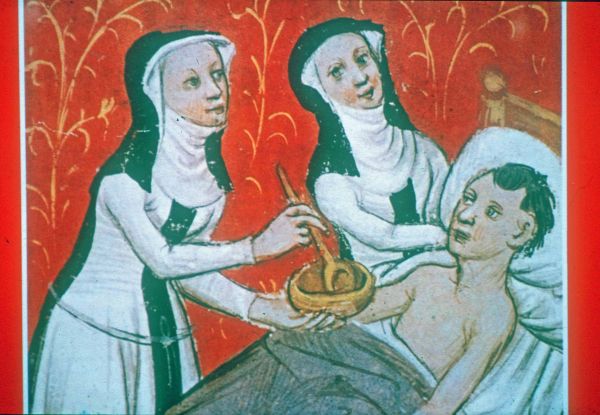
I'm aware that, technically, nuns were supposed to be cloistered, and I know that they often were charged with making embroidered ecclesiastical textiles. However, I came across these two images from the 15th century:
The Hospital of Notre Dame at Tournai, Belgium, kind of Cistercian-looking
The Hotel Dieu in Paris, appears more Benedictine, though could be Fransiscan due to the black-and-white nature of the image. I couldn't find it in color, so I don't know if it exists in color.
Since they're interacting with patients, it doesn't seem as if the women pictured are cloistered by our modern definition (and in the first image, the stress lines on the women's dresses indicates that they're wearing tight clothes). Are they members of tertiary orders, functioning as sisters/lay sisters, or were nuns more connected to the world than we typically think?
Really, any information about the lives of women who took solemn or simple vows in the late Middle Ages would be greatly appreciated.
1 Answers 2014-02-26
From what I recall, the only suggestion I heard for this was because Hirohito keeping a ceremonial post was deemed important in order for Japanese citizens to buy-in to the nation's rebuilding period. There has to be much more to it than that right?
2 Answers 2014-02-26
I'm looking for some objective sources for American political party history. In particular, I'm interested in the factors leading to their genesis, how they changed over time, and, if applicable, their demise. I'm also interested in counter narrative sources as well. Thank you.
1 Answers 2014-02-26
1 Answers 2014-02-26
First note Second note Third note
Randomly found them in my room, have no idea why they were there. My family have also never seen them before.
2 Answers 2014-02-26
I know there were many defections from the KGB to the CIA, but have never read about the CIA actually infiltrating the KGB.
1 Answers 2014-02-26
after reading this somewhere, this made me sad
1 Answers 2014-02-26
1 Answers 2014-02-26
I've heard a lot about Zheng He and his ships and all my textbook would say is that they were stored and deteriorated. Does this mean that all 317 vessels deteriorated? Or does it mean they just haven't been found yet?
1 Answers 2014-02-26
How did the Safavids convert people to Shi'a Islam? How much violence was involved? What other incentives did they use?
In what ways did they support the clergy?
Did they fund and encourage celebrations or mournings on important days, like the anniversary of Husayn's death?
2 Answers 2014-02-26
If you are squeamish, this thread probably won't be for you. My apologies in advance.
In The Spanish Holocaust, Paul Preston makes note of many prisoners of the Nationalists being forced to drink castor oil. As it is a laxative and the prisoners were subsequently paraded through town, the resulting condition was embarrassing and degrading. (edited to add the following sentence) This punishment is mentioned dozens of times in the text, and apparently was used in many regions of the country in 1936 and onward.
Now, I had never heard of this practice prior to this book, or at least I don't recall hearing of it. Was this a uniquely Spanish punishment? Was it confined to the 1930's? Or was it more widely used? Did other groups in other countries (or other times) employ this degrading tactic?
1 Answers 2014-02-26