This is treading close to the "no politics" rule, but I'm asking here precisely because I want a non-political answer.
As stated by Wikipedia
In the [Republican] Party's infancy, its base consisted of Northern white Protestants and African Americans nationwide.
In 2016, The New York Times noted that the Republican Party was strong in the South, the Great Plains, and the Mountain States.
How/when did this flip occur? What events lead to the party of the industrial North becoming the party of the rural south? Conversely, how did the Democratic party, which was previously conservative, become more liberal?
1 Answers 2019-11-11
Places like Hattusa or Mycenae must have been in ruins in the times of the classical/late antiquity. What did ancient roman / persians / etc thought about those places? did they had a knowledge of ancient history or civilizations? are there any written source of someone analyzing the ruins of a place and discussing about what had happened there or who lived there? I assume places like the ones I mentioned above were in lesser ruin conditions than those same places today, so I can't imagine a roman army going throught anatolia and not thinking about what they saw there
2 Answers 2019-11-11
It seems unlikely that all of them are charlatans (obviously some were). But, while possible, it also seems unlikely they all had schizophrenia (and even schizophrenia doesn't normally, in our current culture at least, manifest as such clear hallucinations). So I wonder how historians understand this. What is the explanation?
Or is it just viewed the same way early medieval Saint's hagiographies are viewed; we look at what it tells us about the society at the time, and basically don't bother too much about what "really" happened?
1 Answers 2019-11-11
Not sure if this is allowed on this subreddit.
Anyone know a good comprehensive history of the second world war?
I always wanted to know the overview, but my current picture is fragmented.
1 Answers 2019-11-11
I just read a wikipedia article on Custer's Last Stand and would love more information about it.
Any books, articles, videos, documentaries, even films that are as realistic as possible with the most accurate historical info that anyone recommends I'd be thankful.
1 Answers 2019-11-11
How historical is the movie overall? How accurate are the battle scenes?
Also, at the first scene in the kings dining room there was an argument between Percy and the King. What was the context for it?
1 Answers 2019-11-11
India has been one of the most populous centres since the dawn of civilization. It also had only of the most fertile deltas in the world. The ganga-yamuna feeds to the largest area in the world. So agriculture was never a problem. It also had developed suffosticafed forms of poetry, literature and artwork a while back. Writings had transitioned from religious to scientific enquiries and those of academic rigous, albeit always put together with religious expositions. How is that even after having such a big advantage to themselves that any Indian kingdom could not forray outside of the Indian subcontinent (minus the Cholas). With that kind of an advantage they should have captured a sizable chunk of Asia, atleast from Iran in West to Kazakhsthan in North to Vietnam/Thailand in East. Also, even though the initial Muslim conquests were defeated conclusively, they lost the final battle, why couldn't they counter-attack the Caliphate? Why did they always play on the defensive? They have also never expanded north of Himalayas. Was Geographical barrier such a huge logistical problem back then? They were first subdued by the Muslims and then also by the British, even though while fighting the latter, Maratha empire had gained traction. Also, if it is true, they accounted for the largest economy under the Mughals, why then didn't they expand then?
1 Answers 2019-11-11
1 Answers 2019-11-11
Thank you in advance, I love this community!
What I'm trying to learn is if there was some form of social pressure against slavery or if what happened was physical lack of slaves/collapse of the slave market, hinting at a material factor rather than a social or ideological one.
2 Answers 2019-11-11
1 Answers 2019-11-11
This is somewhat of an esoteric post, so the parlance is extremely unfamiliar without delving into Said's work. Despite not being a historian, Edward Said has had a considerable impact on oriental authors in studying the Orient. His 1978 book "Orientalism" accentuated several flaws by oriental authors, some of which were literary misrepresentations, and others were pictorial misrepresentations. His book was a critique of the Occidental representational methodology. Said quotes Marx: "They cannot represent themselves; they must be represented.” He deemed some of those misrepresentations as unjust and sometimes operated within a colonialist framework. So, my question is directed to those who had studied Edward Said's work, did it influence your methodology in studying the Orient? Do you consider Orientalism when reading a book that addresses the history, politics, religions of the eastern world? Any info you can provide on Edward said will be appreciated.
1 Answers 2019-11-11
I would really like to know how they made holes in the fountain statues. It must have been really hard to make a renaissance statue and then make a tube inside of it to make the water go to the mouth of the statue etc. So how did they do it?
1 Answers 2019-11-11
1 Answers 2019-11-11
pretty much the title, how come Thomas Jefferson worded it that way, was he trying to say you can never derive just Happiness, but you can always be on the mission to receive it? Can someone please explain this ?
1 Answers 2019-11-11
1 Answers 2019-11-11
2 Answers 2019-11-11
So I know that in general, the Wild West is from like west of the Mississipi River to the Pacific. What I do not understand is the general timeframe of the Wild West and how some states are considered part of the Wild West. My best guess for a time span would be from just before the American Civil War until like the 1910s? (Please correct me on this one.)
For the states, what I mean is like this. Texas I would automatically say that it was part of the Wild West but I don't understand how the Mexican Session and the Louisiana Purchase is considered part of the Wild West.
Thank you!
2 Answers 2019-11-11
Furthermore, are there certain resources that are more easily accessible to historians with certain credentials that may be difficult or not even possible for the common peasant like me to be given certain source material accesses?
And one more question sorry, but have you ever been denied access to any written texts or to view certain artifacts in your career?
Okay I lied, last question- When doing research in which you're gathering historical accounts and such, how often are you actually able to read from the very source material if you know the language and can translate yourself?
Much thanks!!
5 Answers 2019-11-11
I was led to believe my grandfather was involved in operation paperclip, as a military escort to Werner Von Braun. I found a letter in my aunt's things after she'd died. The letter reads:
HEADQUARTERS
Res Dev Sv Sub-office (Rocket)
Fort Bliss, Texas
JFH/aje
Mar 15.1946
(Date)
SUBJECT Special Authorization
TO: Whom it may Concern
is an aged on a Special Mission for the War Department.
by the Military Police or other military organizations.
3 He is hereby authorized to have in his personal custody persons
who shall not be questioned or asked to prove identity, and for those
custody and good faith he shall be entirely responsible.
of his reunion. In the event further information is desired or should a
breach of the peace order, it is further requested that the agencies listed
above communicate directly ith this headquarters by telephone, Extension
5221 or 4235.
James p. Hamill
Major, Ord Dept
Commanding
I asked my mom about it, and she said "didn't anyone ever tell you? He was assigned to escort Werner von Braun after the war."
She didn't know much about what happened, but said she thought he'd come in via Mexico. I'm wondering what might have occurred during this travel. Where would they have been? Did they travel openly or in secret? Any insight would be helpful. I'm happy to share photos of the letter.
Thank you very much
1 Answers 2019-11-11
1 Answers 2019-11-11
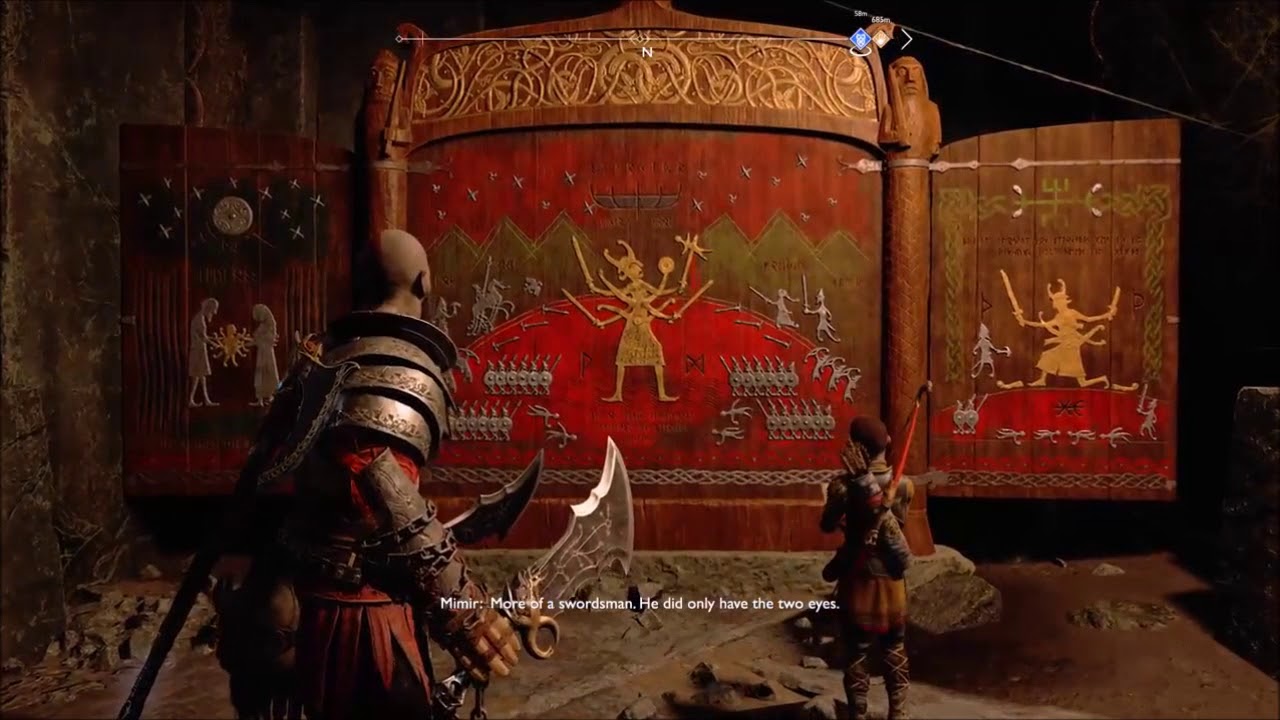
The question came to mind while I was looking at various books of religious art and noticed that Scandinavian/Viking art was sorely lacking. Every piece depicting a Norse deity or religious narrative seems to come centuries later and usually by a Christian artist or as part of some operatic illustration. This seemed weird to me since the practice of devotional art, and the creation of pagan sculptures, seems to go as far back as 20,000 years ago with the various Venus Figurines, and it is a practice that continues to this day.
Did it simply skip the Vikings?
Additionally, at the end of God of War (the PS4 reboot) we see a mural depicting various deities and the narrative of the game in an art style that seem to be based on a traditional style. Was this style Vikings and is it the style that would have been used for devotional pieces?
1 Answers 2019-11-11
Specifically, were relatives able to reunite? How was that accomplished? Where were they able to go? Were they able to just go home and resume their lives? Did people at the time really know and understand all the details about what had happened during the war? We know what we do about it because 60+ years of research has been done, but I'm just wondering how much the common citizen knew.
1 Answers 2019-11-11
I have learned that I have a direct ancestor who was a messenger and scout for the Continental Army during the American Revolution. I just want to know more about what this position was like to get an idea of what my very great grandfather might have gone through. Was this role dangerous, or was there a sort of code of war that would have allowed him to be left unharmed (though potentially searched and robbed of any intelligence)? Would he have likely seen any combat during battles, or would he have kept to his duties during battles to transfer intelligence among commanders? How might he have ended up in this role...perhaps good horsemanship skills?
Any insight is greatly appreciated.
1 Answers 2019-11-11